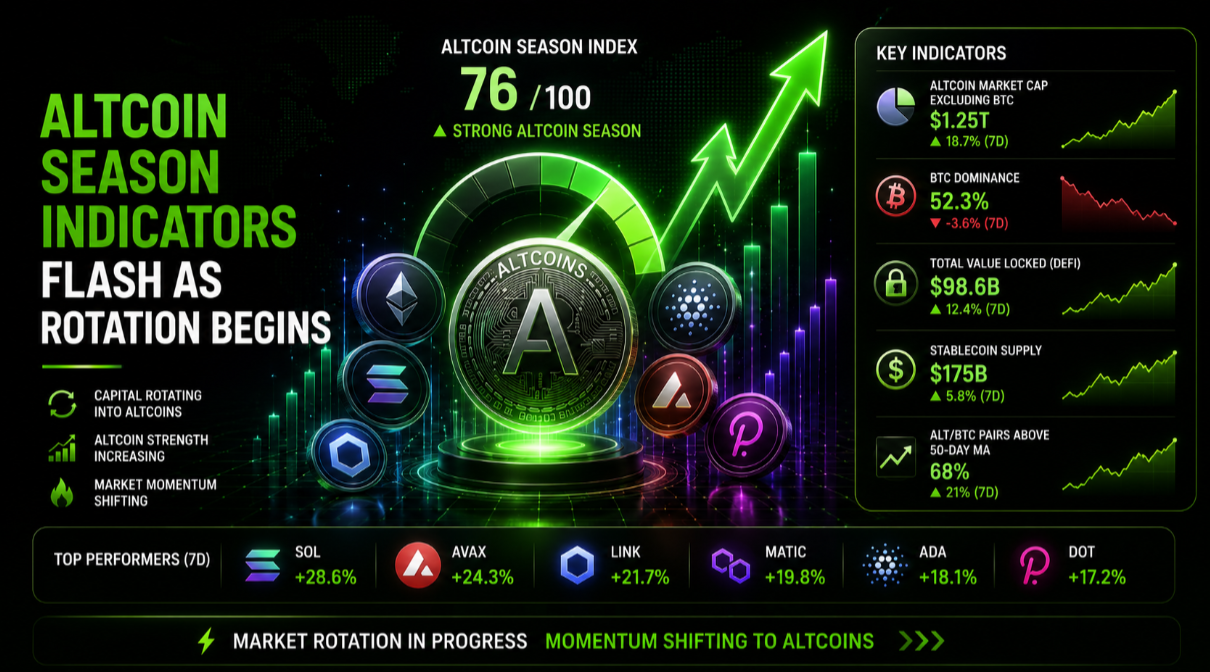
What happened
Several widely tracked gauges of altcoin strength turned higher this week, reviving talk of a broader rotation out of Bitcoin. The CoinMarketCap Altcoin Season Index, which measures how many of the top 100 coins outperformed Bitcoin over the prior 90 days, climbed into the mid-range after spending much of the spring pinned near Bitcoin-season territory.
At the same time, Bitcoin dominance, the share of total crypto market capitalization held by Bitcoin, slipped from its recent highs. Ether outpaced Bitcoin on the week, and a cluster of large-cap layer-1 and layer-2 tokens posted double-digit gains. Trading volume in alternative assets rose relative to Bitcoin, a pattern that often accompanies shifts in speculative appetite.
Why it matters
Rotation matters because it changes where risk and returns concentrate. When capital moves down the market-cap curve, smaller tokens can move sharply in both directions. For traders, a rising Altcoin Season Index has historically preceded periods of wider dispersion, where index-level calm masks large single-token swings.
It also carries a signal about market psychology. Money flowing into higher-beta assets suggests participants are willing to take on more risk, often after Bitcoin has stabilized. That said, one week of data is not a trend. Analysts caution that the index has flashed early before, only to reverse when Bitcoin reasserted leadership.
Market context
The current move follows a stretch in which Bitcoin absorbed most inflows, helped by steady demand through spot exchange-traded funds. When that demand plateaus, liquidity tends to search for returns elsewhere, and altcoins are the usual destination. Ether-linked products drawing renewed interest has added to the rotation narrative.
Historically, altcoin seasons have been uneven. The 2021 cycle saw broad participation, while later rallies proved narrower and shorter. Definitions vary too: the commonly cited threshold treats a reading above 75 as a genuine altcoin season, and current levels sit below that mark. In other words, indicators are warming, not confirming.
Macro conditions remain a backdrop. Expectations around interest rates, dollar strength, and overall liquidity continue to shape appetite for speculative assets. A shift in any of these could stall the rotation as quickly as it began.
What to watch
The clearest tell is Bitcoin dominance. A sustained decline, rather than a brief dip, would lend weight to the rotation thesis. Watch whether the Altcoin Season Index holds its gains or slides back below the Bitcoin-season line over consecutive weeks.
Breadth is the second signal. A durable altcoin season usually shows many tokens participating, not just Ether and a handful of majors. Narrow leadership tends to fade. Finally, keep an eye on stablecoin flows and derivatives funding rates, which can reveal whether the move is backed by fresh capital or leveraged positioning that unwinds fast.
For now, the picture is one of early signals rather than a confirmed regime change. The indicators are worth monitoring, but they are not a forecast. This article is analysis, not financial advice.