What happened
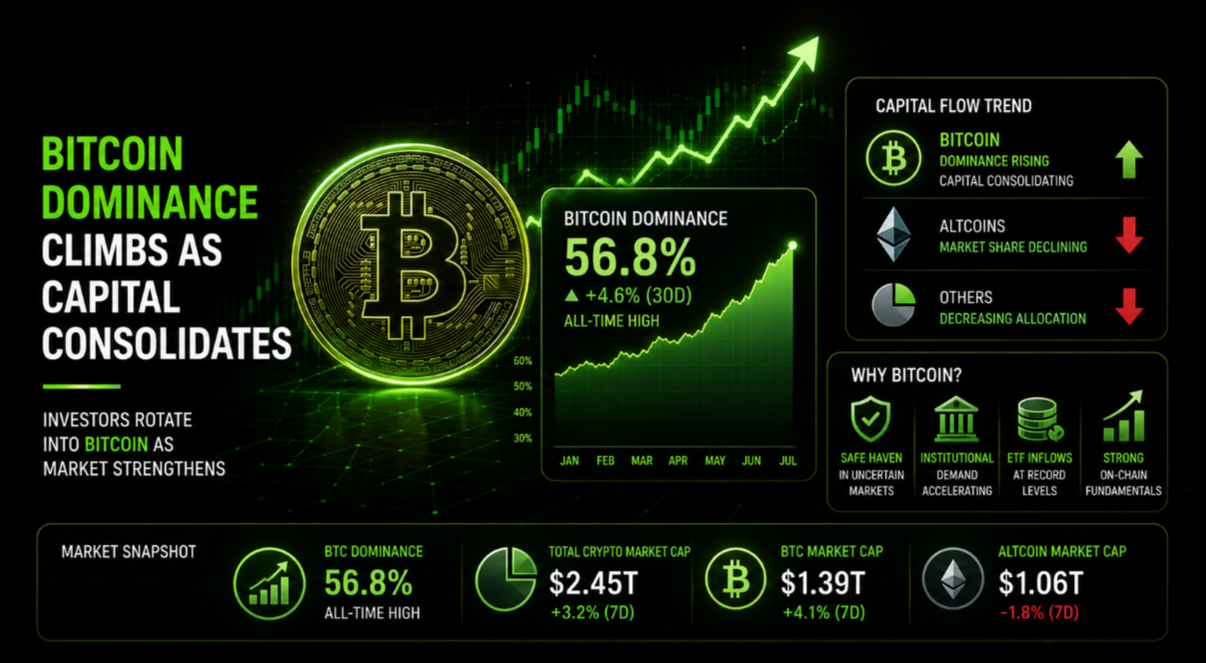
Bitcoin dominance, the metric that tracks Bitcoin's share of the total cryptocurrency market capitalization, has been grinding higher over recent weeks. The gauge measures how much of the combined value of all digital assets sits in Bitcoin rather than in the thousands of alternative tokens that make up the rest of the market. A rising reading means Bitcoin is either outperforming those tokens or holding value more steadily while they slip.
The move has been gradual rather than dramatic. Rather than a single sharp spike, the trend reflects a steady drift of capital toward the largest asset. Altcoin prices, taken as a group, have lagged Bitcoin during the same stretch, which mechanically lifts Bitcoin's proportion of the pie even when its own price is not making fresh highs.
Why it matters
Dominance is a useful lens because it says something about where risk appetite sits. When traders feel cautious, they often consolidate into Bitcoin, treating it as the relatively safer corner of a volatile asset class. When confidence returns and appetite for speculation grows, money tends to fan back out into smaller-cap tokens, and dominance typically falls.
The current climb suggests the market is in a more defensive posture. Capital appears to be concentrating rather than dispersing. For holders of smaller tokens, that dynamic can be frustrating, since even a stable or firm Bitcoin price can coincide with underperformance across the broader altcoin complex. For Bitcoin-focused investors, the same backdrop reads as relative strength.
It is worth stressing what dominance does not tell you. A higher reading does not by itself signal that Bitcoin's price will rise, nor that altcoins are doomed. It is a ratio, and ratios can shift because the numerator climbs or because the denominator shrinks. Reading it in isolation can mislead.
Market context
Several factors tend to accompany periods of rising dominance. Tighter liquidity conditions, uncertainty around macro policy, and a general pullback in speculative flows all push participants toward the assets they perceive as most durable. The growth of spot Bitcoin exchange-traded products has also given institutional capital a familiar on-ramp that flows disproportionately to Bitcoin rather than to the long tail of tokens.
Stablecoin balances offer another piece of the picture. When a large share of market value sits in stablecoins on the sidelines, it can indicate that participants are waiting rather than deploying into riskier positions. That waiting behavior is consistent with the consolidation now visible in the dominance chart.
Historically, dominance has moved in long cycles rather than straight lines. Extended stretches of Bitcoin leadership have often been followed by rotations into altcoins once sentiment turns, though the timing of such shifts is notoriously hard to call and past patterns are not guarantees.
What to watch
The key signal to monitor is whether the trend accelerates, stalls, or reverses. A continued grind higher would reinforce the consolidation narrative. A stall near a well-watched level could hint that the rotation is losing steam. A clear reversal, with altcoins outpacing Bitcoin over a sustained period, would suggest risk appetite is returning.
Watch trading volumes alongside the ratio, since thin volume can exaggerate moves in either direction. Keep an eye on stablecoin flows for clues about whether sidelined capital is re-entering. And treat any single reading with caution; dominance is one input among many, not a standalone forecast.
This article is analysis, not financial advice. Markets can move quickly and in unexpected ways, and readers should do their own research before making decisions.