Bitcoin's rally hit a wall this week, and on the same day one of crypto's oldest exchanges closed its doors for good. Together, the two stories point to the same underlying trend: leveraged crypto trading is moving onshore, into regulated US venues, faster than almost anyone expected a year ago.
Bitcoin Cools After Testing $87,000
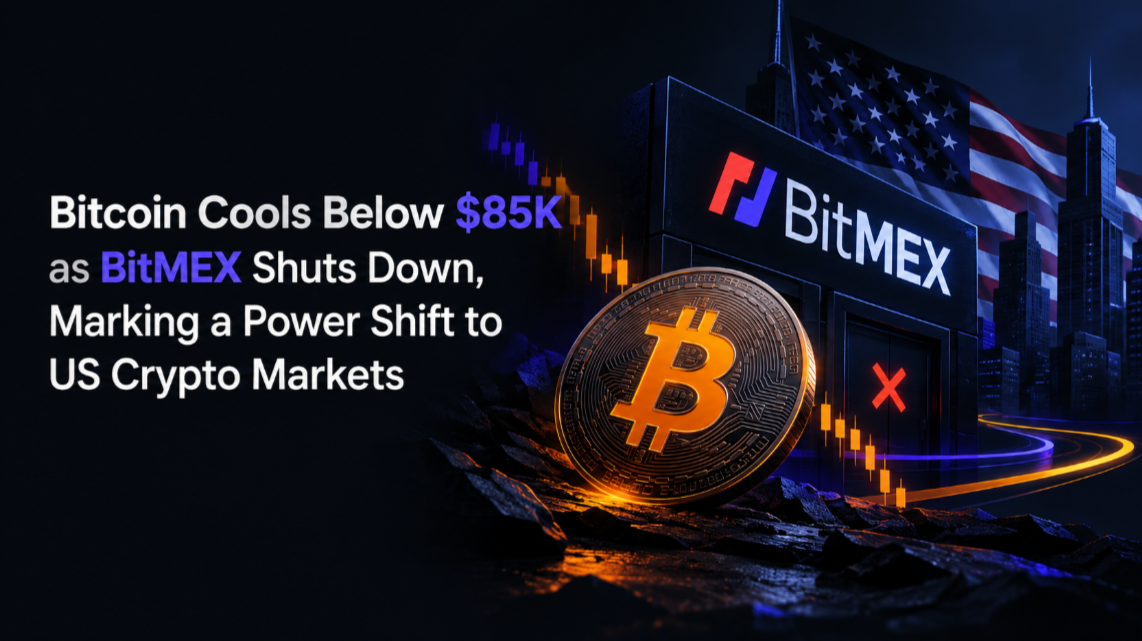
Bitcoin closed at $84,383, down roughly 2% on the day, after briefly pushing above $87,000 for the first time since January. Ether, Solana, and XRP all fell harder than Bitcoin, with XRP down more than 4%, as traders rotated out of riskier altcoins during the pullback.
The retreat looked like straightforward profit-taking. Traders who bought the breakout above the prior resistance zone near $82,000 used the strength to lock in gains ahead of a large options expiry on Deribit this Friday, worth close to $16 billion. Large expiries like this one routinely inject short-term volatility as dealers adjust their hedges.
Adding to the cautious mood, the Senate failed to advance the CLARITY Act, the bill meant to set clearer federal rules for digital assets. The delay leaves US exchanges and token issuers without the regulatory certainty many had hoped would arrive this year, and it tempered enthusiasm even as spot Bitcoin ETFs kept pulling in fresh money — nearly $1 billion in a single day earlier this week, one of the strongest showings since late 2025.
The End of an Era: BitMEX Closes Its Doors
While Bitcoin traders digested the pullback, BitMEX — the exchange that invented the crypto perpetual swap back in 2014 — shut down permanently after 11 years in operation. Owner HDR Global Trading Limited cited a strategic review of the business and the wider industry, rather than any solvency issue; the company said user assets remained fully backed and exceeded liabilities throughout the wind-down.
BitMEX's founders, Arthur Hayes, Ben Delo, and Samuel Reed, built the exchange into the platform that popularized 100x leverage trading during the 2017–2018 bull run. But its offshore model — long popular precisely because it operated outside US oversight — became a liability rather than an advantage as the ground shifted beneath it.
Why Traders Are Moving Onshore
The reason is regulatory, not technical. Over the past two years, the Commodity Futures Trading Commission opened a path for regulated US entities to offer perpetual-style products domestically. Platforms like Coinbase and Kalshi have since rolled out compliant perpetual contracts, giving American traders — who were previously shut out of this market entirely — legal access to the same kind of leveraged trading BitMEX once monopolized offshore.
That shift has quietly eroded the advantage held by unregulated exchanges for over a decade. Industry data shows centralized exchange perpetual futures volume actually fell in the most recent quarter, even as decentralized platforms and now regulated US venues absorbed a growing share of activity.
What It Means for US Investors
For American traders, the combination of these two stories is arguably more important than either headline number. Leverage trading that was once available only through offshore platforms with murky legal standing is now accessible through licensed US exchanges, at the same time as federal legislators continue to stall on giving the broader crypto market the regulatory clarity it has been asking for.
Short term, expect volatility to stay elevated into Friday's options expiry. Longer term, BitMEX's closure looks less like a casualty of a bear market and more like an early marker of where leveraged crypto trading is headed: onshore, regulated, and increasingly built around the same US market structure that now dominates ETF flows.