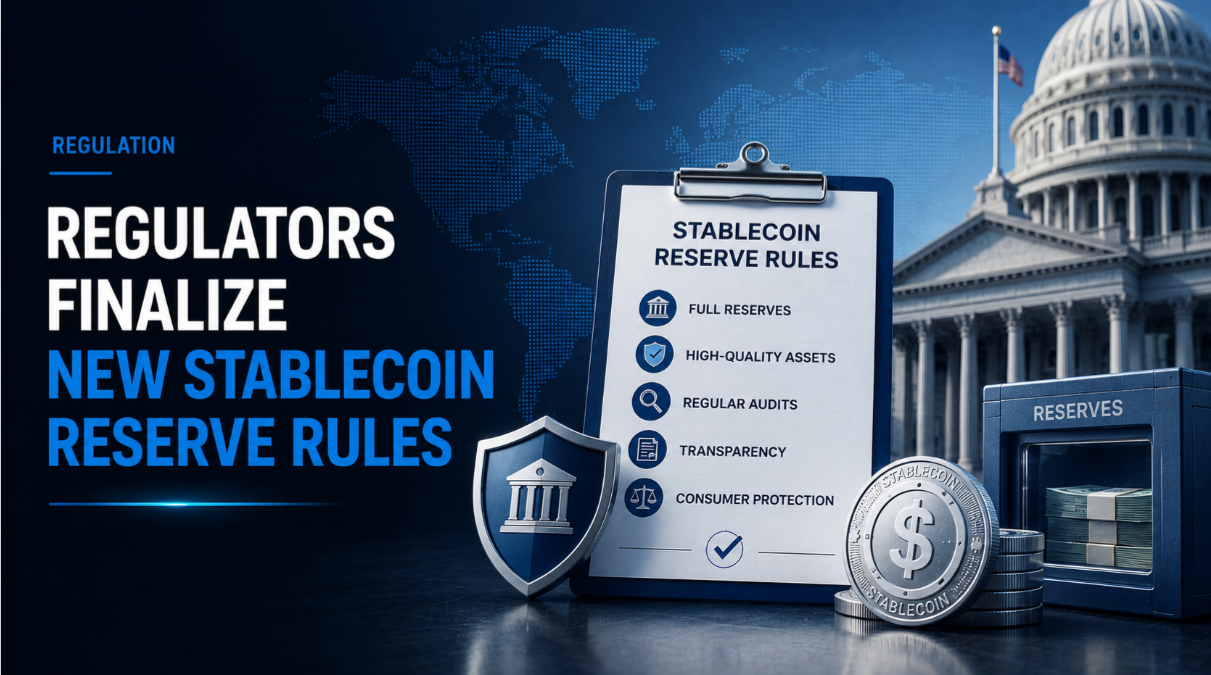
Regulators have finalized a long-signaled framework governing how payment stablecoin issuers must hold and report the assets backing their tokens. The rules move a debate that has run for years into a concrete compliance timeline, and issuers now have a defined set of obligations rather than a patchwork of guidance.
What happened
The finalized rules require issuers of payment stablecoins to hold reserves on at least a one-to-one basis against tokens in circulation. Eligible reserves are limited to high-quality liquid assets such as short-dated government securities, central bank deposits and cash, with tighter limits on riskier or longer-duration holdings. Issuers must publish regular reserve breakdowns and submit to independent examinations rather than self-attestations alone. The framework also sets redemption expectations, so holders can convert tokens to fiat at par within a defined window. Compliance obligations phase in over a transition period, giving existing issuers time to adjust their reserve composition and reporting systems before enforcement begins.
Why it matters
Stablecoins have become core plumbing for crypto trading, cross-border transfers and on-chain settlement, and the largest tokens now move volumes that rival established payment networks. Until now, reserve practices varied widely between issuers, and disclosure quality was uneven. Codifying reserve quality and audit standards is intended to reduce the risk of a sudden loss of confidence, the kind of event that has broken pegs before. For users and businesses, standardized disclosure makes it easier to compare issuers on the same terms. For regulators, the rules bring a fast-growing part of the market inside a supervised perimeter. The tradeoff is higher operating costs, which may weigh more heavily on smaller issuers than on incumbents with large balance sheets.
Market context
The stablecoin sector is concentrated, with a handful of dollar-denominated tokens accounting for most of the supply. Tether's USDT remains the largest by circulation, followed by other major issuers that have already leaned toward government-security-heavy reserves and periodic reporting. Firms that anticipated stricter standards may find the transition manageable, while issuers holding a wider mix of assets could face more restructuring. Analysts will watch whether tightened reserve rules push more issuance toward regulated entities, and whether trading venues adjust which tokens they list or favor. The rules also arrive as several jurisdictions pursue their own stablecoin regimes, raising questions about how cross-border issuers reconcile overlapping requirements.
What to watch
Key signals in the coming months include the exact compliance deadlines and whether any issuers seek extensions, the format and frequency of the required reserve reports, and how examiners treat assets at the edge of the eligibility rules. Watch redemption behavior during volatile periods as a real-world test of the par-value guarantee, and monitor whether market share shifts among the leading tokens as compliance costs sort issuers. Reaction from the largest issuers, including any changes to their published reserve composition, will indicate how binding the new standards prove in practice. This article is analysis, not financial advice.