CoinPulse
Kraken
Centralized exchangeUnited States· founded 2011

What Is Kraken? The Crypto Exchange Run by Payward, Explained

Kraken is a centralized cryptocurrency exchange operated by Payward, Inc., a privately held US company. It has been running since the early 2010s 15. Customers buy, sell and hold crypto through two interfaces on the same account: a simple app with instant buys, and Kraken Pro, an order-book platform with lower volume-based fees 3. Depending on the country, Kraken also offers staking, margin and futures, and tokenized stocks 12. Crypto kept on Kraken is held in custody by Kraken. Kraken says more than 13 million people use it 1. Payward reported 6.6 million funded accounts in Q2 2026 6.

Facts checked 11 cited sources No score on this page, no affiliate links

At a glance

Operator
Payward, Inc. and regional subsidiaries (for example, Payward Interactive, Inc. in the US and Payward Ltd in the UK) 2
Founded
2011, co-founded by Jesse Powell 5
Leadership
Co-CEOs Arjun Sethi and Dave Ripley (as of Sept 2025) 5
Ownership
Private; confidential US IPO filing submitted November 2025 6
Service type
Centralized, custodial exchange; Kraken Pro order book; staking; derivatives where permitted
Custody
Custodial; periodic proof-of-reserves attestations (latest snapshot June 30, 2026) 4
Banking unit
Kraken Financial, a Wyoming special-purpose depository institution with a Fed master account since March 2026 27
Official site
kraken.com
Profile updated
October 19, 2026

Who operates Kraken

"Kraken" is a brand. The contracting company depends on where you live. Kraken's legal disclosures (updated August 11, 2026) list these entities 2:

Region Entity Regulatory status (as stated by Kraken)
United States Payward Interactive, Inc.; Payward Financial, Inc. FinCEN-registered money services businesses holding state money transmitter licenses. California license under the Digital Financial Assets Law is pending, and Kraken may operate there while it is reviewed
United States (bank) Kraken Financial (Wyoming) Special purpose depository institution charter
United Kingdom Payward Ltd; Payward Services Ltd; Crypto Facilities Ltd FCA cryptoasset registration (since Nov 2021); FCA e-money authorization; FCA investment firm (Kraken MTF)
EU/EEA Payward Europe Solutions Ltd; Payward Global Solutions Ltd; Payward Europe Digital Solutions (CY) Ltd Crypto-asset service providers supervised by the Central Bank of Ireland (MiCA); CySEC investment firm for derivatives
Australia Bit Trade Pty Ltd AUSTRAC-registered; holds no Australian financial services license for its spot exchange services

Two cautions apply to this table. First, an FCA registration for cryptoasset AML purposes is not the same as FCA authorization. Kraken's UK disclosures say most cryptoassets are not covered by the Financial Ombudsman Service or the FSCS 2. Second, the Australian spot business works under AUSTRAC registration, not a financial services license 2.

Jesse Powell co-founded Kraken in 2011 and led it for roughly its first decade. He stepped down as CEO in 2022, and Dave Ripley took over. Arjun Sethi joined Ripley as co-CEO in 2024 5.

Ownership, funding and IPO status

Kraken is not publicly traded. Payward filed a confidential draft registration statement for a US IPO on November 19, 2025. In September 2026, CoinDesk reported, citing two people familiar with the plans, that a listing is not expected before Q2 2027. Kraken declined to comment 6. Recent private rounds valued Payward at $20 billion (Citadel Securities, late 2025) and then at $13.3 billion (Deutsche Börse, April 2026) 6. Payward has also been acquiring companies. It closed the Bitnomial deal in May 2026 and the Reap stablecoin-payments deal in July 2026 6. No Kraken share or ticker exists yet. Any website offering "pre-IPO Kraken shares" should be treated with suspicion unless it can show a regulated offering.

Kraken app vs Kraken Pro

The Kraken app and Kraken Pro are two front ends to the same account and balances, not separate companies or logins. They differ mainly in how they charge 3:

  • App (instant buy/sell): a quoted price that includes a spread, plus a 1% trading fee on instant and recurring trades (1.5% on custom orders) and any payment-method fee 3.
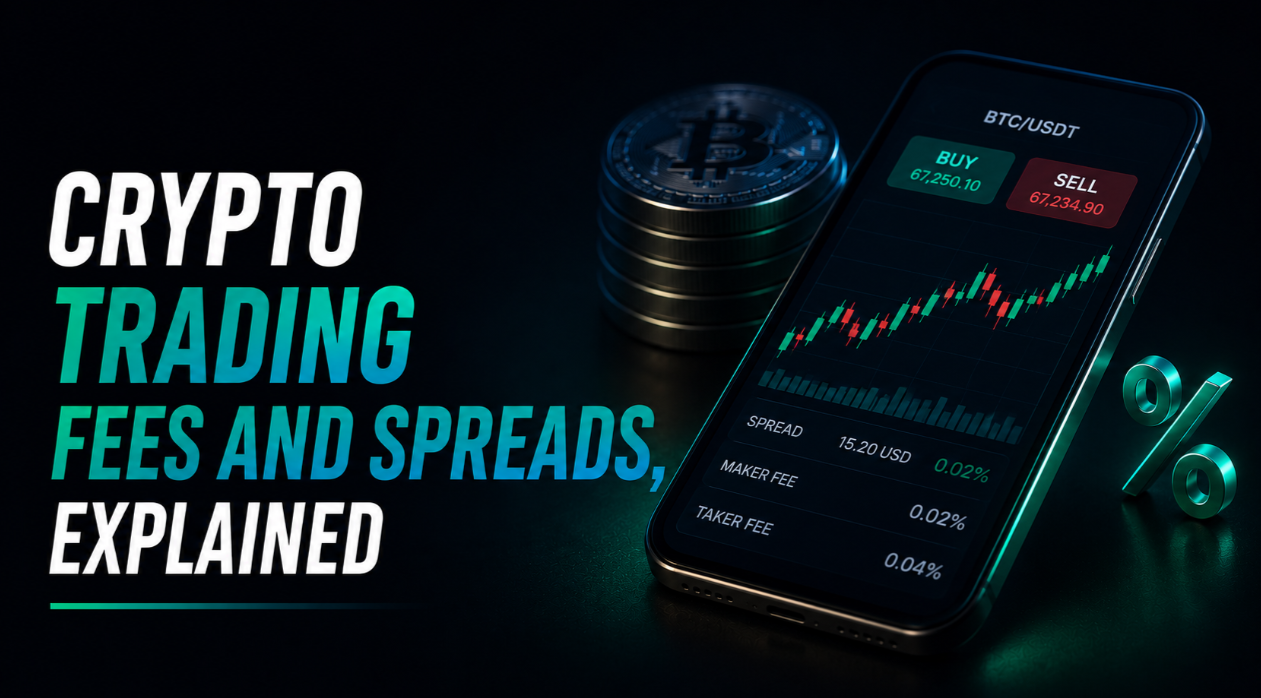
  • Kraken Pro: an order book where you place market, limit and other order types. You pay maker or taker fees by tier and no built-in spread 3. To understand the difference, see maker and taker fees, explained and order types.

Fees

As of October 2026, Kraken's published schedule sets Pro spot fees by trailing 30-day volume or by assets held on the platform 3:

Kraken Pro spot tier Maker Taker
Tier 1 ($0+) 0.40% 0.80%
Tier 2 ($2,500+) 0.30% 0.60%
Highest tier (Pro 5) 0.00% 0.05%
Stablecoin, pegged-token and FX pairs ($0+) 0.20% 0.20%

Other charges listed by Kraken 3:

  • Spread: applies to instant buys and is not a fixed percentage. Kraken says it varies with volatility, asset and order size.
  • Kraken+ subscription: waives the instant-trade fee on up to $10,000 of monthly volume in major fiat currencies. Spreads and card processing fees still apply.
  • Small balances: converting an amount below the minimum order size costs a flat 3%.
  • Deposits and withdrawals: fees depend on the asset and the method. They can be fixed or dynamic, and the fee shown at confirmation is the fee you pay.

Example: placing a $1,000 market order in Kraken Pro at Tier 1 costs $8 in taker fees (0.80%). Buying $1,000 through the app's instant buy costs $10 in trading fees (1%), plus the spread built into the quoted price and any card fee. Both figures use Kraken's published rates 3. The example is illustrative; actual spreads vary.

Products and availability

Kraken's product set depends on jurisdiction. Spot trading is the core. Margin trading has "certain geographic and eligibility limitations." Futures and derivatives run through regulated entities such as the CySEC-licensed EU entity and, in Australia, only for wholesale clients 12. The About page also lists tokenized equities (xStocks) and stock purchases 1.

Staking has a regulatory history. In February 2023, Kraken paid $30 million to settle SEC charges over its US staking-as-a-service program and shut it down for US clients. It relaunched US staking on January 30, 2025, initially in 37 states 9. Staking rewards vary and are not guaranteed. For the mechanics, see staking explained.

Custody and proof of reserves

Kraken holds the private keys for crypto in your exchange account. That makes it a custodial service, not a self-custody wallet. To show that client balances are backed, Kraken publishes proof-of-reserves attestations 4:

  • An independent accountant takes an anonymized snapshot of client balances and builds a Merkle tree from it.
  • Kraken proves control of on-chain addresses with signatures.
  • The accountant checks that on-chain holdings meet or exceed client balances. Each client can confirm their own balance was included.

The latest snapshot (June 30, 2026) shows reserve ratios of 102.9% for BTC and 100.5% for ETH, and above 100% for the other in-scope assets 4. Kraken itself lists what this method cannot show 4. It cannot prove exclusive control of keys, rule out borrowed funds or hidden encumbrances, or reflect changes after the snapshot date. It is a point-in-time check of selected assets, not a full financial audit of Payward.

Regulatory record

  • February 2023: Kraken settled with the SEC for $30 million over its staking program 9.
  • November 2023 – March 2025: The SEC sued Payward, alleging it ran an unregistered exchange, broker and clearing agency. On March 27, 2025, the case was dismissed with prejudice by joint stipulation. The SEC said the dismissal was a policy decision and not a finding on the merits 8.
  • March 2026: Kraken Financial received a Federal Reserve master account, the first for a crypto-native firm. It gives the bank direct Fedwire access, though not the full range of central-bank services 7.

Withdrawals, support and account security

Crypto withdrawals carry an asset-specific fee, which can be fixed or dynamic. Kraken may change it, so check the confirmation screen 3. Blockchain transfers are final once broadcast. Most account losses at large exchanges come from phishing and fake support contacts, not exchange breaches. Reach support only by navigating to kraken.com yourself or opening the app. Never share passwords, 2FA codes or seed phrases with anyone who contacts you. See phishing tactics.

Incident record

1 recovered

A security researcher reported a bug that let a deposit be credited before it completed

June 9–20, 2024recovered
The researcher shared it with two others, who withdrew nearly $3M from Kraken's own treasury. CertiK later said it had done the testing and disputed Kraken's account. Kraken said no client assets were at risk
Outcome
Recovery confirmed
Loss
~$3M (Kraken treasury)
Recovered or reimbursed
Returned "minus a small amount lost to fees" (Kraken CSO, June 20, 2024)
Source: coindesk.com

Hacks in DefiLlama’s public database are also scored as the security record on the Kraken rating page.

Questions about Kraken

Is Kraken publicly traded?
No. Payward, Kraken's parent, filed confidentially for a US IPO in November 2025. As of September 2026, reporting indicated a listing no earlier than Q2 2027 6.
Who owns Kraken?
Kraken is operated by Payward, Inc., a private company co-founded by Jesse Powell. It is led by co-CEOs Arjun Sethi and Dave Ripley and backed by investors including Citadel Securities and Deutsche Börse 56.
Does Kraken have proof of reserves?
Yes. Kraken publishes Merkle-tree attestations by an independent accountant; the most recent snapshot is dated June 30, 2026. They cover selected assets at a single point in time 4.
Is Kraken regulated in the US?
Kraken's US entities are FinCEN-registered money services businesses with state money transmitter licenses. Kraken Financial holds a Wyoming SPDI charter. The SEC's 2023 lawsuit was dismissed in March 2025 278.
Are Kraken and Kraken Pro separate accounts?
No. They share one login and balance. Pro uses maker/taker fees; the app charges a spread plus a 1% instant-trade fee 3.

Kraken elsewhere on CoinPulse

Sources

  1. 1Kraken — Aboutkraken.com
  2. 2Kraken — Legal disclosures (updated 2026-08-11)kraken.com
  3. 3Kraken — Fee schedulekraken.com
  4. 4Kraken — Proof of reserves: (snapshot 2026-06-30)kraken.com
  5. 5Fortune — Kraken's CEOs and IPO plans (Sept 25, 2025)fortune.com
  6. 6Finance Magnates — Kraken parent pushes IPO to Q2 2027 at earliest (Sept 3, 2026)financemagnates.com
  7. 7The Block — Kraken wins Fed master account approval (Mar 4, 2026)theblock.co
  8. 8SEC Litigation Release No. 26278 (Mar 27, 2025)sec.gov
  9. 9The Block — Kraken relaunches staking in US (Jan 30, 2025)theblock.co
  10. 10CoinDesk — Kraken says hackers turned to extortion after exploiting bug for $3M (June 19, 2024)coindesk.com
  11. 11Cointelegraph — Kraken recovers $3M after CertiK bug bounty saga (June 2024)cointelegraph.com

For CoinPulsePoint's separate evaluation, see CoinPulsePoint's Kraken rating and evidence and the crypto exchange ratings. Related profiles: Coinbase, Bitstamp, Gemini.

Other centralized exchangesAll →

What changed on this page

  • 2026-10-19Rewrote the profile with Ahrefs-based keyword targeting. Updated Kraken Pro fees (Tier 1 is 0.40% maker / 0.80% taker) and added the instant-buy fee structure. Added a per-jurisdiction entity table, the proof-of-reserves method and its limits, IPO status, the Fed master account (approved March 2026), the 2025 SEC dismissal and the staking settlement history. Corrected the 2024 incident entry. Removed the "legit" verdict and the competitor comparison.
  • 2026-09-28Profile created: founding and entity facts, proof-of-reserves, fees, the Kraken vs Kraken Pro distinction, the Fed master-account story, and the June 2024 bug exploit with a confirmed-recovery verdict.
All companies