What is crypto staking?
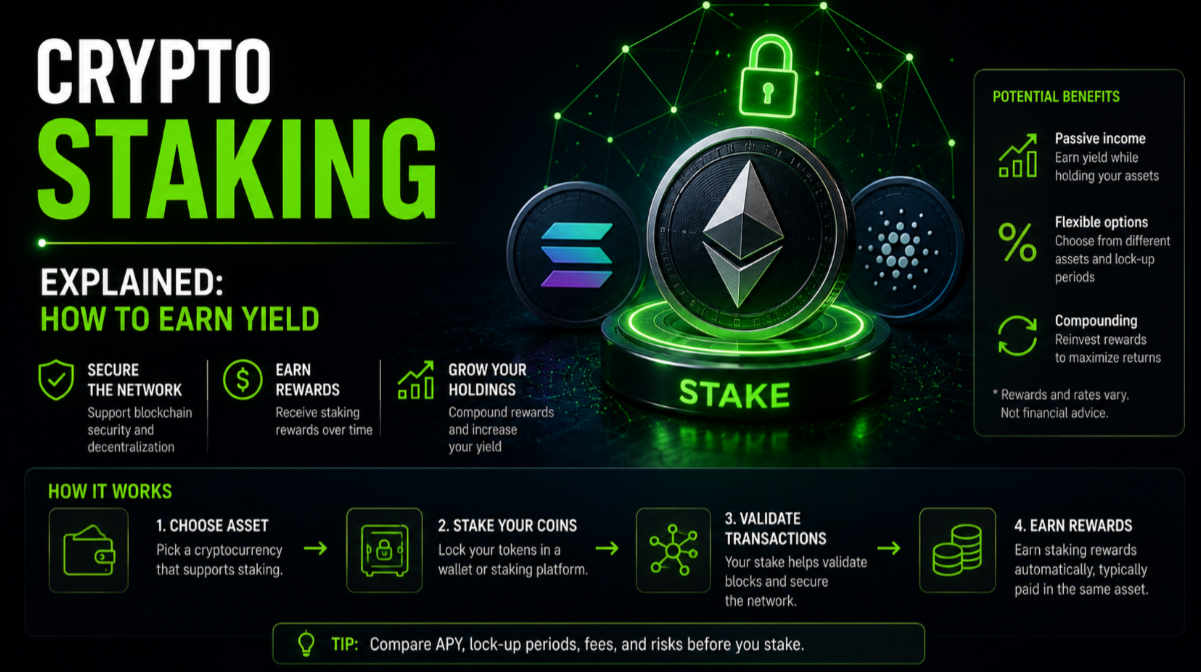
Crypto staking is the process of locking up coins to help secure a blockchain and earning yield in return. On networks that use a consensus mechanism called proof-of-stake, participants commit their tokens to validate transactions and produce new blocks. In exchange for putting capital at risk and keeping the network honest, the protocol pays them freshly issued coins plus a share of transaction fees. If you have owned Ethereum, Solana, Cardano, or Polkadot, you have held an asset you can stake.
Think of it as the blockchain equivalent of earning interest, but the reward comes from the network itself rather than a bank. The more you understand about where that yield originates, the easier it is to judge whether a given rate is sustainable or too good to be true.
How proof-of-stake generates yield
Proof-of-stake replaced the energy-hungry mining of proof-of-work chains like Bitcoin. Instead of computers racing to solve puzzles, validators are chosen to confirm transactions based on how many coins they have staked. A validator who behaves correctly is rewarded. A validator who tries to cheat, or who simply goes offline, can have part of their stake destroyed in a penalty called slashing.
Your yield, usually quoted as an annual percentage rate or APR, comes from two sources:
- New coin issuance: the protocol mints fresh tokens and distributes them to stakers, similar to a controlled inflation schedule.
- Transaction fees: a portion of the fees users pay to transact is passed through to validators and the people who back them.
Because rewards are often paid in the same token you staked, a headline APR does not guarantee your gains in dollars. If the token price falls faster than you accrue rewards, you can still end up behind.
Ways to stake your crypto
There is no single way to stake. Each method trades convenience against control and risk.
- Solo validating: you run your own node and stake the required minimum (32 ETH on Ethereum, for example). Maximum control and full rewards, but it demands technical skill and reliable uptime.
- Staking pools: you combine funds with other users so no single person needs the full minimum. A pool operator runs the infrastructure and takes a small commission.
- Exchange staking: platforms like major exchanges stake on your behalf with a few clicks. Simple, but you hand over custody of your coins and trust the platform.
- Liquid staking: protocols such as Lido or Rocket Pool give you a tradable token representing your staked position, so your capital stays usable in other apps while it earns.
Risks you need to understand
Staking is not free money, and the risks are real. Before committing funds, weigh the following:
- Lock-up and unbonding periods: many networks require days or weeks to withdraw. During that window you cannot sell, even if the market drops.
- Slashing: validator misbehavior or downtime can cost a slice of the staked principal.
- Price volatility: a double-digit APR means little if the underlying token loses half its value.
- Smart contract risk: liquid staking and DeFi platforms can contain bugs or be exploited.
- Counterparty risk: exchange or custodial staking depends on that company staying solvent and honest.
None of these should scare you off, but each deserves a clear-eyed look before you decide how much to commit.
Staking versus other ways to earn
Staking is often confused with lending or yield farming. Lending pays interest from borrowers who want your assets, and it carries default risk. Yield farming chases returns across DeFi protocols and tends to be more complex and volatile. Staking rewards, by contrast, come directly from a blockchain's core economics, which many people consider a more transparent and durable source of yield. That does not make it safer in every case, but it does make the reward easier to reason about.
How to start staking, step by step
If you have decided staking fits your goals, here is a practical path:
- Choose a proof-of-stake asset you already understand and are comfortable holding long term.
- Pick a method that matches your skill level: an exchange or liquid staking service for beginners, or solo validating if you are technical.
- Check the real numbers: the current APR, the commission taken, and the unbonding period.
- Start with an amount you can afford to lock up and potentially see decline in value.
- Track your rewards and any tax obligations, since staking income is taxable in many jurisdictions.
The practical takeaway
Crypto staking lets you put idle coins to work and earn yield while supporting the networks you believe in. The mechanics are approachable once you separate the two things that matter most: where the yield actually comes from, and what you give up to receive it. Favor assets you would hold anyway, read the lock-up terms carefully, and treat any unusually high APR as a signal to dig deeper rather than a reason to rush in. This article is educational and not financial advice, so do your own research and consider your own circumstances before staking.