What is a DAO?
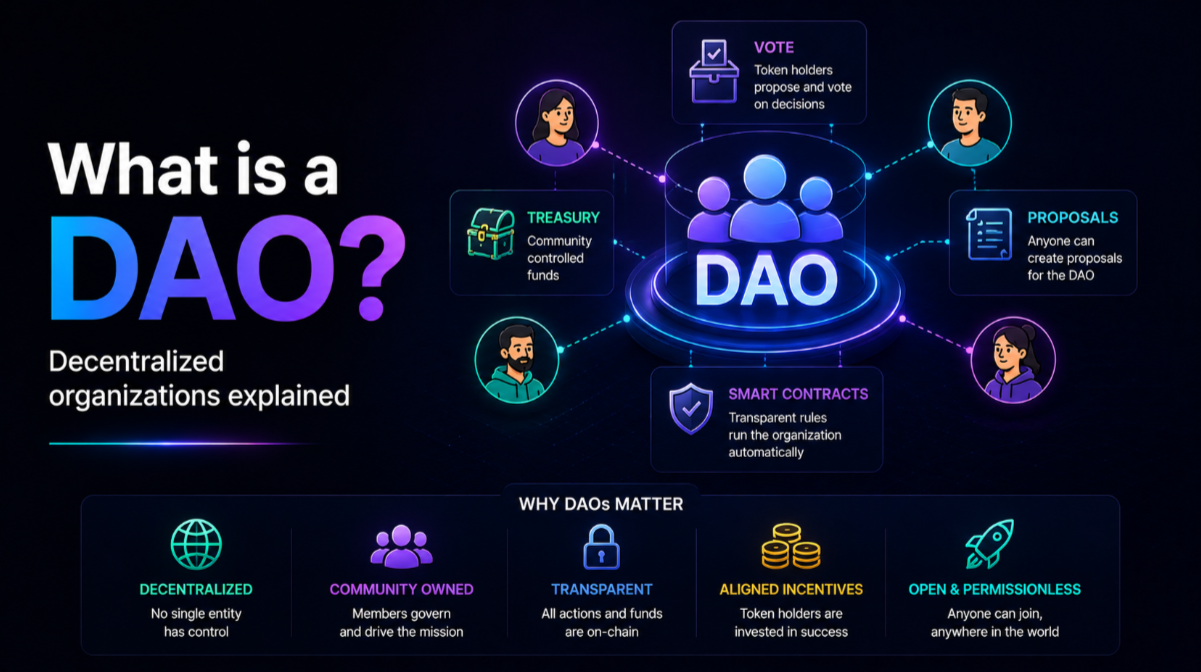
A DAO, or decentralized autonomous organization, is a group that coordinates money and decisions through blockchain code instead of a central boss or head office. Members hold governance tokens that let them propose ideas and vote on them, and the outcomes are carried out automatically by smart contracts. In short, a DAO replaces the paperwork of a traditional company with transparent rules that anyone can read and verify on a public ledger.
The idea sounds abstract until you compare it to a normal organization. A company has executives, a bank account only a few people control, and internal rules you mostly have to trust. A DAO tries to move those functions into open software: the treasury sits in a shared wallet, the rules live in code, and every vote and transaction is recorded publicly.
How DAOs work
Most DAOs share a similar structure, even when they pursue very different goals. Understanding the moving parts makes the whole concept much clearer.
- Smart contracts: self-executing programs that hold the treasury and enforce the rules without a middleman.
- Governance tokens: digital assets that represent voting power, usually earned, bought, or granted for contributions.
- Proposals: formal suggestions to spend funds, change a rule, or launch a project, submitted by members.
- On-chain voting: token holders vote, and if a proposal passes its threshold, the contract acts on it automatically.
- The treasury: a shared pool of crypto assets that only approved proposals can unlock.
Because these steps happen in public, anyone can audit how a DAO spends its money and whether it followed its own rules. That transparency is the core difference between a DAO and a private company.
Common types of DAOs
DAOs are a tool, not a single product, so people use them for many purposes. A few categories show up again and again.
- Protocol DAOs govern decentralized finance platforms, deciding fees, upgrades, and how rewards are shared.
- Investment DAOs pool member funds to back startups, tokens, or NFTs as a collective.
- Grants and social DAOs fund public goods or bring like-minded people together around a shared interest.
- Collector DAOs buy and manage high-value digital or physical assets as a group.
Whatever the flavor, the shared thread is collective ownership: no single person holds the keys, and decisions flow from the membership.
Why people use DAOs
The appeal comes down to trust and reach. A DAO lets strangers across the world coordinate real money without needing to know or trust each other personally, because the code enforces the deal. Membership is often open, so anyone who meets the token requirement can take part rather than waiting for permission.
Transparency is another draw. Every transaction is visible, which makes hidden spending or quiet rule changes far harder. For contributors, that openness can also mean clearer credit and rewards for the work they do.
Risks and limitations
DAOs are still an early experiment, and the honest picture includes real weaknesses. Anyone considering one should weigh these carefully.
- Code bugs: if a smart contract has a flaw, funds can be drained, and there may be no easy way to reverse it.
- Voter apathy: many token holders never vote, which can concentrate power in a small, active minority.
- Whale dominance: members with large token holdings can sway outcomes toward their own interests.
- Legal uncertainty: the rules for taxes, liability, and legal status vary widely and are still forming in most countries.
- Slow decisions: voting on everything can make a DAO react far slower than a traditional team.
How to get involved
You do not need to be a developer to explore a DAO. Most communities welcome newcomers who start small and learn by watching before committing anything.
- Join the DAO's community chat and read past proposals to see how decisions are actually made.
- Understand what the governance token does and how it is distributed before acquiring any.
- Start by contributing time or ideas rather than large sums of money.
- Read the smart contract audits, if they exist, and note whether the treasury is transparent.
The key takeaway
A DAO is an attempt to run an organization with open code and shared ownership instead of a central authority. That design can unlock genuine transparency and global coordination, but it also inherits the risks of young software and unsettled law. Treat any DAO as an experiment worth understanding on its own terms: read its rules, check how power is spread, and never commit more than you can afford to lose. This guide is educational and not financial advice.