What is Web3?
Web3 is a term for a version of the internet built on public blockchains, where control is spread across many participants instead of concentrated in a handful of companies. The core idea behind Web3 is ownership: users hold their own accounts, data, and digital assets directly, rather than renting access from a platform that can change the rules or lock them out. Instead of trusting a single company to run the servers and hold your information, Web3 apps run on shared, open networks that anyone can inspect and use.
You will sometimes see Web3 written as "web3" or described as the "decentralized web." These all point to the same shift: moving from an internet where a few intermediaries hold power to one where the underlying software and economics are open and community-run.
Web1, Web2, and Web3 explained
The clearest way to understand Web3 is to compare it with the eras that came before it. Each stage changed who creates value online and who captures it.
- Web1 (roughly 1990 to 2004): the "read-only" web. Mostly static pages you could view but not interact with. Publishing meant owning a server and writing HTML by hand.
- Web2 (roughly 2004 to today): the "read-write" web. Social media, streaming, and cloud apps let anyone post and interact, but a small number of platforms host the content, own the data, and monetize the attention.
- Web3 (emerging): the "read-write-own" web. Users can still create and interact, and they can also hold assets, identity, and a stake in the networks they use.
The pattern is a steady shift in ownership. Web1 gave us information, Web2 gave us participation, and Web3 aims to give us property rights over our digital lives.
How Web3 works under the hood
Web3 relies on a few building blocks working together. None of them are magic, but combined they make a genuinely different kind of application possible.
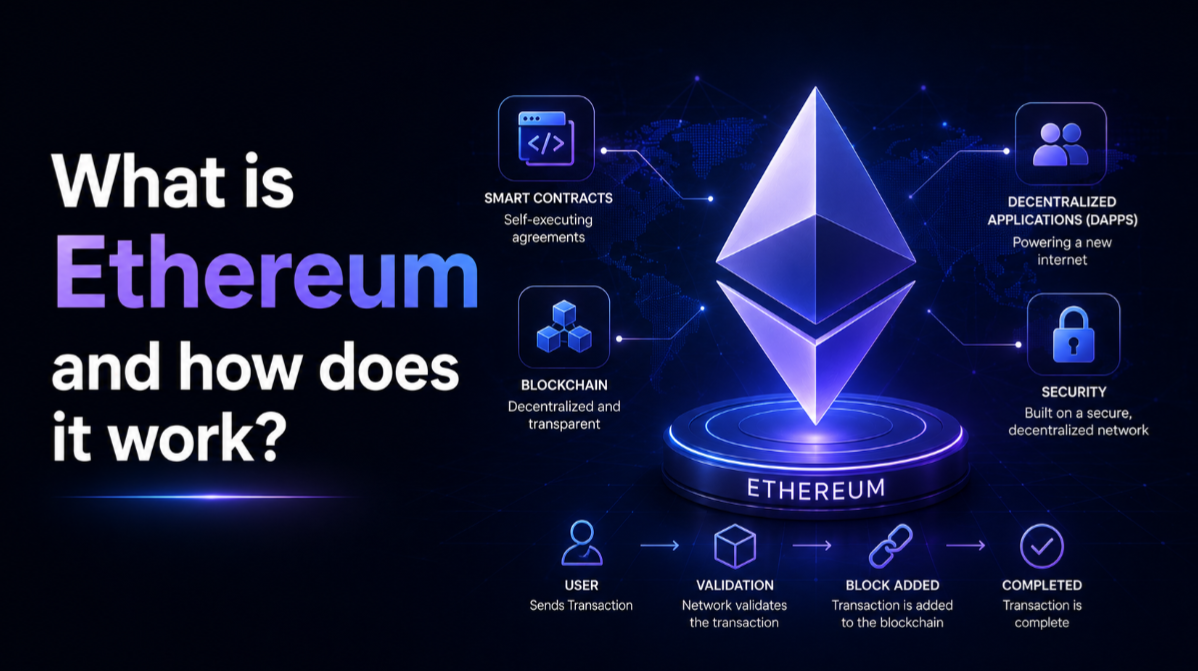
- Blockchains: shared ledgers, such as Ethereum, that thousands of independent computers maintain in sync. No single operator can quietly alter the record.
- Smart contracts: small programs that live on a blockchain and run exactly as written, automating things like trades, lending, or membership rules without a middleman.
- Wallets: apps that hold your cryptographic keys. Your wallet is both your login and your bank, which is powerful and demands care.
- Tokens: units of value or access recorded on-chain, ranging from cryptocurrencies to NFTs that represent ownership of a specific item.
When you use a Web3 app, your wallet signs a request and the network verifies it against the public rules encoded in a smart contract. There is no central account database to hack or freeze because the state lives across the whole network.
How Web3 is different from Web2
The difference that matters most is where control sits. In Web2, a company owns the servers, the user accounts, and the data, so it decides what you can do and can change terms at any time. In Web3, those functions are spread across an open network, so the rules are transparent and harder to reverse unilaterally.
A few practical contrasts stand out. In Web2 you log in with an email and password managed by a provider, while in Web3 you connect a wallet you control. In Web2 your posts and purchases live inside a platform's database, while in Web3 many assets are recorded on a public ledger you can carry between apps. And in Web2 the platform captures most of the financial upside, while Web3 tries to share that value with the people who use and build the network.
Real-world uses of Web3
Web3 is still early, but several categories already have working products and real users.
- Decentralized finance (DeFi): lending, trading, and saving through smart contracts instead of banks.
- NFTs and digital ownership: proving you hold a specific piece of art, a game item, or an event ticket.
- DAOs: internet-native organizations where members vote on decisions and manage shared funds transparently.
- Self-sovereign identity: credentials you control and present without a central authority holding your data.
Limitations and honest trade-offs
Web3 is not a finished product, and its promises come with real costs. Being clear-eyed about them will save you money and frustration.
- Complexity: managing keys and signing transactions is harder than a familiar email login, and small mistakes can be costly.
- Irreversibility: if you send funds to the wrong address or lose your recovery phrase, there is usually no support desk to call.
- Scams and volatility: the open, permissionless nature that makes Web3 powerful also attracts bad actors, and token prices can swing sharply.
- Scalability and cost: some networks are slow or expensive at busy times, though newer designs keep improving this.
Practical takeaway
The simplest way to understand Web3 is as a shift from renting your digital life to owning it. You do not need to invest anything to learn how it works. If you want hands-on experience, start small: set up a self-custody wallet, write down and safely store the recovery phrase offline, and try a tiny transaction on a low-cost network before doing anything larger. Treat every link and message with skepticism, since no legitimate service will ever ask for your recovery phrase.
Web3 may or may not become the default internet, and reasonable people disagree about how far it will spread. What is clear is that the ideas behind it, open networks and user ownership, are already influencing how software gets built. Understanding those ideas puts you in a stronger position no matter how the technology evolves. This article is educational and not financial advice.