What is Ethereum?
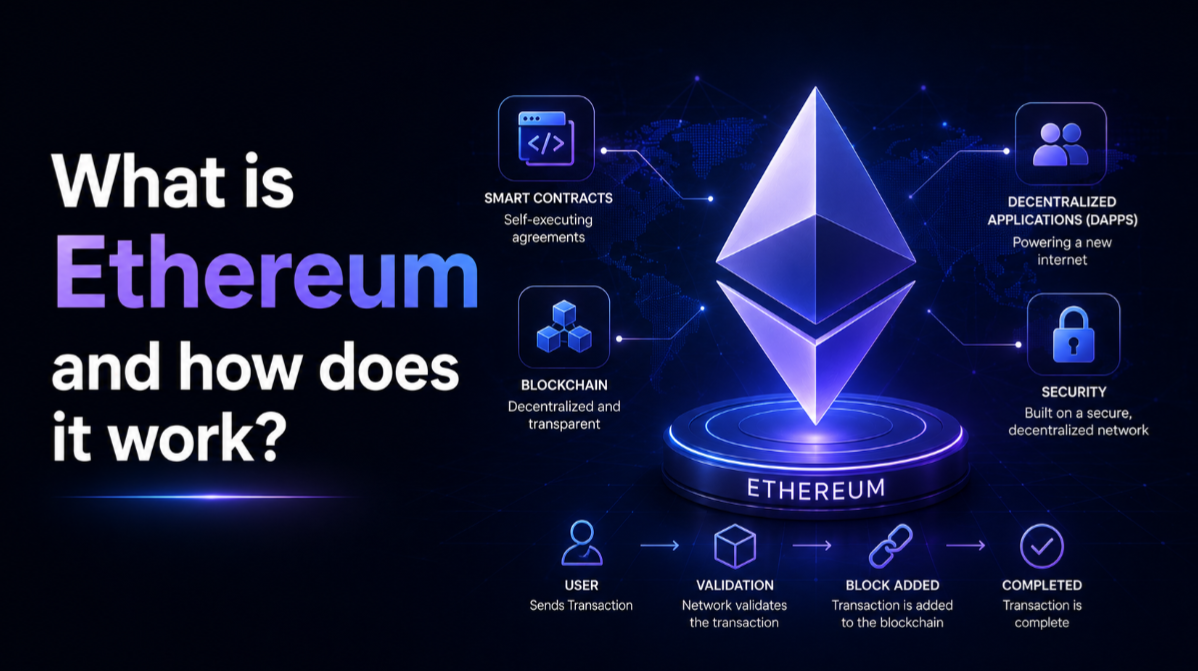
Ethereum is a decentralized, open-source blockchain network that lets people run programs, called smart contracts, without a central company in control. If Bitcoin is best understood as digital money, Ethereum is closer to a shared global computer: thousands of machines around the world keep an identical copy of the same ledger and agree on its state. Ether (ETH) is the network's native currency, but the bigger idea is that developers can build applications on top of Ethereum that no single party can shut down or censor.
Ethereum launched in 2015, proposed by programmer Vitalik Buterin and a group of co-founders. Its goal was to generalize what a blockchain could do. Instead of only tracking who owns which coins, Ethereum can track any rule you can express in code.
How Ethereum works
At its core, Ethereum works by having a distributed network of computers, called nodes, maintain a single shared database. Every time someone sends ETH or interacts with an application, that action is bundled with others into a block. Nodes then agree that the block is valid and add it to the chain, creating a permanent, tamper-resistant history.
What makes Ethereum different is the Ethereum Virtual Machine (EVM). Think of the EVM as the runtime that every node uses to execute code identically. When you trigger a smart contract, every participating node runs the same instructions and reaches the same result, which is why no one has to trust a single server.
- Accounts: Your wallet address holds ETH and can send transactions.
- Transactions: Signed instructions that move funds or call a contract.
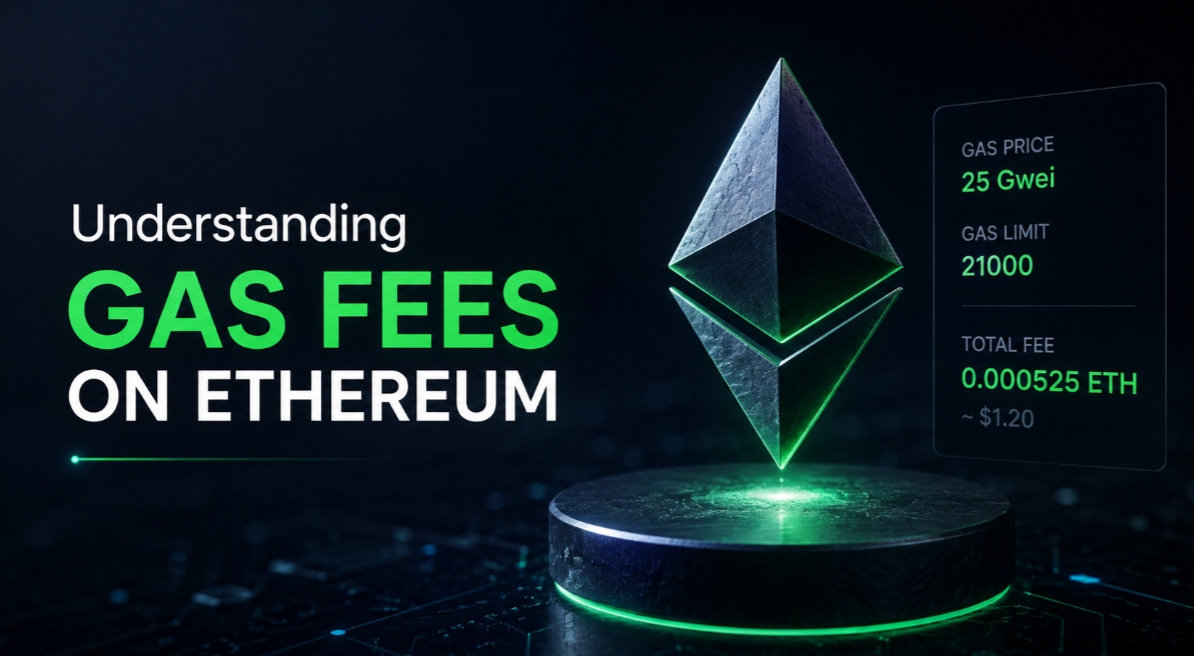
- Gas: A small fee, paid in ETH, that compensates the network for computation.
- Blocks: Ordered batches of transactions added roughly every 12 seconds.
Smart contracts explained
A smart contract is a program stored on the blockchain that runs exactly as written. Once deployed, its code is public and cannot be quietly changed. If the conditions in the code are met, the contract acts automatically, with no bank or middleman needed to approve it.
For example, a lending contract can hold collateral, release a loan, and return the collateral when the loan is repaid, all without a human clerk. This is the foundation of decentralized finance (DeFi), non-fungible tokens (NFTs), and many other applications. The trade-off is that bugs are also permanent, so audited, well-tested code matters enormously.
What is gas and why do fees change?
Every action on Ethereum consumes computational resources, and gas is the unit that measures it. You pay gas fees in ETH to reward the validators who process your transaction. Simple transfers cost little gas; complex contract interactions cost more.
Fees rise when the network is busy because users effectively bid for limited block space. During quiet periods, fees fall. Layer 2 networks, which we cover below, exist largely to make these fees cheaper and more predictable.
Proof of stake and validators
In 2022, Ethereum completed an upgrade known as The Merge, switching from energy-intensive proof of work to proof of stake. Under proof of stake, participants called validators lock up ETH as a security deposit for the right to propose and confirm blocks.
- Validators must stake ETH, which they can lose if they act dishonestly.
- Honest validators earn rewards for helping secure the network.
- The change cut Ethereum's energy use by more than 99 percent.
This design keeps the network secure through economic incentives rather than raw computing power.
Layer 2 and scaling
The base Ethereum chain, often called Layer 1, prioritizes security and decentralization over raw speed. To handle more users affordably, developers built Layer 2 networks such as rollups. These process transactions off the main chain in bulk, then post a compressed summary back to Ethereum for final settlement.
The result is much lower fees and faster confirmations while still inheriting Ethereum's security. If you have used a cheaper, faster version of an Ethereum app, you were likely using a Layer 2.
A practical takeaway
If you want to explore Ethereum, start small and prioritize learning over spending. A sensible first path looks like this:
- Set up a self-custody wallet and write down your recovery phrase offline.
- Learn to read a block explorer so you can verify transactions yourself.
- Try a small transaction on a Layer 2 to see how gas and confirmations feel.
- Never share your seed phrase, and assume unsolicited offers are scams.
Ethereum is a powerful, evolving technology, but it rewards patience and curiosity. Understanding how the pieces fit together, accounts, gas, smart contracts, and validators, will serve you far better than chasing any single trend. This guide is educational and is not financial advice.