What is a Layer-2?
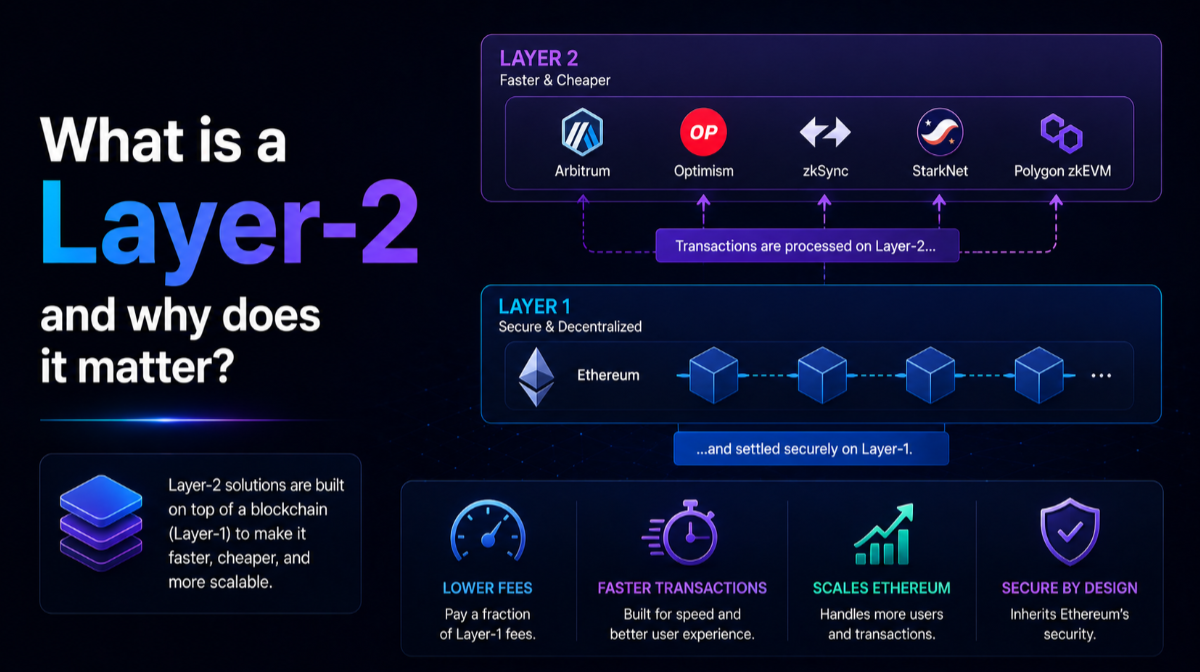
A Layer-2 is a separate network built on top of a base blockchain, called the Layer-1, that processes transactions faster and more cheaply while still relying on the Layer-1 for security. The most common example sits on top of Ethereum, but the same idea applies to other chains. Instead of every transaction competing for space directly on the main network, a Layer-2 handles the heavy lifting off to the side, then reports back to the Layer-1 in a compressed, verifiable form. The result is lower fees and quicker confirmations without giving up the trust guarantees of the underlying chain.
Think of the Layer-1 as a busy courthouse where every ruling is permanent and public, but slow and expensive to access. A Layer-2 is like an authorized office that handles thousands of cases nearby and periodically files a certified summary with the courthouse. You get the speed of the local office and the finality of the official record.
Why blockchains need scaling
Base-layer blockchains like Ethereum were designed to be secure and decentralized, and those priorities come at a cost: limited capacity. Every full node in the network must process and store every transaction, which caps how many transactions the chain can handle per second. When demand spikes, users compete by bidding higher fees, and the price of a simple transfer can climb to uncomfortable levels.
This trade-off is often described as the blockchain trilemma, the idea that a network struggles to maximize all three of the following at once:
- Security: resistance to attacks and censorship.
- Decentralization: no single party controls the network.
- Scalability: the ability to process many transactions cheaply.
Rather than weakening security or decentralization on the base layer, Layer-2 networks add scalability as a separate layer on top. This lets the Layer-1 stay conservative and robust while the Layer-2 pushes throughput up.
How Layer-2s work
Most modern Layer-2s are a type called a rollup. A rollup executes transactions on its own network, bundles many of them together, and posts a compressed batch back to the Layer-1. Because hundreds of transactions share the cost of a single base-layer submission, the fee each user pays drops dramatically. Crucially, the rollup also posts enough data or proof for anyone to verify that the batch is valid, so users do not have to simply trust the operator.
The security of the whole arrangement comes from the Layer-1. The main chain acts as the final referee: if a Layer-2 ever tries to submit an invalid state, the base layer's rules and the posted proofs allow that fraud to be caught or rejected. This is why people say Layer-2s inherit the security of the chain beneath them.
Types of Layer-2s
Not all Layer-2s prove their work the same way. The two dominant designs differ mainly in how they convince the Layer-1 that their transactions are honest:
- Optimistic rollups: these assume every batch is valid by default and allow a challenge window during which anyone can submit a fraud proof to dispute bad activity. They are simpler and broadly compatible with existing apps, but withdrawals back to the Layer-1 can take longer because of that challenge period.
- Zero-knowledge (ZK) rollups: these generate a cryptographic validity proof for every batch, mathematically demonstrating the transactions are correct before they are accepted. Withdrawals can be faster and the security model is tighter, though the technology is more complex to build.
You may also hear about older approaches like state channels and sidechains. Sidechains, in particular, run in parallel with their own security rather than inheriting the Layer-1's, which is an important distinction to keep in mind.
Why Layer-2 matters for everyday users
For most people, the appeal of a Layer-2 is practical. It turns actions that were once too expensive into routine ones. Sending money, swapping tokens, minting a collectible, or interacting with an app might cost a few cents on a Layer-2 instead of several dollars on the base chain, and confirmations often feel near-instant.
The benefits worth remembering include:
- Lower fees: batching spreads base-layer costs across many users.
- Faster transactions: the Layer-2 network is not bottlenecked by base-layer capacity.
- Same underlying security: rollups anchor their state to the Layer-1.
- Access to more apps: cheaper transactions make small, frequent interactions viable.
Risks and trade-offs to understand
Layer-2s are powerful, but they are still maturing, and they introduce their own considerations. Being aware of them helps you use these networks sensibly:
- Bridging risk: moving funds between a Layer-1 and a Layer-2 uses bridge contracts, which have historically been targets for exploits.
- Centralization today: many Layer-2s currently rely on a single operator, called a sequencer, to order transactions, which is a work in progress toward fuller decentralization.
- Withdrawal delays: optimistic rollups can require a waiting period to move assets back to the base layer.
- Ecosystem maturity: newer networks may have fewer apps, less liquidity, and less battle-tested code.
The practical takeaway
A Layer-2 is how blockchains scale without abandoning the security and decentralization that make them valuable. By processing transactions off the main chain and settling back to it, rollups deliver the low fees and speed everyday use demands. If you have found base-layer fees frustrating, exploring a reputable Layer-2 is often the single biggest quality-of-life improvement available, provided you understand bridging and withdrawal mechanics before moving significant funds. This article is educational and not financial advice, so research any specific network and consider your own circumstances before using it.