What is an NFT?
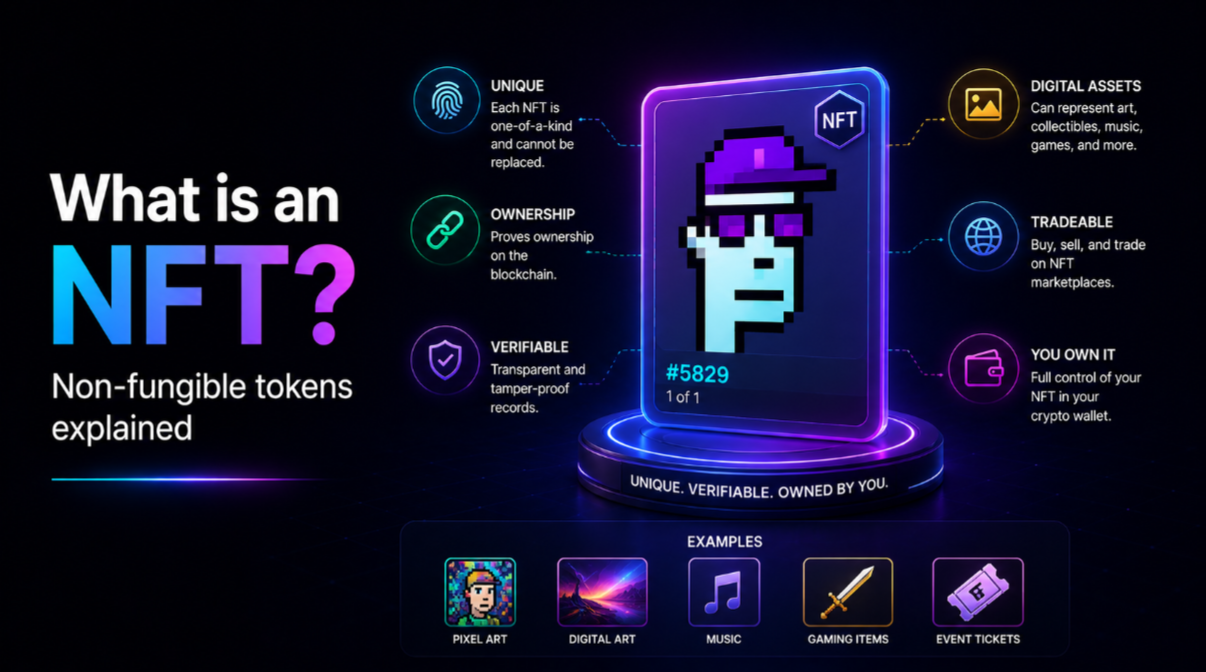
An NFT, or non-fungible token, is a unique record stored on a blockchain that points to a specific item and proves who owns it. The word "non-fungible" is the key. Fungible things are interchangeable: one dollar or one bitcoin is worth exactly the same as any other, so you can swap them without anyone losing out. A non-fungible token is the opposite. Each one is distinct, carries its own identifier, and cannot be swapped one-for-one with another. That uniqueness is what lets an NFT act as a certificate of ownership for a particular digital or physical thing.
People most often associate NFTs with digital art and collectibles, but the underlying idea is broader. An NFT is really just a container for verifiable ownership. What sits inside that container can be a picture, a piece of music, a game item, an event ticket, or a claim on something in the real world.
How NFTs work on a blockchain
An NFT lives on a blockchain, most commonly Ethereum, though many other networks support them too. The blockchain is a shared public ledger that thousands of computers keep in sync. When an NFT is created, or "minted," a new entry is written to that ledger recording the token's unique ID and its current owner. Every later transfer is recorded as well, which builds a permanent, public history of who has held the token.
Most NFTs follow an agreed technical standard, such as ERC-721 or ERC-1155 on Ethereum. These standards are just shared rulebooks so that wallets, marketplaces, and apps all know how to read and move the token. Because everyone follows the same rules, an NFT you buy on one marketplace can usually be viewed and sold on another.
One point that trips up beginners: the artwork itself is usually too large to store directly on the blockchain. Instead, the token typically holds a link to the file, often stored on a decentralized system like IPFS. The blockchain proves ownership of the token; the token points to the content.
NFT versus cryptocurrency
NFTs and cryptocurrencies both live on blockchains, but they answer different questions. Here is the short version:
- Cryptocurrency is fungible. One unit equals any other unit of the same coin, which makes it useful as money or a store of value.
- An NFT is non-fungible. Each token is one of a kind, which makes it useful as a certificate for a specific item.
- You often need both. On most networks you pay for the NFT, and the transaction fee to move it, using the network's cryptocurrency.
Think of cryptocurrency as the cash in your wallet and the NFT as the numbered ticket or deed you buy with it.
What NFTs are actually used for
Beyond the headline art sales, NFTs are being tested in several practical areas:
- Digital art and collectibles: artists sell work directly to buyers and can earn a royalty each time it resells.
- Gaming: in-game items such as skins or characters that a player genuinely owns and can trade outside the game.
- Event tickets: tickets that are hard to counterfeit and whose resale can be tracked or capped.
- Memberships and access: holding a token can act like a keycard to a community, a service, or exclusive content.
- Real-world assets: early experiments in representing property records, luxury goods, or certificates of authenticity.
Not every use case will survive, and many early projects were speculative. The durable value tends to show up where a verifiable, transferable record of ownership solves a genuine problem.
What owning an NFT really means
Owning an NFT means the blockchain records you as the holder of that specific token. It does not automatically mean you own the copyright to the underlying work. Unless the seller explicitly grants those rights, the creator usually keeps them, and you own the token rather than the intellectual property behind it. Read what a project actually promises before assuming a purchase gives you commercial rights.
It is also worth being clear-eyed about permanence. If the artwork is stored off-chain and that storage disappears, your token may end up pointing at nothing. The ownership record survives; the content it references might not.
Risks and things to watch
NFTs carry real risks, and prices have been extremely volatile. Keep these in mind:
- Price swings: many NFTs have fallen far below their purchase price, and some have no active buyers at all.
- Scams and fakes: copied artwork, fake marketplaces, and phishing links that drain wallets are common.
- Fees: minting and trading can cost meaningful transaction fees depending on the network.
- Liquidity: unlike a popular coin, a specific NFT may be hard to sell when you want to.
This guide is educational and is not financial advice. Never invest money you cannot afford to lose.
A practical takeaway
If you want to explore NFTs, start slowly. Set up a reputable self-custody wallet, learn how to store your recovery phrase safely offline, and practice with a small amount on a well-known marketplace before doing anything larger. Verify project details from more than one source, be skeptical of unsolicited offers or links, and treat any promise of guaranteed returns as a warning sign. The core idea behind NFTs, provable ownership of a unique item, is genuinely useful. Understanding how the technology works is the best protection against the hype and the scams that surround it.