What happened
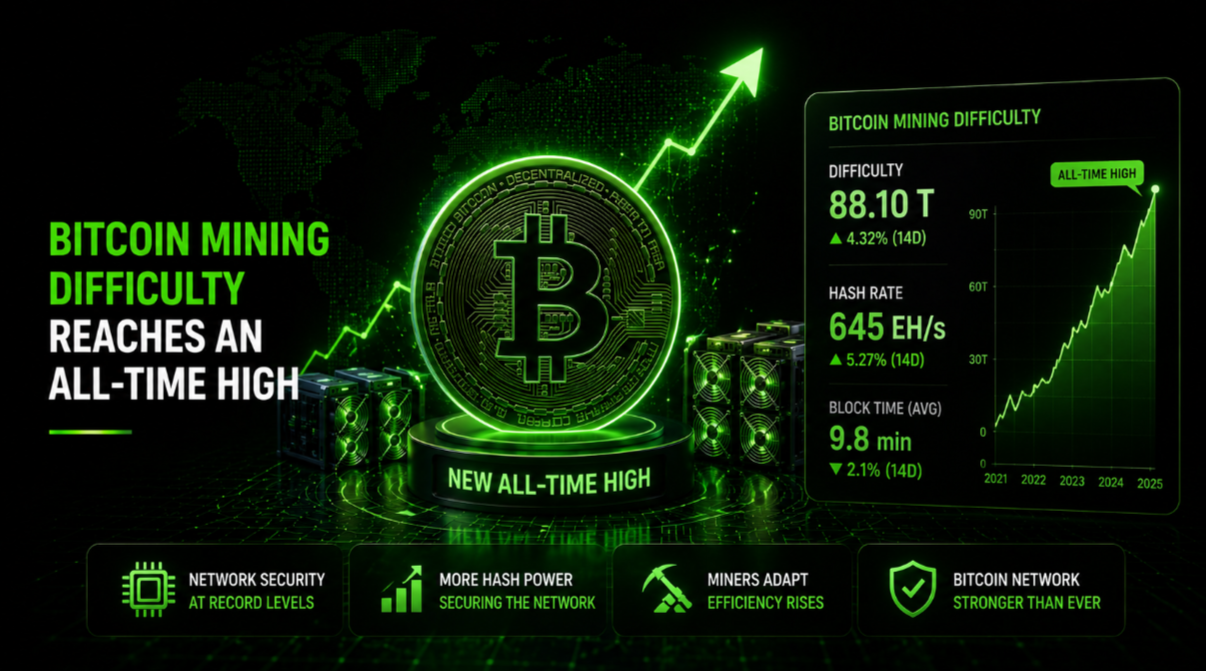
Bitcoin's mining difficulty has climbed to a new all-time high following its latest scheduled adjustment. Difficulty is the measure of how hard it is to find a valid block on the network, and the protocol recalibrates it roughly every two weeks, or every 2,016 blocks, to keep the average time between blocks near ten minutes. When more computing power comes online and blocks are found faster, the next adjustment raises difficulty to slow things back down.
The upward move follows a sustained rise in the network's hashrate, the total amount of computing power that miners are pointing at Bitcoin. As more machines join and older rigs are replaced with more efficient models, blocks get solved slightly ahead of schedule, and the automatic recalibration pushes difficulty higher. The current record simply reflects that the network is now more competitive to mine than at any prior point.
Why it matters
Difficulty is one of the clearest windows into the health and security of the Bitcoin network. A higher reading means more resources are committed to validating transactions and securing the chain, which raises the cost an attacker would need to bear to disrupt it. In that sense, a record difficulty is often read as a sign of confidence among the companies that operate mining hardware.
The flip side falls on miner economics. When difficulty rises but the Bitcoin price and transaction fees do not keep pace, each unit of computing power earns fewer coins. Margins compress, and operators running older or less efficient equipment feel the squeeze first. Miners with cheap electricity and newer machines are better positioned to absorb the change, while higher-cost operations may curtail activity or sell more of their holdings to cover expenses.
It is worth being precise about what difficulty does not tell you. A record high does not directly predict the Bitcoin price, nor does it guarantee that mining remains profitable across the board. It describes the competitive intensity of the network, not the market value of the asset being mined.
Market context
Several forces have pushed hashrate and difficulty higher over the past year. The rollout of more efficient mining chips has let operators add capacity without a proportional jump in power use. Publicly listed miners have expanded facilities, and some have diversified into adjacent computing work to smooth out revenue. Access to relatively low-cost energy in certain regions continues to draw new capacity.
The backdrop also includes the long-term effect of the periodic halving, which cuts the block reward paid to miners. With the subsidy per block lower than in earlier eras, miners depend more heavily on scale, efficiency, and transaction fees to stay in the black. Rising difficulty against that reward structure intensifies the pressure to run lean.
Historically, difficulty has trended upward over Bitcoin's life, with occasional sharp drops during periods when large amounts of capacity went offline, such as regional mining bans or energy disruptions. Those declines tend to be temporary, and the long-run direction has been higher as the network matures.
What to watch
The next difficulty adjustment is the immediate signal to monitor. A further increase would confirm that hashrate is still expanding, while a flat or lower reading could hint that some capacity is being switched off as margins tighten. Watching the hashrate trend between adjustments gives an earlier read on where the next move is likely to land.
Also worth tracking are miner reserves and any notable selling from large operators, transaction fee levels that supplement block rewards, and energy prices in major mining regions. Together these factors shape whether record difficulty reflects durable growth or a stretch that some miners will struggle to sustain.
This article is analysis, not financial advice. Market and network conditions can change quickly, and readers should do their own research before making decisions.