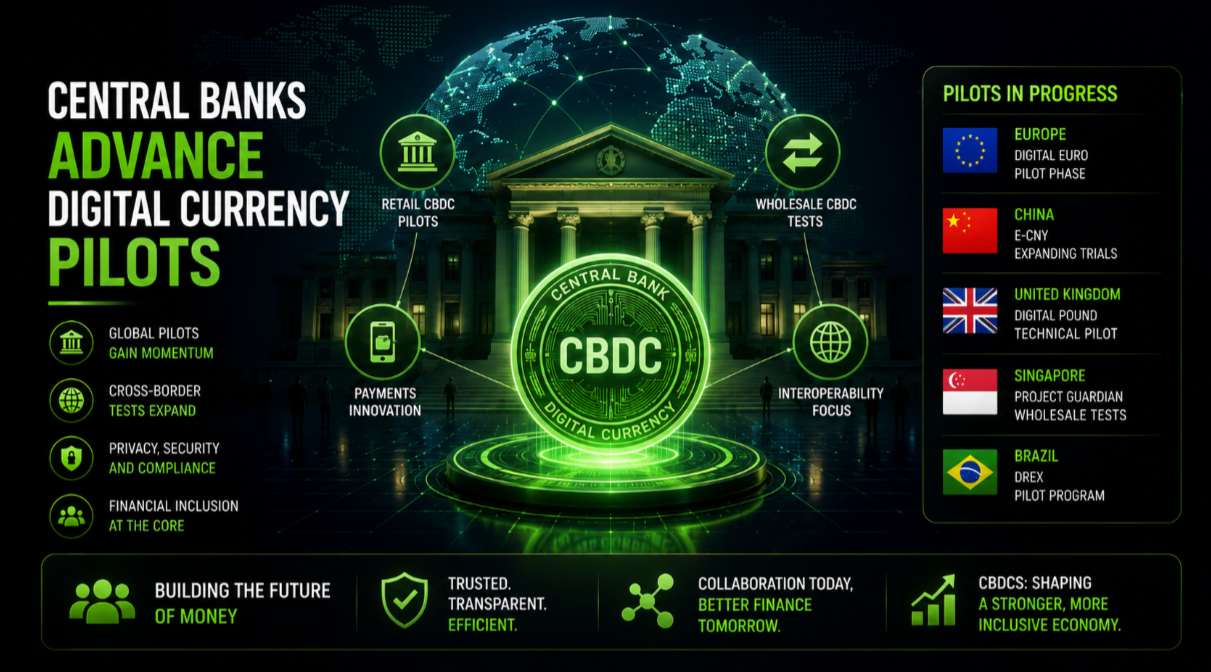
What happened
A growing cluster of central banks has moved digital currency work out of the research lab and into working pilots. Recent updates from monetary authorities in Europe, Asia and the Gulf describe live tests that route real or simulated value through wholesale settlement systems, retail wallet trials and cross-border corridors. The European Central Bank has continued its preparation phase for a digital euro, running experiments with selected banks and merchants. In Asia, several regulators have expanded programmable payment trials to more participants, while cross-border projects coordinated through the Bank for International Settlements have tested interbank settlement between multiple jurisdictions.
The common thread is a shift in emphasis. Earlier announcements focused on feasibility and design principles. The newer wave centers on operational questions: transaction throughput, offline functionality, privacy safeguards and how a central bank digital currency would coexist with commercial bank deposits and existing card networks.
Why it matters
Central bank digital currencies sit at the intersection of monetary policy, payments infrastructure and financial regulation, so pilot results carry weight beyond the crypto sector. A retail CBDC could change how households hold money and how quickly deposits move during periods of stress. A wholesale CBDC could reshape how banks settle large transactions with one another. Either path forces regulators to weigh public access to central bank money against the risk of disintermediating commercial banks.
For the broader digital asset industry, the direction of travel matters because CBDCs and privately issued stablecoins increasingly occupy adjacent territory. Some jurisdictions frame the two as complementary, with regulated stablecoins handling retail activity and CBDCs anchoring wholesale settlement. Others treat a public digital currency as a partial substitute. How that balance is struck in law and technical standards will influence where liquidity and product development concentrate.
Market context
According to trackers maintained by research institutions, a large majority of the world's central banks are engaged in some form of CBDC exploration, though only a small number have launched fully live currencies. Progress remains uneven. A handful of early retail launches have seen limited public uptake, underscoring that issuing a digital currency is easier than persuading people to use it. Wholesale pilots, by contrast, have drawn steadier interest from banks seeking faster settlement.
Political and privacy debates continue to shape timelines. In some countries, lawmakers have pushed back on retail CBDCs over surveillance concerns, while others have accelerated work to keep pace with regional peers. These pressures mean that technical readiness does not automatically translate into deployment, and several authorities have stressed that pilots do not commit them to a launch.
What to watch
Three signals are worth monitoring in the coming months. First, whether the European Central Bank moves from its preparation phase toward a formal decision, and what design choices it settles on for privacy and holding limits. Second, results from cross-border settlement trials, which could indicate whether interoperable CBDC networks are viable or whether fragmentation persists. Third, how regulators position CBDCs relative to stablecoin frameworks now advancing in several major markets.
For now, the pilots represent measured progress rather than a finished product. Readers should treat individual milestones as data points in a long process. This article is analysis, not financial advice.