What happened
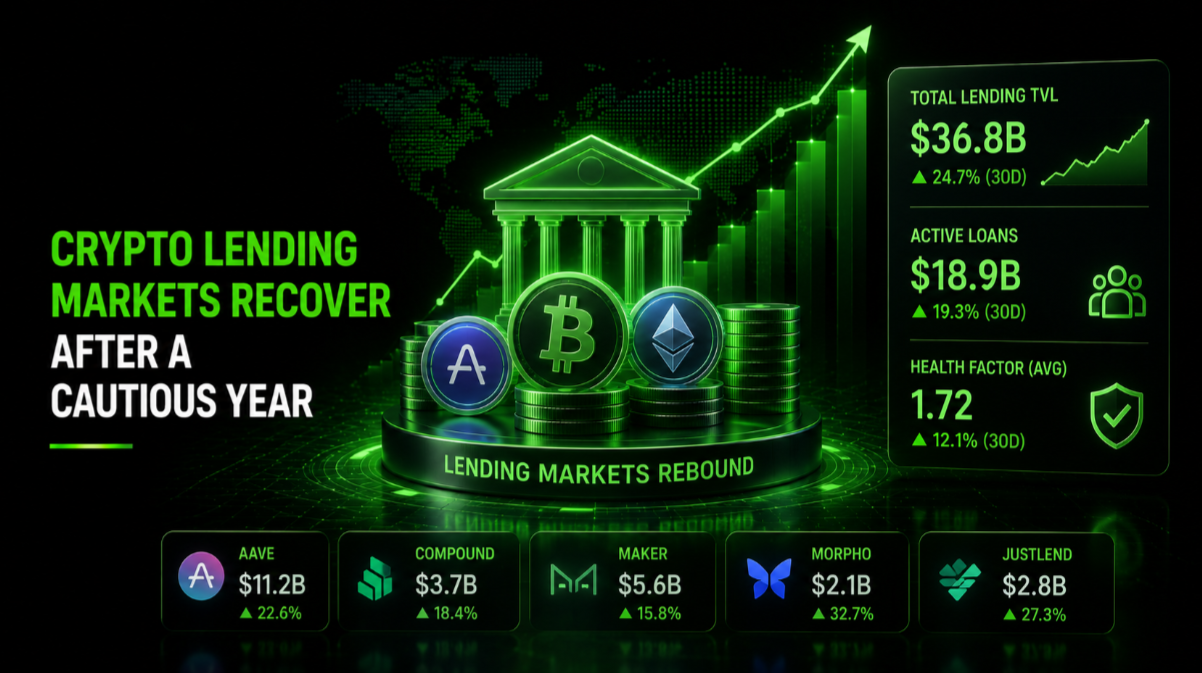
Crypto lending activity has picked up meaningfully over the past two quarters, according to on-chain dashboards and industry trackers. Total value borrowed across major decentralized protocols such as Aave, Morpho, and Compound has climbed back toward levels last seen before the risk-off stretch that defined much of the prior year. Deposits into these markets have grown alongside borrowing, and utilization rates on blue-chip collateral like ether and staked-ETH derivatives have edged higher.
Centralized lending desks report a similar, if quieter, thaw. After the failures and restructurings that hollowed out the sector, a smaller set of better-capitalized players is writing new loans, often to institutional counterparties and with tighter collateral terms. The rebound is broad but not uniform, and it comes off a low base.
Why it matters
Lending is the plumbing that connects idle capital to leverage, market-making, and yield. When it seizes up, spreads widen and liquidity thins across the board. A functioning lending market lets traders finance positions, lets holders earn on assets they would otherwise leave dormant, and gives stablecoin issuers and treasuries a place to deploy reserves.
What is notable this time is the composition of the recovery. More of the growth is happening on transparent, over-collateralized on-chain rails where positions and liquidations are visible in real time, rather than through the opaque, under-collateralized bilateral deals that amplified the last blowup. That shift does not remove risk, but it changes where the risk sits and how quickly it can be observed.
Market context
The backdrop helps explain the timing. Stablecoin supply has expanded, giving lenders more of the dollar-denominated liquidity that borrowers actually want. Benchmark on-chain yields have stabilized in a range that looks attractive relative to the caution of the past year without reaching the double-digit levels that once signaled froth. Regulatory clarity in several jurisdictions has also nudged some institutional participants off the sidelines.
Structural changes matter too. Protocols have leaned on isolated markets, supply caps, and more conservative loan-to-value settings, while newer designs separate risk curation from the base layer. These are incremental guardrails, not guarantees, and they have yet to be stress-tested by a sharp, disorderly drawdown.
What to watch
A few signals will show whether the recovery is durable. Watch utilization and borrow rates on the largest markets: a sustained climb suggests real demand, while a spike can flag crowding before a squeeze. Track how much lending growth stays on-chain versus migrating back to private desks, since the former is easier to monitor. Keep an eye on collateral concentration, the health of liquidation mechanisms during volatile sessions, and any renewed appetite for under-collateralized or recursive leverage, which historically preceded trouble.
For now, the data points to a cautious market slowly regaining its footing rather than a return to the exuberance of prior cycles. That distinction is worth holding onto as the numbers improve.
This article is for informational purposes only and is not financial advice.