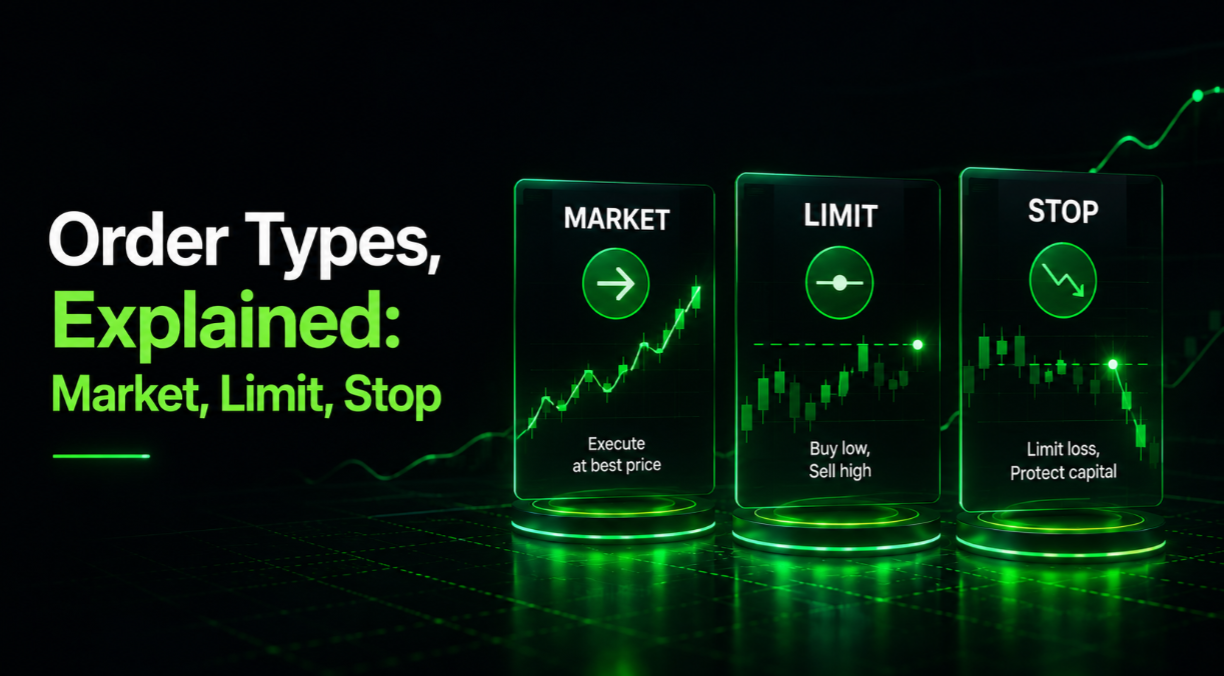
Crypto order types are the instructions you give an exchange about how and when to fill your trade, and choosing the right one controls whether you prioritize speed or price. The three you meet first are the market order, which trades immediately at whatever price is available; the limit order, which trades only at a price you specify or better; and the stop order, which stays dormant until price reaches a trigger and then activates. Learning the difference is the single most practical skill in trading, because the same trade idea can succeed or fail purely on how you enter and exit it.
Key takeaways
- A market order prioritizes speed and fills now; a limit order prioritizes price and may not fill at all.
- A stop order is a dormant instruction that activates only when price hits your trigger.
- Market orders can suffer slippage in thin markets, filling worse than the last quoted price.
- Makers add liquidity to the order book; takers remove it, and exchanges often charge them different fees.
- Combining stops with limits gives you both a trigger and a price ceiling or floor.
First, the order book
Every order type makes more sense once you picture the order book: a live list of what buyers are willing to pay (bids) and what sellers are asking (asks). The gap between the highest bid and lowest ask is the spread. When you trade, you are either matching an existing order in that book or adding a new one to it. That single distinction — matching versus adding — is what separates a taker from a maker, and it shapes both your fill and your fee.
Market orders: speed over price
A market order says "fill me now, whatever it takes." It sweeps the order book, matching against the best available prices until your size is filled. The advantage is certainty of execution: in a normal market, your order completes in an instant. The cost is control. You do not choose the price, and in a fast-moving or thin market, your order can walk up or down the book and fill at a noticeably worse average price than you expected. That gap is slippage, and it grows with order size and shrinks with liquidity.
Market orders make you a taker, because you remove liquidity that was already resting in the book. Use them when getting filled matters more than getting an exact price — for example, exiting a position quickly.
Limit orders: price over speed
A limit order says "fill me only at this price or better." You set a maximum you will pay to buy, or a minimum you will accept to sell. If the market reaches your price, you get filled at that price or an improvement; if it never does, the order simply waits, and may expire unfilled. This gives you precise control over cost and protects you from slippage, at the price of no guarantee of execution.
Because a resting limit order adds liquidity to the book, it usually makes you a maker, which on many venues carries a lower fee than taker orders. Limit orders suit patient entries and exits: you name your price and let the market come to you rather than chasing it.
Stop orders: automation for risk
A stop order is dormant until price crosses a level you set, at which point it activates and becomes a live order. Its most common use is the stop-loss: an instruction to sell if price falls to a level where you want to cap your loss, so you do not have to watch the screen. There are two important variants:
- Stop-market: when the trigger is hit, it becomes a market order — guaranteed to execute, but exposed to slippage exactly when the market is moving fast.
- Stop-limit: when the trigger is hit, it becomes a limit order at a price you set — protected from slippage, but at risk of not filling if price gaps straight past your limit.
A take-profit order works the same way in reverse, activating to lock in gains at a target. Stops turn a plan into an automatic action, which is why disciplined traders set them before emotion takes over.
A trailing stop is a useful refinement: instead of a fixed trigger, it follows the price by a set distance as the trade moves in your favor, then locks in only once price reverses by that amount. It lets a winning trade keep running while still protecting accumulated gains. The trade-off is that a normal pullback can trail you out of a position that then continues in your original direction, so the distance you choose matters as much as the tool itself.
Risks and common mistakes
Each order type has a failure mode worth respecting. Market orders in an illiquid pair can fill far from the quote you saw — always check depth before sending size into a thin book. Limit orders can leave you unfilled while the market runs without you, tempting you to chase. Stop-market orders can trigger during a brief wick and sell you out at a bad price, while stop-limit orders can fail to protect you at all if price gaps clean through your limit in a crash. There is no order type that is safe in every situation; the skill is matching the tool to the moment. Position sizing and a plan matter more than any single order.
Putting it together
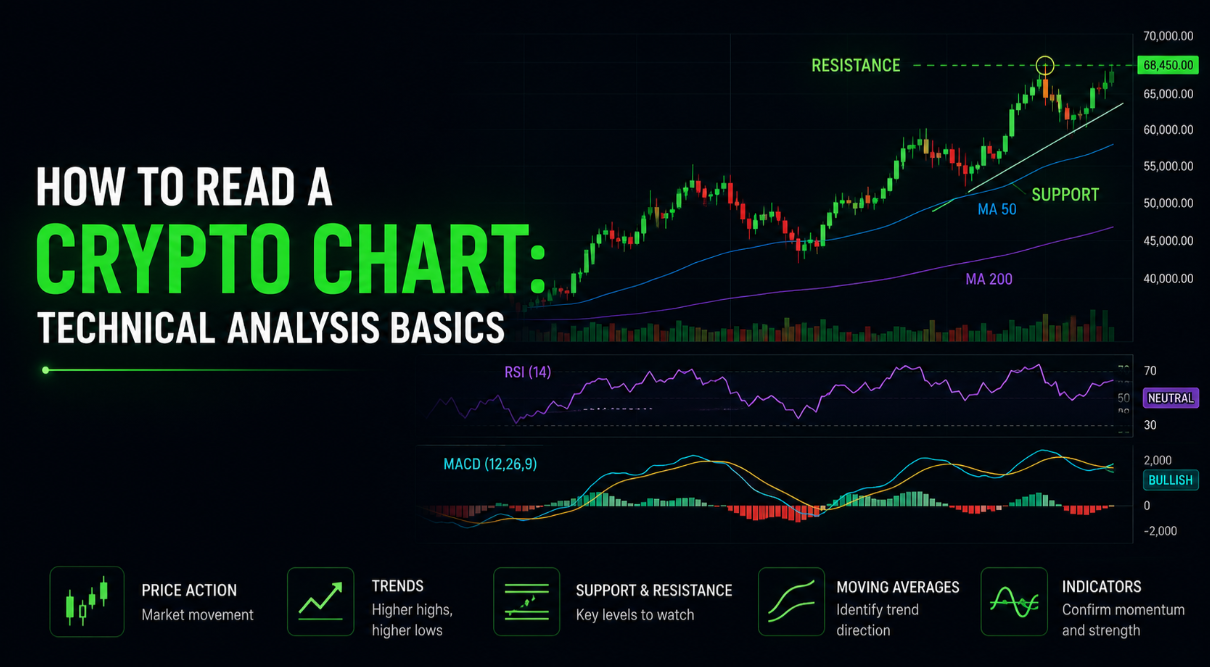
In practice, most traders blend these. You might enter with a limit order to control cost, protect the position with a stop-loss, and set a take-profit at your target — a full plan defined before the trade even opens. If you would rather remove timing decisions entirely, a scheduled approach like dollar-cost averaging sidesteps order-type juggling, and some traders automate their rules with trading bots. To read the price levels where stops and limits belong, study how to read a crypto chart, and browse our wider guides to build the surrounding context. None of this is financial advice — order types manage how you trade, not whether a trade is wise.