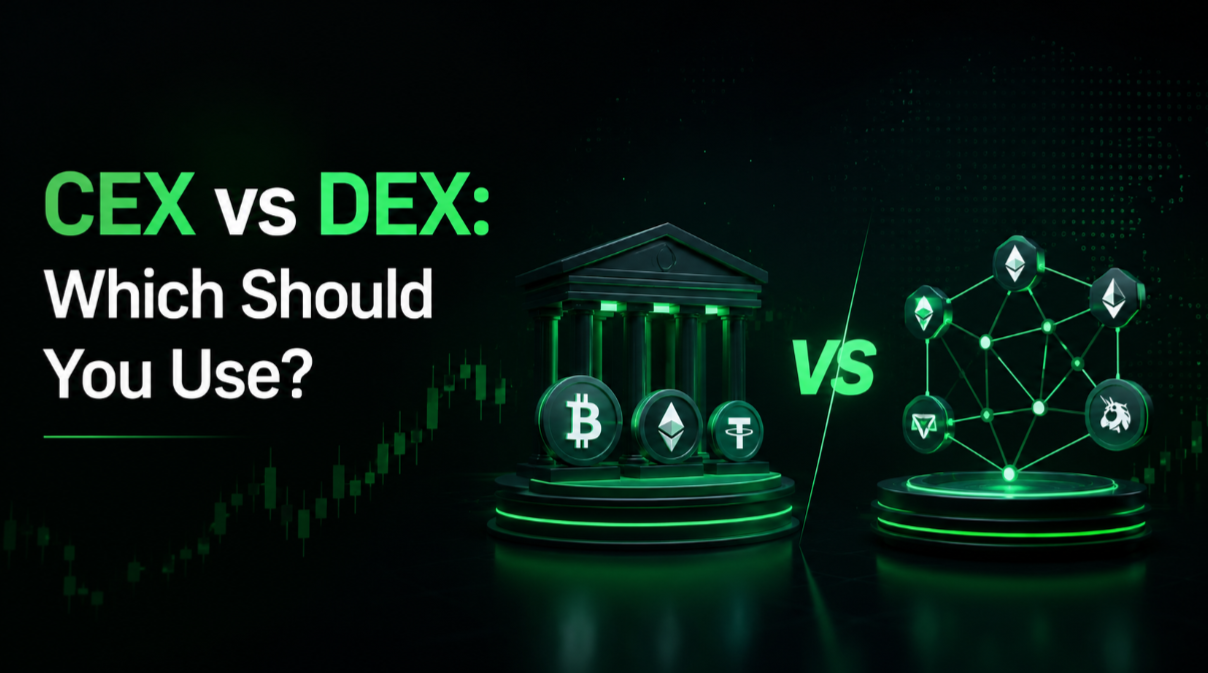
The choice between a CEX vs DEX comes down to one question: do you want a company to hold your crypto for you, or do you want to hold it yourself? A centralized exchange (CEX) works like an online broker, matching buyers and sellers on its own books and keeping custody of your funds. A decentralized exchange (DEX) is software running on a blockchain that lets wallets trade directly with pooled liquidity, with no company holding your coins. Both let you swap one asset for another, but they trade off convenience, control and risk in very different ways.
Key takeaways
- A CEX holds your funds and handles trades on its own systems; a DEX lets you trade from your own wallet with no custodian.
- CEXs usually offer easier onboarding, fiat deposits and customer support, but require identity verification and trust in the operator.
- DEXs offer self-custody and access to newer tokens, but demand more technical care and expose you to smart-contract and scam risks.
- Many people use both: a CEX to convert cash to crypto, and a DEX for on-chain swaps.
How a centralized exchange works
A centralized exchange is a business that operates an order book and a wallet system on your behalf. You create an account, verify your identity, deposit money or crypto, and the platform records your balance in its internal database. When you place an order, the exchange matches it against other users and updates those records. Because the company controls the keys to the underlying wallets, it can offer familiar features: fiat on-ramps, password recovery, spot and derivatives markets, and human support.
That convenience is also the core trade-off. When your coins sit on a CEX, the exchange is the legal and technical custodian. If it is hacked, mismanaged or freezes withdrawals, your access depends on that company. The phrase "not your keys, not your coins" exists precisely because CEX balances are IOUs until you withdraw to a wallet you control.
What CEXs are good at
- Onboarding: buying crypto with a card or bank transfer is straightforward.
- Liquidity and speed: large order books mean tight spreads on major pairs.
- Support and recovery: lost password flows and help desks reduce user error.
How a decentralized exchange works
A DEX replaces the company with code. Instead of an order book run by a business, most DEXs use liquidity pools and an automated market maker: users deposit pairs of tokens into a pool, and a formula sets the price as people trade against it. You connect a self-custody wallet, approve the transaction, and the swap settles on-chain. No account, no deposit into someone else's custody, and usually no identity check to make a basic trade. You can explore ratings for Decentralized exchanges to see how leading venues differ on liquidity and security.
The upside is control. Your assets stay in your wallet until the moment of the trade, and settlement is transparent on the blockchain. DEXs also list new or niche tokens long before a CEX would. The downside is that everything rests on you and on the code. There is no support line if you sign a malicious approval, send to the wrong network, or fall for a fake token with a copied name.
What DEXs are good at
- Self-custody: you never hand your keys to a third party.
- Access: early or long-tail tokens that centralized venues have not listed.
- Permissionless use: anyone with a wallet can trade without an account.
Comparing the two side by side
The clearest way to decide is to weigh what matters most to you. Custody, cost, privacy and safety pull in different directions.
- Custody: CEX holds funds for you; DEX leaves them in your wallet.
- Identity: CEXs require verification; most DEX swaps do not.
- Fiat: CEXs accept cash; DEXs trade crypto for crypto only.
- Costs: CEXs charge trading fees and spreads; DEXs charge pool fees plus network gas, which can spike when a chain is busy.
- Recovery: a CEX can help with a forgotten password; a lost DEX wallet seed phrase is unrecoverable.
To dig into the true cost of each route, our explainer on trading fees and spreads breaks down what you actually pay. If you are still deciding which platform to open first, our guide to how to choose a crypto exchange walks through the criteria that matter.
Risks and what to watch
Neither model is risk-free, and the risks are different in kind. On a CEX, the main danger is counterparty risk: the operator could be hacked, become insolvent, or halt withdrawals. Reduce it by using established platforms, enabling strong two-factor authentication, and withdrawing long-term holdings to your own wallet rather than leaving them on the exchange.
On a DEX, the risks are technical and self-inflicted. Smart-contract bugs can be exploited, token "approvals" you sign can grant broad spending access, and fake tokens or copycat sites are common. Always confirm you are on the correct site, check the token contract address, and review what each transaction is authorizing before you approve it. Because there is no undo button on-chain, a single careless click can be costly.
So which should you use?
Your own priorities should settle it. If ease of use, fiat access and support matter most, a CEX fits. If self-custody and access to newer tokens matter more, a DEX earns its place. Most active users end up with a foot in both camps, and that flexibility is a feature rather than a compromise.
For most newcomers, a reputable CEX is the simplest starting point: it turns cash into crypto and offers a safety net while you learn. As you gain confidence, a DEX becomes useful for self-custody and for tokens a CEX does not list. There is no rule that you must pick one. A common pattern is to buy on a CEX, move funds to a personal wallet, and use a DEX for on-chain activity. Read more foundational guides before committing real money, and choose the tool that fits the specific task in front of you rather than treating it as a permanent allegiance.