How to store cryptocurrency safely
Learning how to store cryptocurrency safely is the single most important skill you can build as a crypto owner. Unlike money in a bank, most cryptocurrency has no support line to call and no chargeback button if funds go missing. When you hold your own coins, you are your own bank, which means the responsibility for keeping them secure sits with you. The good news is that safe storage comes down to a handful of clear concepts and a few consistent habits that anyone can learn.
This guide explains how crypto wallets actually work, the difference between the main wallet types, and the practical steps that separate a well-protected stash from an easy target. None of this is financial advice; it is a plain-language walkthrough of the security basics.
What a crypto wallet really is
A common misconception is that a wallet stores your coins. It does not. Your cryptocurrency lives on a public blockchain, and a wallet is really a tool for managing the keys that prove ownership of it. Every wallet has two parts: a public key (or address) that others use to send you funds, and a private key that authorizes you to spend them.
Whoever controls the private key controls the funds. That is why the phrase "not your keys, not your coins" is repeated so often. Understanding this one idea reshapes how you think about every storage decision you make.
Hot wallets vs cold wallets
Wallets fall into two broad categories based on whether they are connected to the internet.
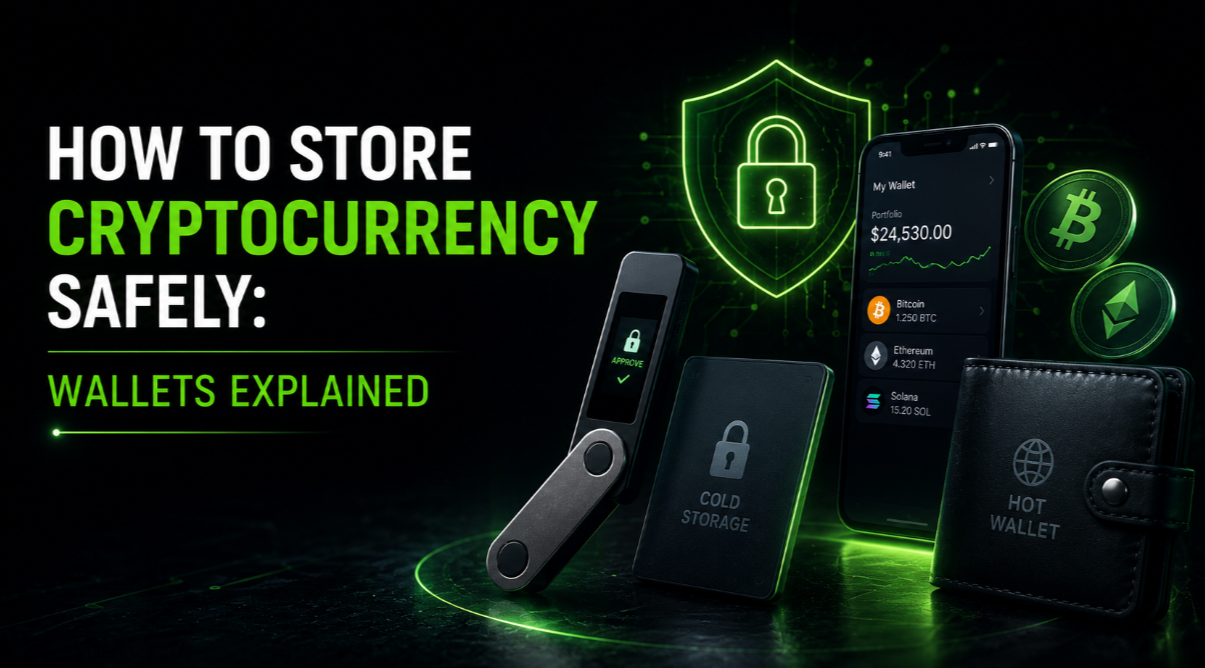
- Hot wallets are software wallets on a phone, browser extension, or desktop app. They are convenient for frequent trading and spending, but because they are online, they are more exposed to malware, phishing, and remote attacks.
- Cold wallets keep your private keys offline. The most common type is a hardware wallet, a small physical device that signs transactions without ever revealing your keys to your computer. Paper wallets and offline devices also count as cold storage.
A practical approach many people use is a two-tier system: keep a small amount in a hot wallet for everyday use, and store the bulk of your holdings in cold storage where it is much harder to reach.
Custodial vs non-custodial storage
You also need to decide who holds your keys. With a custodial setup, such as leaving coins on an exchange, a third party controls the private keys on your behalf. This is convenient and can be beginner-friendly, but it means trusting that company to stay solvent and secure.
With a non-custodial wallet, you alone hold the keys. You gain full control and remove counterparty risk, but you also carry full responsibility, because there is no one to reset your access if you lose your recovery details. Many owners keep only funds they are actively trading on an exchange and move long-term holdings into a non-custodial wallet.
Protecting your seed phrase
When you set up a non-custodial wallet, you receive a recovery phrase, also called a seed phrase, usually 12 or 24 words. This phrase can regenerate your entire wallet and all its private keys, so it deserves the highest level of protection.
- Write it down on paper or stamp it into metal, and store it offline.
- Never type it into a website, email, chat, or photo, and never store it in cloud notes.
- Keep at least one backup in a separate secure location in case of fire or theft.
- Treat anyone who asks for your seed phrase as a scammer, without exception. No legitimate support team will ever need it.
If someone gets your seed phrase, they can drain your wallet from anywhere in the world. If you lose it and have no backup, the funds are gone for good.
Everyday security habits
Strong storage is reinforced by daily habits. A few routines dramatically lower your risk:
- Enable two-factor authentication using an app or hardware key rather than SMS.
- Bookmark official wallet and exchange sites, and double-check web addresses before connecting.
- Verify transaction details on your hardware wallet screen before approving.
- Keep wallet software and device firmware updated.
- Be skeptical of giveaways, urgent messages, and unsolicited links, which are the most common ways funds are stolen.
Most losses do not come from broken cryptography. They come from human mistakes such as clicking a fake link or approving a malicious transaction, so slowing down is a genuine security feature.
Practical takeaway
Storing cryptocurrency safely is less about advanced technology and more about clear priorities. Understand that your keys are the real asset, match your wallet type to how you actually use your crypto, and protect your seed phrase as if everything depends on it, because it does. Start small: move a modest amount into a wallet you control, practice sending and receiving, and back up your recovery phrase offline. Once those steps feel routine, you can scale up with confidence, knowing your setup is built on habits that hold up over time.