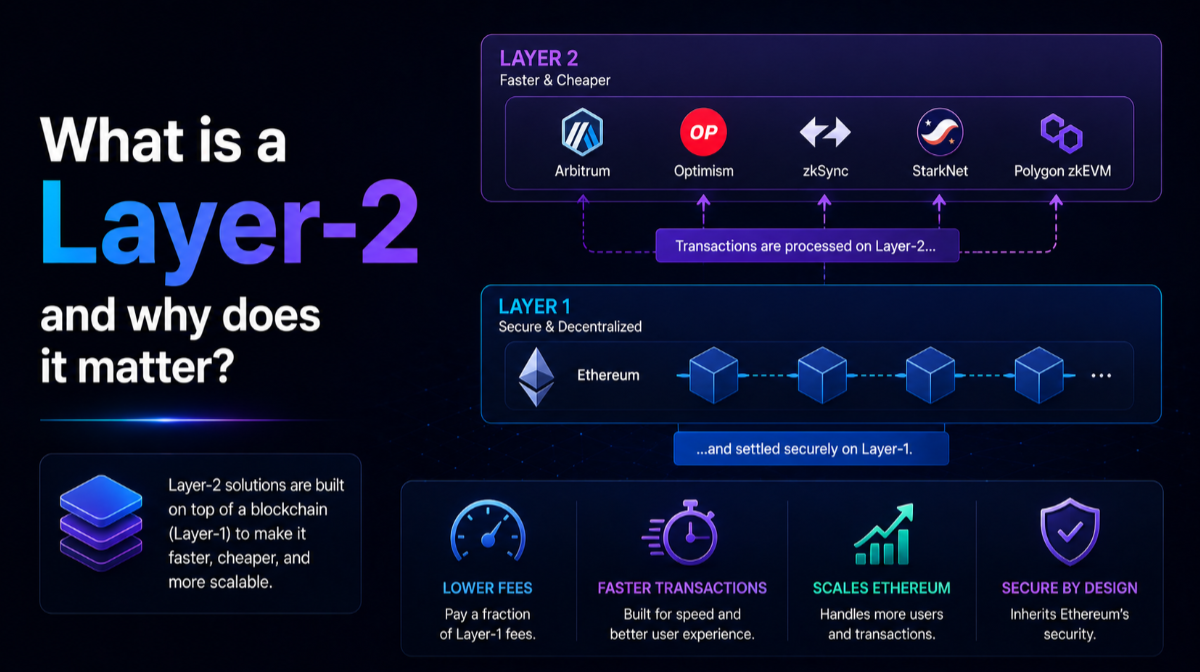
Layer 1 vs Layer 2 describes the difference between a base blockchain and the networks built on top of it to make it scale. A Layer 1 is the foundational chain that stores the ledger, runs the consensus rules, and provides security. A Layer 2 is a separate network that handles transactions off the base chain and then settles the results back to it, which lets users transact faster and for lower fees while still relying on Layer 1 for final security.
Key takeaways
- Layer 1 is the base blockchain that provides settlement, consensus, and security.
- Layer 2 processes transactions off-chain and posts results back to Layer 1 to reduce cost and congestion.
- Layer 1s prioritize security and decentralization but face limits on speed and fee cost.
- Layer 2s inherit much of Layer 1's security while offering higher throughput and cheaper fees.
- The trade-off is added complexity, new trust assumptions, and reliance on the base chain staying secure.
What a Layer 1 is
A Layer 1 is a standalone blockchain that maintains its own ledger and validates its own transactions. It defines the consensus mechanism that keeps participants in agreement, whether that is the approach described in proof of work vs proof of stake, and it is where transactions achieve final settlement. When people talk about the security of a network, they usually mean the security of its Layer 1, because that is the layer an attacker would have to overpower to rewrite history.
The challenge is that a single base chain must balance three goals that pull against each other: security, decentralization, and scalability. Keeping the network open and secure means every full participant verifies the same data, which caps how many transactions it can handle per second. When demand outgrows that capacity, blocks fill up and gas fees rise. This bottleneck is the reason Layer 2 networks exist.
What a Layer 2 is
A Layer 2 is a network that sits on top of a Layer 1 and moves the heavy lifting of transaction processing off the base chain. Instead of recording every individual transaction on Layer 1, a Layer 2 executes many transactions on its own, bundles them together, and posts a compressed summary or proof back to the base chain. The base chain still guarantees the final result, but it only has to store and verify the summary rather than every step.
Because a single Layer 1 slot can now represent hundreds or thousands of Layer 2 transactions, the cost of the base chain's block space is spread across many users. That is why fees on a Layer 2 are typically a fraction of the cost of transacting directly on Layer 1, and why throughput can be dramatically higher.
Common approaches to Layer 2
Not all Layer 2s work the same way. Two broad families dominate:
- Rollups that use fraud proofs: these assume transactions are valid and allow a challenge window during which anyone can submit proof of an invalid transaction. This keeps costs low but adds a delay before withdrawals are considered final.
- Rollups that use validity proofs: these post a cryptographic proof that the bundled transactions were executed correctly. Verification is near-instant on the base chain, though generating the proofs is computationally intensive.
Both approaches share the same core idea: do the work off-chain, prove it on-chain.
Layer 1 vs Layer 2: the trade-offs
Neither layer is simply better. They solve different problems and depend on each other:
- Security: Layer 1 provides the ultimate security guarantee. A Layer 2 inherits much of that security but adds its own assumptions, such as trusting that a proof system or challenge process works as designed.
- Speed and cost: Layer 2 wins clearly here, offering faster confirmation and far lower fees for everyday transactions.
- Complexity: Layer 1 is conceptually simpler for users, while Layer 2 introduces extra steps such as bridging assets between layers and understanding withdrawal delays.
- Finality: a transaction on Layer 2 is only as final as the moment its data is settled on Layer 1, which is worth understanding before moving large amounts.
You can explore related foundations in our guides, including how transactions reach settlement in the first place.
Why the distinction matters to users
For most people, the practical difference shows up as cost and speed. Doing a token swap or transfer on a busy Layer 1 can be slow and expensive, while the same action on a Layer 2 is often cheap and quick. But the convenience comes with responsibilities: you may need to bridge assets onto the Layer 2, keep the base chain's native coin for fees, and understand that withdrawing back to Layer 1 can involve a waiting period depending on the design.
It also matters for security reasoning. When you use a Layer 2, you are trusting both the base chain and the additional machinery of the Layer 2. A well-designed Layer 2 minimizes that extra trust by leaning on the Layer 1 for security, which is why the strength of the underlying base chain remains central even when you never touch it directly.
The bottom line
Think of Layer 1 as the foundation and Layer 2 as the extension built to relieve pressure on it. The base chain provides the security and settlement that make the whole system trustworthy, while Layer 2s make that security usable at scale by keeping fees low and throughput high. Understanding which layer you are transacting on, and what each one guarantees, helps you weigh cost against security every time you move funds. If a Layer 2 uses smart contracts to enforce its rules, our explainer on smart contracts is a useful companion read.
Other scaling approaches to know
Rollups are the most prominent Layer 2 design, but they are not the only way to scale. Some networks use sidechains, which are separate blockchains that connect to a base chain through a bridge but run their own consensus and provide their own security rather than inheriting it. Sidechains can be fast and cheap, but because they do not settle every result back to the base chain in the same way a rollup does, the security assumptions are different and worth understanding before moving significant value.
There are also state channels, which let two or more parties transact off-chain many times and only record the opening and closing balances on the base chain. These are efficient for repeated interactions between the same participants, though less flexible than a general-purpose Layer 2. The broader point is that scaling is not a single technique but a family of approaches, each trading some combination of security, speed, cost, and complexity. When you see a network described as a Layer 2 or a scaling solution, it is worth asking exactly how it settles back to its base chain, because that answer tells you how much of the base layer's security it actually inherits.