Liquid staking is a way to stake tokens on a proof-of-stake network while receiving a tradable receipt token, called a liquid staking token (LST), that represents your staked position and its accruing rewards. It solves the biggest inconvenience of ordinary staking: the fact that bonded tokens are normally locked and cannot be used for anything else. With an LST in your wallet, your capital keeps working across the rest of the ecosystem.
Key takeaways
- An LST is a claim on staked tokens plus rewards, issued when you deposit into a liquid staking protocol.
- Liquidity is the main benefit: you can trade, lend, or use the LST as collateral instead of waiting out an unbonding period.
- Value tracks the underlying, either by rebasing your balance or by the LST slowly appreciating against the base token.
- New risks appear: smart-contract bugs, depeg of the LST from its underlying value, and reliance on the protocol's validator set.
How liquid staking works
When you deposit a token into a liquid staking protocol, the protocol pools your funds with others and stakes them through its own set of validators. In exchange, it mints an LST and sends it to your wallet. That token is a receipt: it entitles you to your original stake plus the rewards it earns over time. Because the LST is a standard on-chain token, it can move freely, be traded on exchanges, or be deposited into other applications.
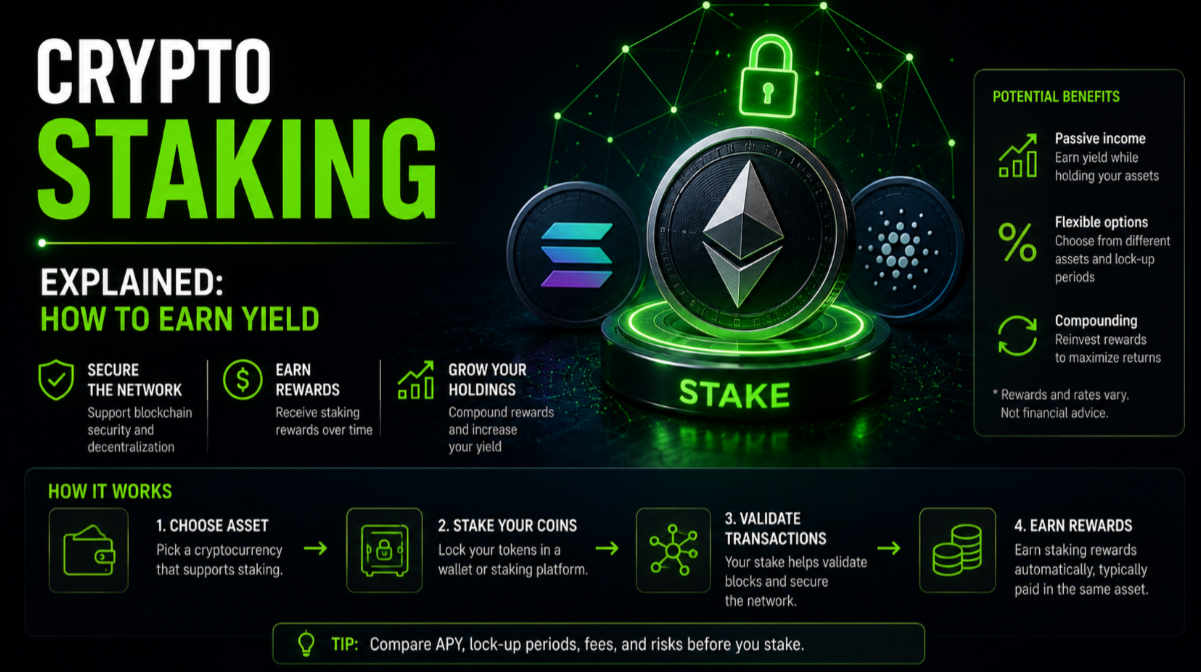
Behind the scenes, the protocol handles the parts that make direct staking cumbersome, choosing and monitoring validators, claiming rewards, and managing the unbonding queue when users want to exit. This is conceptually similar to delegated staking, but the receipt token is what sets liquid staking apart. If you are new to the underlying concept, start with our guide to crypto staking.
Rebasing vs value-accruing tokens
LSTs express rewards in one of two ways. A rebasing token keeps a stable price and grows the number of tokens in your wallet as rewards accrue. A value-accruing token keeps the balance fixed but rises in value relative to the base asset, so one LST is redeemable for gradually more of the underlying over time. The economics are similar; the difference matters mainly for accounting, tax treatment in some jurisdictions, and how other DeFi apps handle the token.
Why people use liquid staking
The appeal is capital efficiency. Ordinary staking forces a choice between earning staking rewards and keeping funds available. Liquid staking removes that trade-off by letting the same capital do both at once.
- No idle capital: the LST can be used as collateral for borrowing, supplied to liquidity pools, or held while still earning staking rewards.
- Faster exits: instead of waiting through an unbonding delay, you can often sell the LST on the open market for immediate liquidity.
- Lower barriers: pooled staking means you do not need the full validator bond or any hardware to participate.
This composability is also what connects liquid staking to more advanced strategies. Receipt tokens can be layered into further protocols, which is the starting point for restaking. Layering rewards this way can amplify returns, but it also stacks risk.
How liquid staking differs from delegation
It is easy to confuse liquid staking with ordinary delegated staking, because both let a professional operator do the technical work. The difference is the receipt token. With plain delegation, your stake is bonded and illiquid until you unbond it. With liquid staking, you hold a token that can move the moment it is minted. That single design choice changes the risk picture: you gain flexibility, but you now depend on the receipt token holding its value and on the contracts that mint and redeem it. In other words, liquid staking trades some of staking's simplicity for capital efficiency, and the extra convenience is paid for with extra dependencies.
Redemption and the withdrawal queue
There are two ways to convert an LST back to the underlying asset: redeem it through the protocol, which routes you into the network's unbonding queue, or sell it on the open market for immediate settlement. In calm conditions these two prices are almost identical. Under stress they can diverge, because everyone wanting out at once overwhelms both the queue and the available buyers. Knowing which exit you would use, and how it behaves when markets are moving fast, is part of using liquid staking responsibly.
Risks of liquid staking
Liquid staking inherits every risk of ordinary staking and adds several of its own. Understanding them is essential before committing funds.
- Smart-contract risk: your deposit is controlled by the protocol's code. A bug or exploit in the staking, minting, or withdrawal contracts could lead to loss of funds.
- Depeg risk: an LST should trade close to the value of its underlying stake, but market stress, thin liquidity, or loss of confidence can push its price below that value. Selling during a depeg locks in a loss.
- Slashing pass-through: if the protocol's validators are slashed for misbehavior or downtime, the penalty is shared across all LST holders, reducing what each token is worth.
- Validator concentration: if a single protocol controls a large share of a network's stake, it raises centralization concerns and can become a systemic point of failure.
- Liquidity risk: the ability to sell an LST quickly depends on there being buyers. In a sharp downturn, liquidity can dry up exactly when you most want to exit.
What to check before staking
Because so much depends on the protocol, due diligence focuses on its trustworthiness and resilience rather than on any single reward figure. Look at whether the code has been independently audited, how the validator set is distributed, how the withdrawal queue behaves under stress, and how deep the LST's market liquidity is. A slightly lower headline rate from a well-audited, well-distributed protocol can be safer than a higher one from an unproven contract.
To compare providers on security, decentralization, and terms, see our independent Liquid staking ratings. You can also explore the wider set of guides to understand how liquid staking fits alongside other ways of earning on-chain.