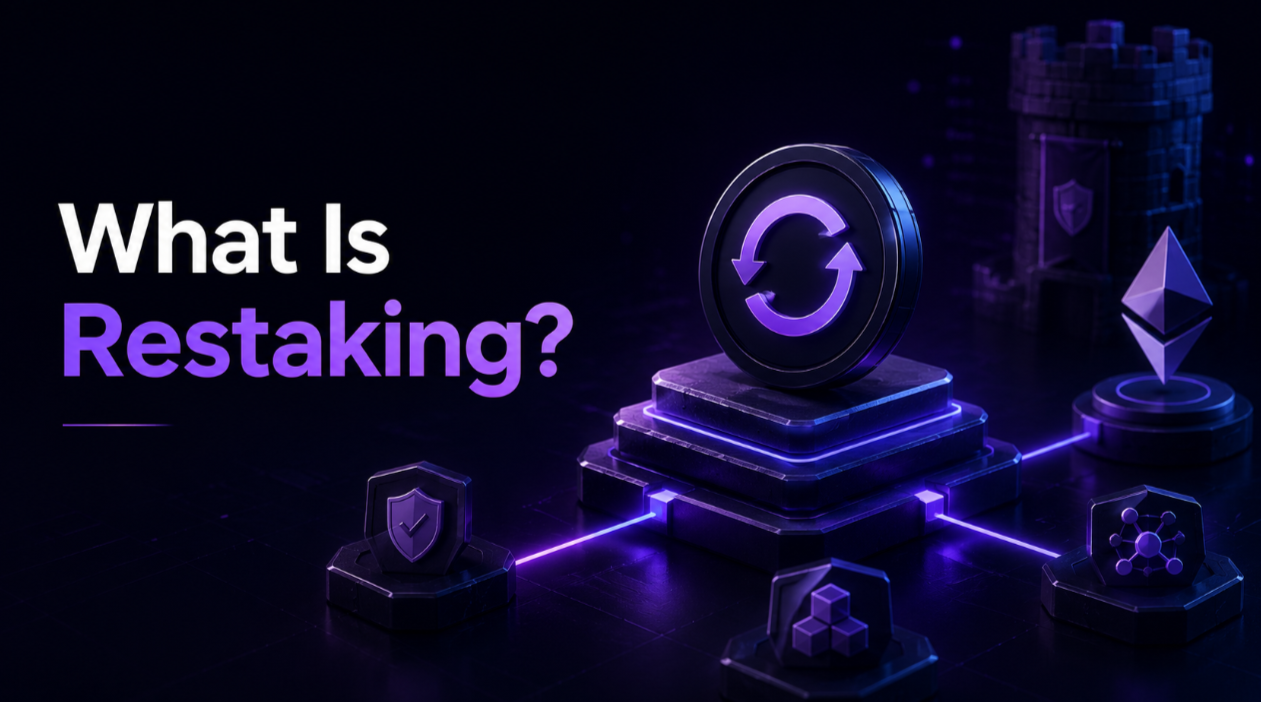
Restaking is the practice of reusing tokens that are already staked on a proof-of-stake network to help secure additional protocols or services at the same time, earning extra rewards on top of the base staking yield. Instead of a validator's bonded stake backing only one blockchain, restaking lets that same economic security be extended to other systems, and in exchange those systems pay their own rewards to the participants who back them.
Key takeaways
- Restaking reuses staked capital to secure extra services, so one pool of collateral earns rewards from more than one source.
- It builds on staking and liquid staking, often using staked tokens or liquid staking tokens as the input.
- Liquid restaking tokens (LRTs) give a tradable receipt for a restaked position, mirroring how LSTs work.
- Risk compounds: restakers face additional slashing conditions, layered smart-contract risk, and LRT depeg risk on top of ordinary staking risk.
How restaking works
To understand restaking, start with the idea that a proof-of-stake network is secured by bonded collateral. Validators put up stake, and if they misbehave, that stake can be penalized. This bonded capital is a form of economic security, and normally it protects just one chain.
Restaking asks a simple question: if that stake is already committed and idle in a security role, could it also back other systems that need security but do not have their own large validator set? Through a restaking layer, a staker opts in to additional obligations. Their stake now also secures these extra services, often called actively validated services or modules, and they accept the extra rules and penalties those services impose. In return, each service pays rewards for the security it receives.
The inputs to restaking are usually either natively staked tokens or the receipt tokens from liquid staking. If you are not yet familiar with those building blocks, review our guides to crypto staking and liquid staking first, because restaking assumes you understand both.
Liquid restaking and LRTs
Just as liquid staking produces a tradable token, restaking has its own liquid version. A liquid restaking protocol takes your deposit, restakes it across a chosen set of services, and issues a liquid restaking token (LRT) representing that position. The LRT can then be traded or used elsewhere in DeFi, keeping the capital productive while it earns restaking rewards. This is convenient, but it stacks yet another layer of tokenization and its associated risk on top of the position.
Native vs liquid restaking
There are two broad routes into restaking. In native restaking, a validator's own staked position is pointed at additional services directly, keeping the operator close to the underlying obligations. In liquid restaking, a protocol pools deposits, allocates them across a curated set of services, and hands you an LRT in return. Native restaking gives more control and transparency but demands that you run or closely manage a validator; liquid restaking is far more accessible but adds a manager and a receipt token between you and the underlying security work. The choice mirrors the trade-off between solo staking and pooled staking, only with more moving parts, because the manager is now also deciding which services your capital secures.
Why restaking exists
Restaking emerged to solve a bootstrapping problem. New protocols, oracles, bridges, and other infrastructure all need economic security, but building a large, trustworthy validator set from scratch is slow and expensive. Restaking lets them rent security from an existing pool of staked capital rather than mint and distribute a new token to attract validators.
- Shared security: smaller services gain access to a large base of bonded collateral without launching their own staking system.
- Extra yield for stakers: participants can earn rewards from multiple sources using the same underlying capital.
- Capital efficiency: security that would otherwise sit idle behind a single chain is put to broader use.
The appeal of layering rewards is clear, but so is the temptation to overextend. The more services a single pool of stake backs, the more ways there are for it to be penalized.
Risks of restaking
Restaking is one of the more advanced activities in the staking ecosystem, and its risks are cumulative rather than isolated. Every layer you add inherits the risks of the layers beneath it.
- Additional slashing conditions: each service your stake secures can impose its own penalties. A fault in any one of them can slash the shared collateral, so committing to more services widens your exposure to loss.
- Layered smart-contract risk: restaking involves the base staking contracts, the restaking layer, and each service's code. A bug anywhere in that stack can put funds at risk, and the combined attack surface is larger than for simple staking.
- LRT depeg risk: a liquid restaking token can trade below the value of the position it represents during stress or thin liquidity, and selling in that state locks in a loss.
- Correlated failure: if many services rely on the same restaked collateral, a single large penalty event can cascade across the ecosystem, affecting more participants than expected.
- Complexity risk: restaking is hard to fully evaluate. It is easy to underestimate how much total risk you are taking on when rewards come from several opaque sources at once.
Is restaking worth it?
Restaking rewards the capital-efficient, but it concentrates risk in ways that are difficult to see at a glance. It suits participants who already understand staking and liquid staking, who read the specific slashing conditions of each service, and who size positions on the assumption that extra yield carries extra downside. Chasing the highest layered return without understanding what secures it is how restakers get caught out. A sensible rule of thumb is to treat every additional service your capital backs as another independent way to lose money, and to accept only the ones whose rewards clearly justify that added exposure. If you cannot name the specific slashing conditions attached to a position, you do not yet understand it well enough to size it.
To compare providers on their security practices, audited code, and how they manage service selection, see our independent Liquid restaking ratings. For the broader picture of how these strategies connect, browse the full set of guides before committing capital.