What is market capitalization in crypto?
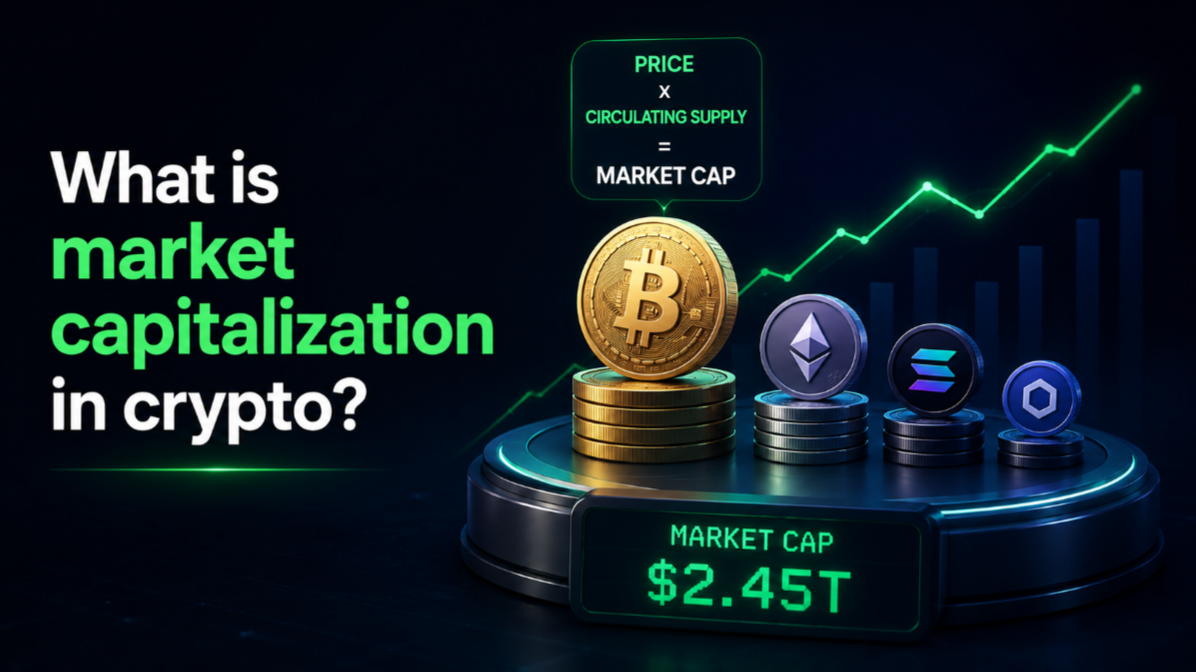
Market capitalization in crypto is the total value of a coin or token, calculated by multiplying its current price by the number of units in circulation. In short, market cap answers a simple question: if you added up every coin that people can currently trade, how much would the whole thing be worth? A coin trading at $2 with 500 million units in circulation has a market cap of $1 billion. The formula is deliberately plain, but it does a lot of work. Price alone tells you what one unit costs; market cap tells you the size of the asset as a whole.
This distinction matters because newcomers often judge a coin by its per-unit price. A token that costs $0.01 sounds cheap, and one that costs $60,000 sounds expensive. Market cap cuts through that illusion by accounting for how many units exist.
The formula, step by step
The core calculation is: market cap = current price x circulating supply. Circulating supply means the coins that are actually available and moving in the market right now, not tokens that are locked, reserved, or not yet issued.
- Price: the latest trading price on exchanges, usually shown against the US dollar.
- Circulating supply: the number of coins currently held by the public and available to trade.
- Result: a single figure that lets you compare assets of very different unit prices on equal footing.
Because price changes every second, market cap is a live number. A coin's rank can shift throughout the day as its price and reported supply update.
Why market cap matters
Market cap is the most common way to size up and compare crypto assets. It gives you a quick sense of an asset's scale, relative maturity, and how much capital would be needed to move its price.
- Comparison: it lets you weigh a $0.01 token against a $60,000 coin without being fooled by the sticker price.
- Ranking: most data sites, including CoinPulse, order assets by market cap to show which are largest.
- Stability signals: larger-cap assets tend to be less volatile than tiny ones, though this is a tendency, not a rule.
Investors often group assets into tiers. Large-cap coins are the biggest and most established. Mid-cap assets carry more growth potential and more risk. Small-cap tokens can move dramatically in either direction on relatively little trading volume.
Circulating vs. fully diluted value
You will often see two market-cap figures side by side. The standard market cap uses circulating supply. Fully diluted valuation (FDV) uses the maximum supply that will ever exist, including coins not yet released.
The gap between the two can be revealing. If a project has a small circulating supply but a huge maximum supply, its FDV may be many times its current market cap. That signals future coins will enter the market over time, which can dilute holders if demand does not keep pace. Always check whether a low market cap is genuinely small or just early in its release schedule.
What market cap does not tell you
Market cap is useful, but it is a starting point, not a verdict. A high number does not prove a project is safe, and a low one does not prove it is a bargain.
- It is not money invested: market cap is a theoretical total, not the amount of cash that has flowed into an asset.
- It ignores liquidity: a thinly traded coin can show a large cap while being hard to buy or sell without moving the price.
- Supply figures can mislead: if a few wallets hold most of the supply, the market cap overstates how much is realistically tradable.
- It says nothing about quality: technology, adoption, and the team behind a project are separate questions entirely.
Read market cap alongside trading volume, supply distribution, and the project's fundamentals rather than in isolation.
A practical takeaway
When you look at any crypto asset, treat market cap as your first filter, not your final answer. Note the market cap to understand its scale, then compare it with the fully diluted valuation to see how much supply is still to come. Check trading volume to gauge whether the number reflects a genuinely liquid market. Only after that should you weigh the harder questions of technology, use, and risk.
Used this way, market cap becomes a fast, honest lens for comparing assets that would otherwise look wildly different by price alone. It will not make decisions for you, but it will stop you from making them for the wrong reasons.
This guide is for educational purposes only and is not financial advice. Always do your own research before making any investment decision.