Crypto trading fees are the combined costs you pay to buy or sell on an exchange, and they are almost always larger than the single percentage a platform advertises. The visible trading fee is only one layer. On top of it sit the spread between buy and sell prices, deposit and withdrawal charges, currency-conversion margins, and, on-chain, network gas. Understanding how these stack up is the difference between thinking a trade cost you a fraction of a percent and realising it cost several times that.
Key takeaways
- Your real cost is the trading fee plus the spread plus any deposit, withdrawal or network charges.
- Maker-taker pricing rewards orders that add liquidity and charges more for orders that remove it.
- The spread is a hidden cost that grows on illiquid pairs and during volatility.
- Frequent small trades multiply fees; fewer, larger trades and limit orders can reduce total cost.
The headline trading fee
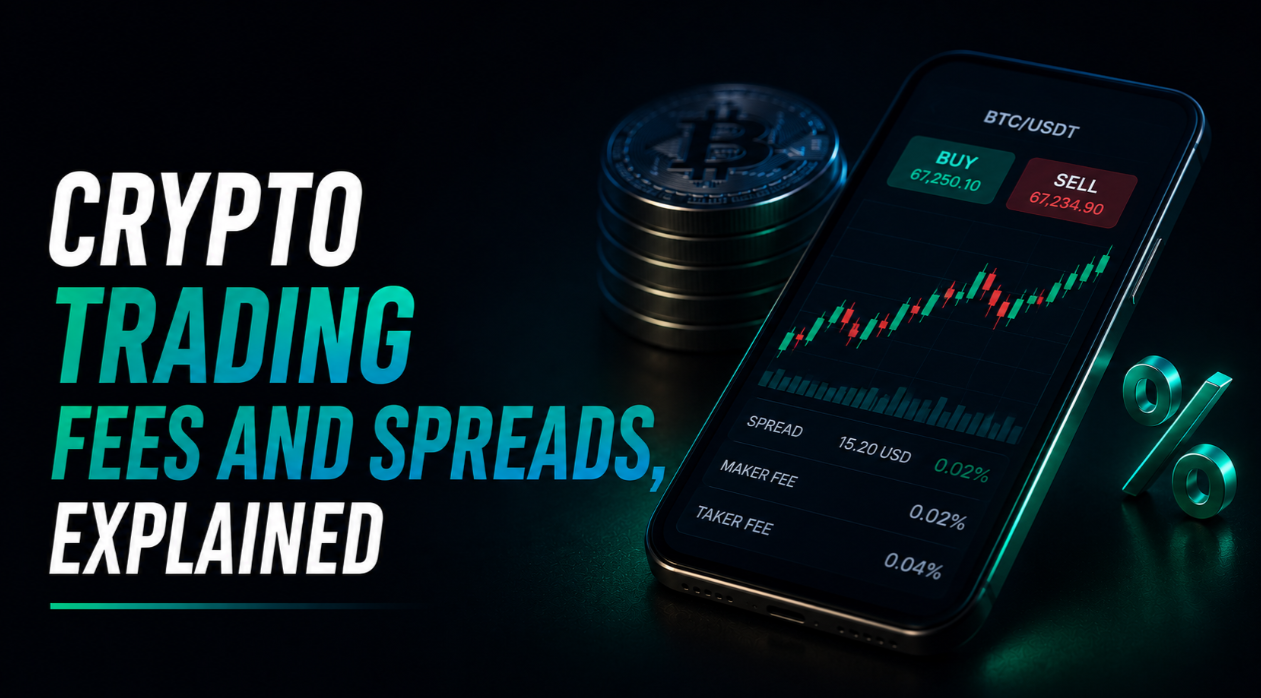
The trading fee is the percentage an exchange charges to execute an order. Many centralized platforms use a maker-taker model. A maker places an order that sits on the book and adds liquidity, such as a limit order that does not fill immediately. A taker places an order that fills instantly against existing orders, removing liquidity, such as a market order. Takers usually pay a higher rate because they consume what makers provide. Some platforms also lower your fee as your trading volume rises, or when you hold or use the platform's own token.
Maker vs taker in practice
- Market order: fills now at the best available price, and you pay the taker fee.
- Limit order: waits for your price and, if it rests on the book, earns the lower maker fee.
- Volume tiers: higher monthly volume can move you into cheaper fee bands.
The spread: the cost you do not see on the fee page
The spread is the gap between the highest price buyers will pay and the lowest price sellers will accept. When you buy at the ask and could only sell immediately at the lower bid, that difference is a real cost, even though no line item calls it a fee. On deep, liquid markets for major coins, the spread is tiny. On thin markets, small-cap tokens, or during sharp price moves, it can widen dramatically and dwarf the stated trading fee.
Beginner-friendly "instant buy" and simple-mode interfaces often bundle their profit into a wide spread rather than a visible percentage, which is why a purchase can feel free yet cost more than a normal order. Whenever possible, check the actual bid and ask before trading, and prefer liquid pairs where the spread is small.
Deposit, withdrawal and network costs
Getting money in and out has its own price. Card deposits often cost more than bank transfers. Withdrawing crypto to your own wallet incurs a network fee, and some platforms add a markup on top. Buying with a currency the platform does not natively support can trigger a conversion charge. If you trade on-chain through a decentralized exchange, you also pay gas, the network's fee for processing your transaction, which rises when the blockchain is busy. Our comparison of CEX vs DEX covers how these on-chain costs differ from a centralized platform's fee schedule.
- Deposit fees: vary by method; bank transfers are usually cheaper than cards.
- Withdrawal fees: a network fee, sometimes with an added platform markup.
- Conversion margins: extra cost when your currency is converted.
- Gas: on-chain trades pay network fees that fluctuate with congestion.
Adding it all up
To compare platforms fairly, estimate the total cost of a realistic round trip: buying and later selling. Combine the trading fee on both sides, the spread you cross, and any deposit or withdrawal charges. A platform with a low advertised fee but a wide spread can easily cost more than one with a slightly higher fee and tight, liquid markets. This total view is one of the criteria in our guide to how to choose a crypto exchange, because fees only make sense alongside security and reliability. You can find more foundational guides to round out your understanding.
How to keep costs down
You cannot avoid fees entirely, but you can shrink them. Use limit orders to capture maker rates and control your price. Trade liquid pairs where spreads are tight. Consolidate activity into fewer, larger trades instead of many small ones, since each trade pays fees again. Fund your account with cheaper deposit methods, and batch withdrawals rather than moving small amounts repeatedly. On-chain, transact when the network is less congested to pay lower gas.
It also helps to think in terms of round trips rather than single trades. Every time you buy and later sell, you pay the trading fee and cross the spread twice, so a strategy that involves constant switching between assets can quietly erode returns even when each individual move looks cheap. A calmer approach, with fewer deliberate trades, often keeps more of your money working for you. If you do trade actively, factor the cumulative fee drag into whether a given move is actually worth making.
Risks and what to watch
The main risk with fees is that they are easy to overlook until they have quietly eaten into returns. Watch for interfaces that hide their cost in the spread, promotions that waive one fee while raising another, and "zero-fee" claims that recover the cost elsewhere. Be cautious of platforms that make deposits cheap but withdrawals expensive or slow, which can trap funds. Read the full fee schedule before you commit, test with a small amount, and remember that frequent trading turns even modest per-trade costs into a significant drag over time. Keep in mind, too, that promotional fee discounts and rebates often depend on holding a platform's own token or hitting volume targets, so the rate you were shown at sign-up may not be the rate you actually pay day to day. The lowest fee is never worth trading on a platform you cannot trust to hold and return your money.