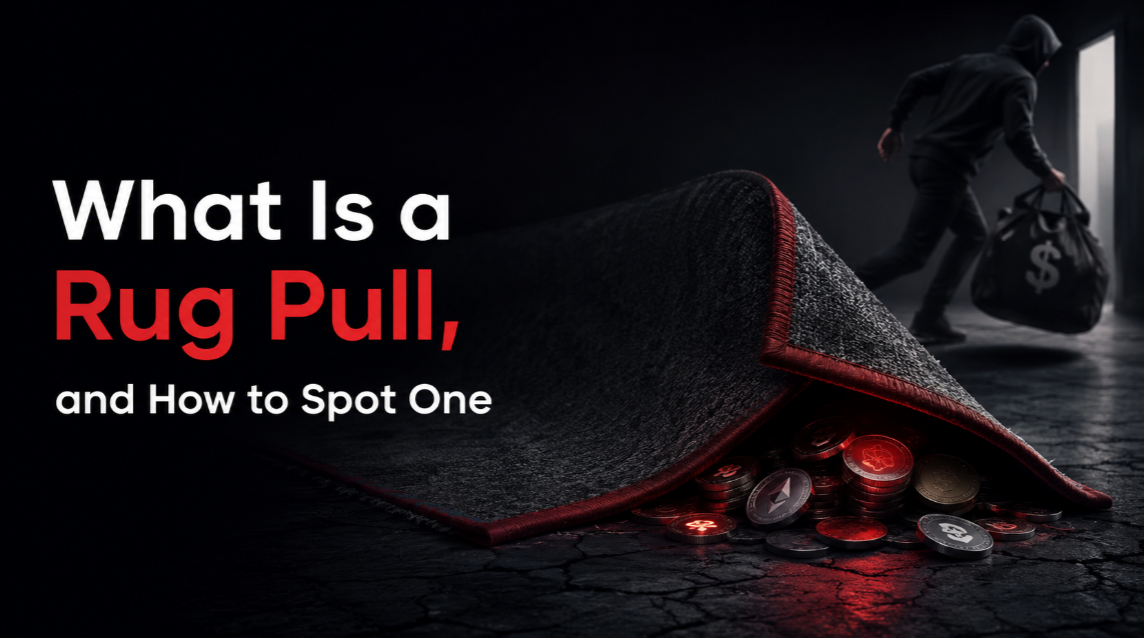
A rug pull is a type of crypto scam in which the people behind a token or project suddenly withdraw the money backing it, sell off their holdings, or disable your ability to sell, leaving investors with assets that are worthless or impossible to exit. The name captures the experience perfectly: the ground is pulled out from under you. Rug pulls thrive where anyone can launch a token in minutes and where hype travels faster than due diligence, which is why knowing the mechanics matters more than chasing the next moonshot.
Key takeaways
- A rug pull is an exit scam where founders drain liquidity, dump tokens, or block selling after attracting buyers.
- They come in "hard" forms (outright theft coded into the project) and "soft" forms (coordinated dumping and abandonment).
- Red flags include anonymous teams, unlocked liquidity, concentrated token ownership, and code that lets insiders mint or freeze tokens.
- You can screen most projects yourself using block explorers, liquidity-lock checks, and holder distribution before ever buying.
How a rug pull actually works
Most rug pulls follow a familiar arc. A team launches a token, pairs it with a real asset in a liquidity pool so it can be traded, and generates excitement through social media, influencers, and promises of outsized returns. As buyers pile in, the token's price climbs and the pool fills with genuine value. Then the insiders act: they remove the liquidity, sell their large allocation into the demand, or flip a hidden setting that stops everyone else from selling. The value that flowed in flows straight out to them, and the token collapses.
Because these projects often live entirely on decentralised infrastructure with no company, no registration, and frequently no real identities behind them, there is rarely anyone to hold accountable afterwards. The defence has to happen before you buy.
Hard rug pulls vs soft rug pulls
Hard rug pulls
These are premeditated theft, often written directly into the token's code. A liquidity pool with no time lock lets developers pull the paired funds at will. "Honeypot" contracts allow buying but silently prevent selling for everyone except insiders. Hidden mint functions let the team create unlimited new tokens and crash the price. Because the trap is baked into the contract, a hard rug pull can trigger the moment enough money is in the pool.
Soft rug pulls
These are slower and murkier. The team does not necessarily break any code; they simply dump their tokens en masse, stop developing the project, delete social channels, and disappear. There may be no single illegal action, only a coordinated abandonment that leaves holders with a dead asset. Soft rugs blur the line between fraud and a project that merely failed, which is what makes them hard to prosecute.
Warning signs of a rug pull
- Anonymous or unverifiable team. No real names, no track record, and no accountability. Anonymity alone is not proof, but it removes a major deterrent to theft.
- Unlocked or short-locked liquidity. If developers can remove the pooled funds at any time, they can rug at any time.
- Concentrated ownership. A handful of wallets holding most of the supply can crash the market by selling.
- Dangerous contract permissions. Functions that let insiders mint new tokens, pause trading, or blacklist sellers are red flags.
- Guaranteed returns and relentless hype. Countdown timers, "1000x" promises, and pressure to buy immediately exist to stop you from checking.
- No audit, or a vague, unverifiable one. Missing or fake security reviews leave the code's real behaviour unknown.
- Copy-paste project. Cloned websites, plagiarised whitepapers, and recycled branding suggest a disposable operation.
How to check a token before you buy
You do not need to be a developer to run a basic safety screen. A methodical fifteen minutes filters out the majority of obvious traps.
- Inspect holder distribution. Use a block explorer to see how supply is spread. If a few non-exchange wallets hold a huge share, exiting could be catastrophic when they sell.
- Verify liquidity is locked. Confirm the liquidity pool is time-locked or burned, and for how long. Unlocked liquidity is the single most common hard-rug vector.
- Read the contract permissions. Check whether the code allows minting, pausing transfers, or blacklisting addresses. Verified, renounced contracts reduce insider control.
- Test tradability. Confirm the token can actually be sold, not just bought, to rule out a honeypot.
- Research the team and community. Look for genuine, consistent history rather than accounts and hype that appeared overnight.
- Scale your risk. Treat any new, unaudited token as money you can afford to lose entirely, and size positions accordingly.
For the wider picture of on-chain fraud and defensive habits, see our guide to avoiding crypto scams, and the broader collection of guides in our learning hub. Many rug pulls are also promoted through fake platforms, so it is worth knowing how to spot a fake crypto exchange as well.
What to do if you get caught in a rug pull
If a token you hold is rugged, resist the urge to average down or chase a "recovery" pump; the value is usually gone for good. Revoke any spending approvals you granted the project's contracts so it cannot touch other assets in your wallet. Document the transaction hashes and addresses, and report the scam to relevant authorities and platforms, even though on-chain recovery is rare. Then be alert for the classic follow-up: scammers who target victims with promises of recovering lost funds for an upfront payment. Treat those offers as a fresh scam.
It also helps to understand the psychology that makes rug pulls work. They almost always ride a wave of social proof: a fast-growing community, endorsements from anonymous influencers, and a fear of missing out on a token that seems to be climbing by the hour. That momentum is engineered to make careful analysis feel like hesitation, and hesitation feel like lost profit. In reality, the projects worth holding will still be there after you have finished your checks, while the ones that punish you for pausing are the ones most likely to punish you for buying.
Rug pulls are one of the most preventable losses in crypto because the warning signs are visible on-chain before you commit a cent. Slowing down, checking liquidity and ownership, and reading contract permissions turns an opaque gamble into an informed decision. No single indicator is proof on its own, but a stack of red flags, an anonymous team, unlocked liquidity, concentrated supply, and dangerous permissions together, is a clear signal to stay away.