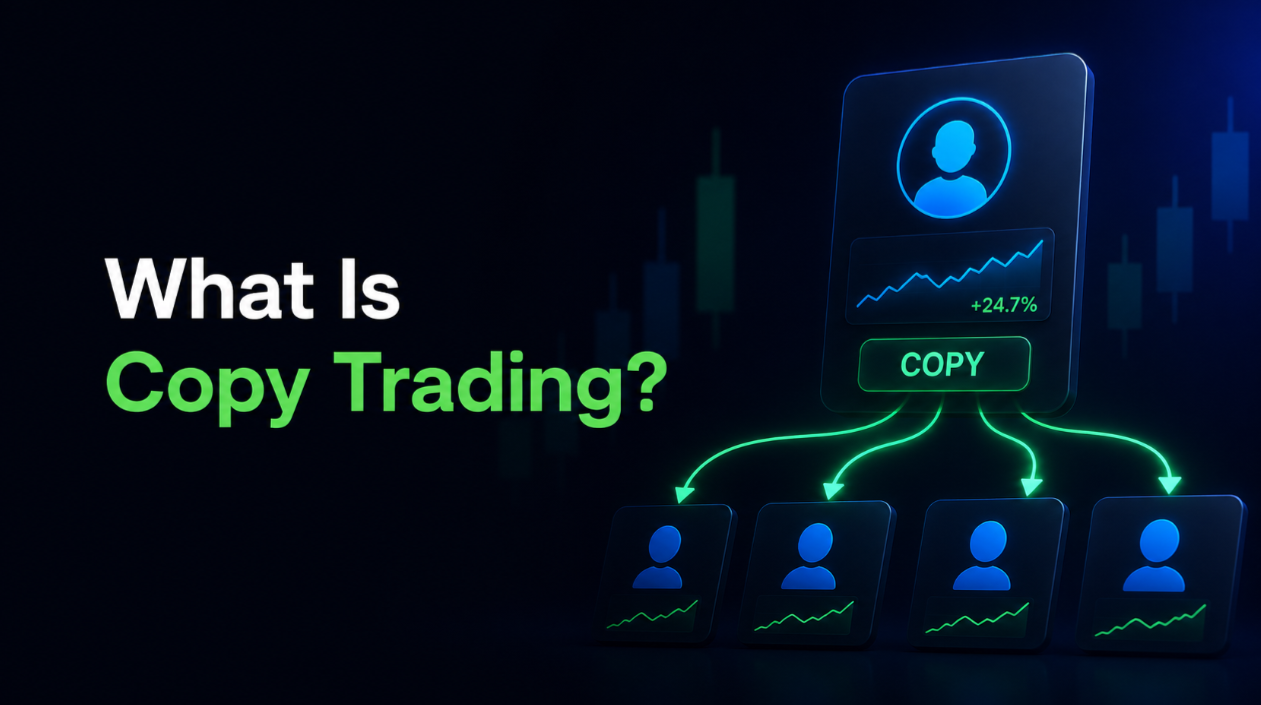
Copy trading is a feature that automatically mirrors the trades of another person in your own account, so when they open or close a position, your account does the same in proportion to what you allocated. It turns someone else's live decisions into your executed trades, which appeals to people who want exposure to a strategy without making every call themselves. Unlike a bot that follows fixed rules, copy trading follows a human, with all the judgment and all the fallibility that implies. It can be a way to learn by watching, but it is not a shortcut to guaranteed returns, and it carries risks that are easy to overlook.
Key takeaways
- Copy trading mirrors another trader's live positions in your account, scaled to your allocation.
- It follows a human's decisions, unlike a bot that follows preset rules.
- Past performance shown on leaderboards does not predict future results.
- You are exposed to the copied trader's mistakes, style drift, and use of leverage.
- Fees, from performance cuts to spreads, quietly reduce whatever the strategy earns.
How copy trading works
A copy-trading platform connects your account to a trader you select, often called a lead or a strategy provider. You decide how much capital to allocate, and from then on the platform replicates that trader's actions: if they put a tenth of their portfolio into a position, your account does the same with a tenth of your allocated funds. When they close, you close. The scaling keeps the mirror proportional even though your balance differs from theirs.
Most platforms let you set guardrails — a maximum you are willing to lose before copying stops, or limits on position size — and you can usually stop copying at any time. Choosing whom to follow is the core decision, and platforms surface leaderboards ranking traders by past returns, risk scores, and follower counts to help. Those rankings are a starting point, not a verdict.
It is worth being clear about what copy trading is not. It is not the same as a managed fund, where a regulated professional invests on your behalf under a legal duty of care. In most copy-trading setups the person you follow is simply another retail trader who has opted to make their activity public, often incentivized by a share of the fees their followers generate. That incentive can quietly encourage bolder, more attention-grabbing trades than they would take with only their own money on the line, which is a dynamic you should keep in mind when a leaderboard dazzles you.
Why people use it
The appeal is understandable. Trading well takes time and study, and copy trading offers a way to participate while you are still learning. For someone who knows they lack the time, temperament, or knowledge to trade actively, leaning on another person's discipline can feel more honest than pretending to have a strategy of their own.
- Lower time commitment: you are not glued to charts making every decision.
- Learning by observation: watching an experienced trader's entries and exits can teach you how they think.
- Diversification of approach: some people copy several traders with different styles.
- Accessibility: it lowers the barrier for beginners who lack a strategy of their own.
Used deliberately, with small amounts and an eye on how the copied trader actually behaves, it can be an educational bridge toward trading your own plan.
The learning benefit is real only if you engage with it. Passively watching your balance move teaches nothing; asking why the trader entered here, sized the position this way, or cut the loss there is what turns copying into education. Some platforms show the reasoning behind trades, and following that commentary is far more valuable than following the returns.
How the fees work
Copy trading is rarely free, and the fee structure shapes your net outcome. Some platforms take a performance fee — a percentage of the profits your copied trades generate — which aligns the lead's incentive with yours but eats into gains. Others charge subscription fees, wider spreads, or a share of the standard trading costs. These charges compound over many trades, so a strategy that looks profitable gross can be mediocre net. Always read exactly what you are paying and to whom before you allocate.
Risks you must understand
Copy trading concentrates risk in a single point: the person you copy. Their strengths become yours, but so do their weaknesses, and you have no control over their decisions in real time.
- Past performance is not predictive: a trader can top a leaderboard for months on a risky style that eventually blows up. High recent returns often come with high hidden risk.
- Leverage amplification: if the copied trader uses leverage, your mirrored positions do too, magnifying losses and the chance of liquidation.
- Style drift and tilt: a disciplined trader can start gambling after a loss, and you inherit that behavior instantly.
- Platform and custody risk: your funds sit on the platform enabling the copying, so its security and solvency matter.
- No understanding transfer: copying trades does not teach you why they were made, leaving you unable to judge when to stop.
- Survivorship on leaderboards: rankings highlight recent winners while the many who blew up quietly disappear, making the visible field look more skilled than it is.
Using copy trading wisely
If you try copy trading, treat it as a supervised experiment rather than a set-and-forget income stream. Start with an amount you can afford to lose, favor traders with long, consistent records over short, spectacular ones, and pay close attention to how much risk and leverage they take rather than headline returns alone. Set your loss limits before you begin, and keep learning the fundamentals so you can eventually judge the trades you are copying. Compare independent reviews of Trading tools before trusting any platform with your funds, and read our broader guides to build the knowledge that makes you a smarter follower. This is not financial advice, and copying a trader never removes your own responsibility for the outcome.