APY, or annual percentage yield, is the total return you would earn on a crypto position over one year once the effect of compounding is included. It answers a simple question, how much does this actually grow in a year, by accounting not just for the base reward rate but also for the fact that rewards can themselves earn rewards. That makes APY a more complete measure of return than a raw interest rate, and understanding how it is built helps you compare opportunities honestly.
Key takeaways
- APY includes compounding; APR does not. For the same base rate, more frequent compounding produces a higher APY.
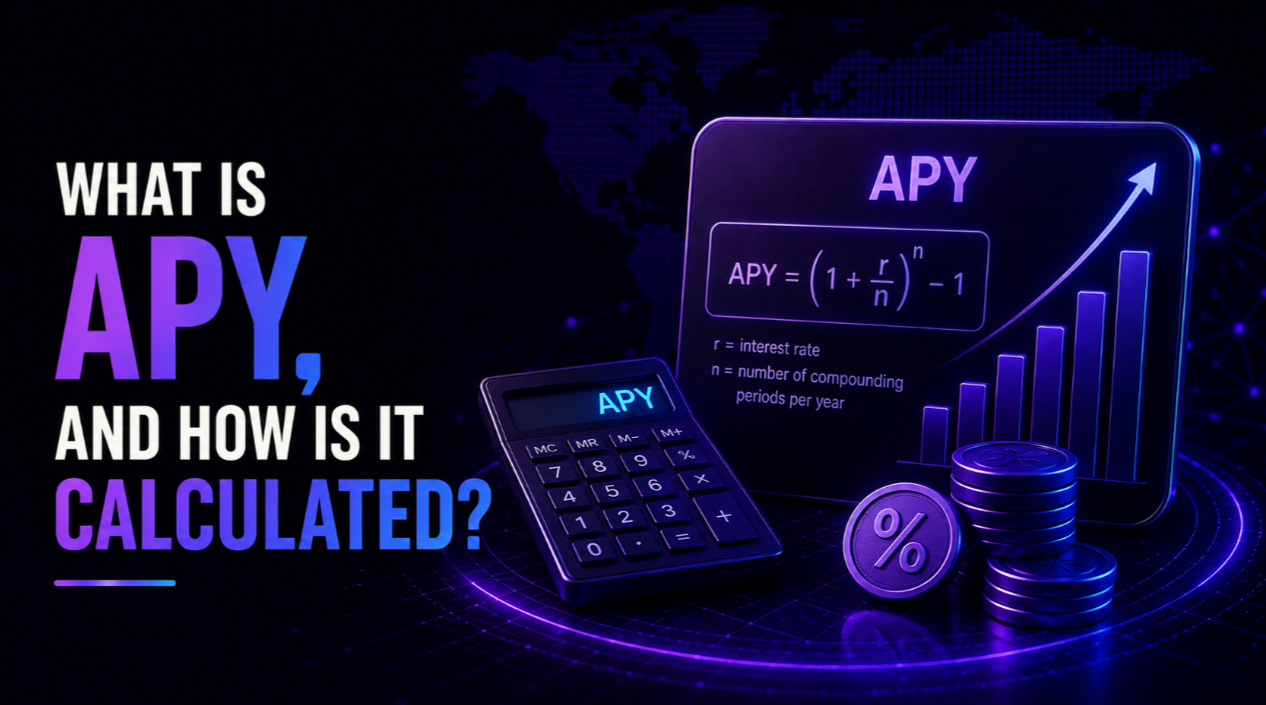
- The formula is APY = (1 + r / n)^n - 1, where r is the nominal annual rate and n is the number of compounding periods.
- Quoted APYs are estimates, not guarantees, and often assume ideal, uninterrupted compounding.
- Real returns are lower after fees, token price changes, and any periods when rewards are not reinvested.
APY vs APR
The two terms are often used loosely, but they mean different things. APR (annual percentage rate) is the simple, non-compounded yearly rate, what you earn if rewards are never reinvested. APY takes the same underlying rate and assumes rewards are periodically added back to your position, so future rewards are calculated on a growing balance.
Because of this, APY is always equal to or greater than APR for the same base rate. The gap between them widens as compounding becomes more frequent. A platform that quotes APR is describing a floor; one that quotes APY is describing the compounded outcome under its own assumptions. Comparing an APR from one source with an APY from another is a common mistake that makes offers look more different than they are.
The math behind APY
The standard formula is:
APY = (1 + r / n)^n - 1
Here r is the nominal annual rate expressed as a decimal, and n is the number of times rewards compound in a year. The intuition is that each period you earn a slice of the rate, that slice is added to your balance, and the next period's rewards are calculated on the larger balance. Repeated across all periods, this snowball effect lifts the effective yearly return above the simple rate.
Why compounding frequency matters
The more often rewards are reinvested, the higher the resulting APY for a given nominal rate. Compounding once a year produces the smallest gap between APR and APY; compounding monthly, daily, or continuously produces successively larger gaps. As compounding frequency approaches infinity, the result converges toward continuous compounding, which sets a mathematical ceiling on how much frequency alone can add. In practice, the difference between daily and continuous compounding is small, so extremely frequent compounding offers diminishing benefit.
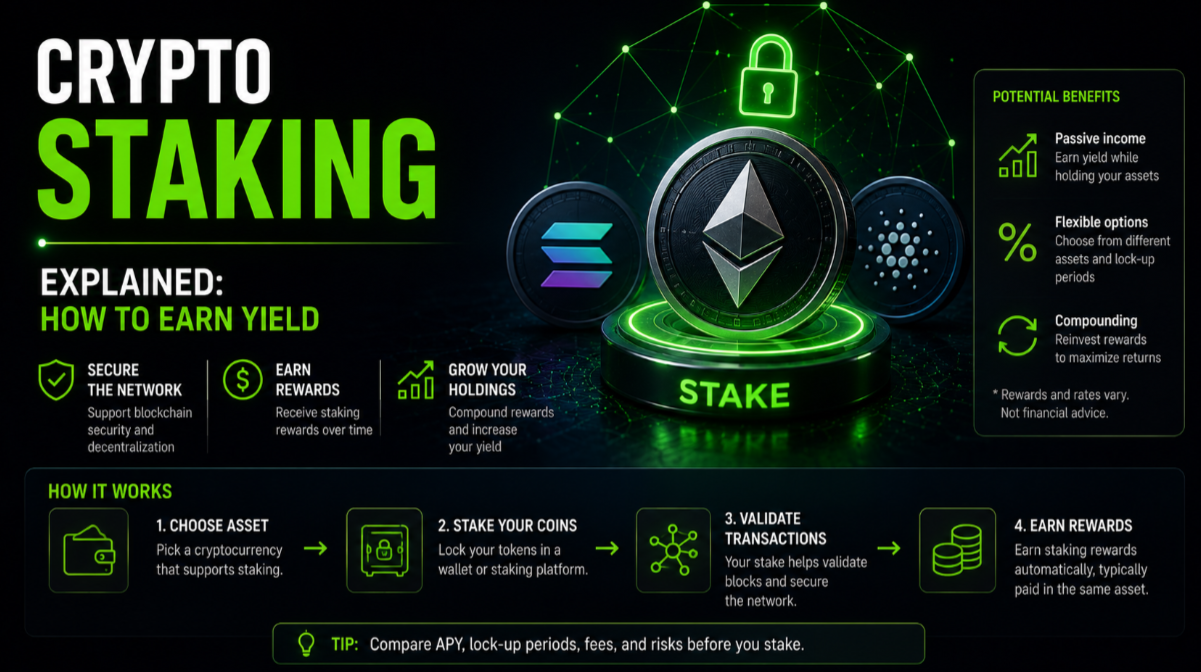
This is why the timing of reward claims matters in crypto. In staking, whether rewards auto-compound or must be manually claimed and re-bonded changes the real APY you receive. Our guide to crypto staking covers how different setups handle reward reinvestment.
A worked intuition
Imagine a position with a nominal annual rate that pays out in equal slices. If you never touch the rewards, you end the year with the simple APR. If instead each slice is added back so the next slice is calculated on a slightly larger balance, the final total edges above the APR, and that edge is the compounding premium APY captures. Manual claiming introduces friction: every time you must pay a network fee to claim and re-bond, part of the reward is lost, and any delay between earning and reinvesting means the balance compounds less often than the quoted figure assumes. On a large position these frictions are minor; on a small one they can turn an attractive advertised APY into a barely positive real return. This is why the same nominal rate can produce meaningfully different outcomes for two people, depending purely on how, and how often, they reinvest.
Why quoted APY can mislead
A headline APY is a projection, not a promise, and several factors mean the number you see is rarely the number you keep.
- It assumes perfect compounding: many quoted figures assume rewards are reinvested continuously and instantly, which real-world claiming and fees do not allow.
- It ignores costs: validator commissions, platform fees, and network transaction costs all reduce the net figure, especially on small positions.
- It is denominated in a volatile token: a high APY paid in a token whose price falls can still leave you with less value than you started with.
- Rates change: staking and DeFi yields shift with participation and market conditions, so a rate shown today may not persist.
- Incentive inflation: unusually high APYs are often propped up by temporary token incentives that dilute holders and fade over time.
Reading APY without getting burned
Treating APY as a fixed, guaranteed return is the core mistake behind many disappointing outcomes. A responsible reading separates the mechanics from the marketing. Confirm whether a figure is APR or APY. Check the compounding assumption. Subtract fees and commissions to estimate net yield. Ask what the reward token is and whether its value is stable. And remember that an eye-catching APY almost always reflects elevated risk, whether from smart-contract exposure, depeg risk in receipt tokens, slashing in staking, or the fragility of temporary incentives.
APY is a comparison tool, not a forecast of your bank balance. Used carefully, it lets you weigh opportunities on a consistent basis; used naively, it invites exactly the kind of yield-chasing that ignores downside. A disciplined approach is to normalize every offer before comparing: convert any APR to an equivalent APY (or vice versa) using the same compounding assumption, strip out temporary incentives, and estimate the figure net of realistic fees. Only then are two numbers truly comparable. It also helps to ask what would have to remain true for a quoted rate to hold, because a yield that depends on ever-rising participation, a stable token price, and uninterrupted compounding is far more fragile than one built mostly on durable, organic activity. To see how compounding fits into different earning strategies, compare our guides on liquid staking and the broader library of guides.