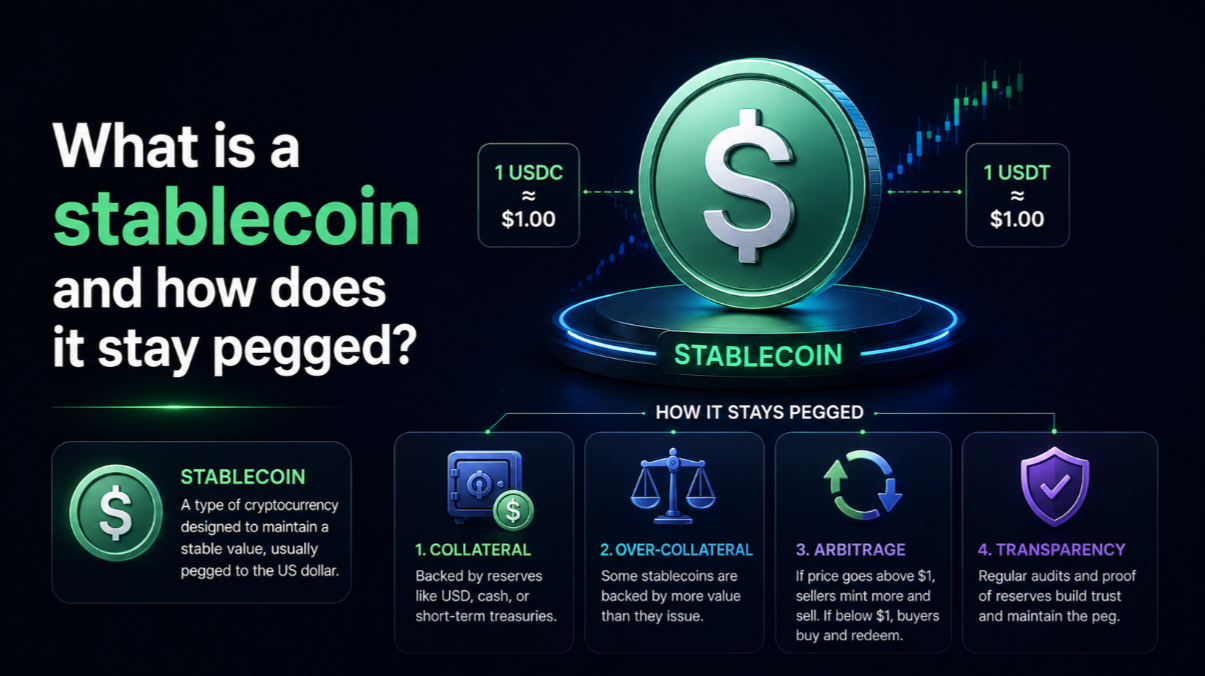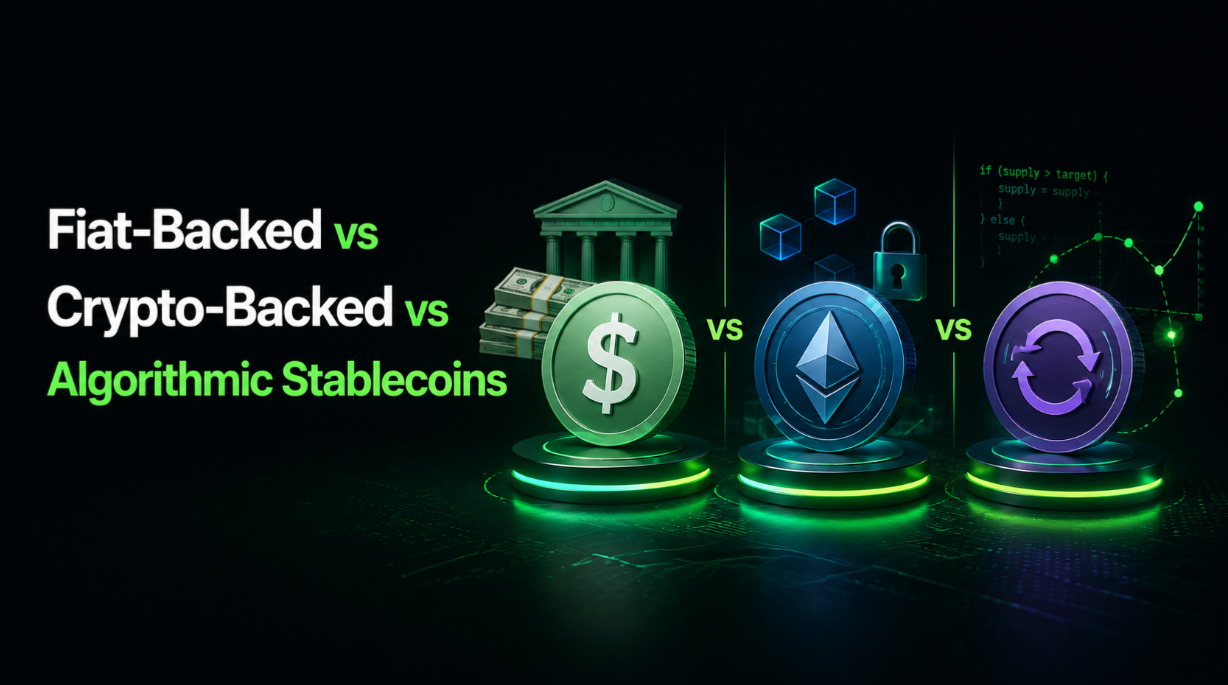
The main types of stablecoins are fiat-backed, crypto-backed, and algorithmic, and the difference comes down to what stands behind each token and how its peg is defended. Choosing between them is really a choice about trade-offs: how much you trust a central issuer, how much transparency you get, and how the design behaves when markets turn volatile.
Each model tries to solve the same problem, holding a steady value on a volatile blockchain, but they take very different routes. Understanding those routes is the single most useful thing you can do before holding, trading, or building with any stablecoin.
Key takeaways
- Fiat-backed stablecoins hold cash and equivalents in reserve, offering simplicity but relying on a central issuer.
- Crypto-backed stablecoins are over-collateralised with other crypto assets, trading capital efficiency for decentralisation.
- Algorithmic stablecoins use supply rules or incentives rather than full backing, which is the most fragile approach.
- Every model shares the same core risks: depegging, transparency gaps, and points of centralisation.
Fiat-backed stablecoins
Fiat-backed stablecoins are the most common and the easiest to understand. For each token in circulation, the issuer claims to hold one unit of fiat currency (or an equivalent short-term instrument) in reserve. When you redeem a token, the issuer releases the matching cash and removes the token from supply. That direct, one-to-one redemption is what anchors the peg.
The strengths are simplicity, deep liquidity, and a peg that is easy to reason about. The weaknesses are centralisation and trust. You are relying on the issuer to actually hold the reserves, to manage them safely, and to honour redemptions, and the issuer can typically freeze balances. This makes reserve transparency and independent attestations essential.
Crypto-backed stablecoins
Crypto-backed stablecoins replace bank reserves with on-chain collateral. Because that collateral is itself volatile, these systems require over-collateralisation: you might lock up a larger value of crypto than the stablecoins you mint against it. If the collateral value falls toward the debt, the position can be liquidated automatically to keep the system solvent.
The appeal is decentralisation and transparency, since anyone can verify the collateral on-chain. The cost is capital inefficiency and exposure to sharp market moves that can trigger cascading liquidations. These designs lean heavily on the smart contracts and price oracles that power much of DeFi, and you can read more in our guides. Because the collateral and the debt both live on-chain, the health of the whole system can be monitored in real time, which is a genuine advantage over models where you must simply trust a periodic report. The flip side is that a fast, disorderly market can overwhelm even a well-designed liquidation engine, so the size and quality of the collateral buffer is what really determines resilience.
Algorithmic stablecoins
Algorithmic stablecoins try to hold a peg with little or no full backing, using rules that expand or contract supply, or that rely on a paired volatile token, to steer the price. In theory, the market arbitrages the token back to target. In practice, this is the most fragile category, because the mechanism depends on continuous confidence and demand.
When that confidence breaks, the corrective incentives can spiral in the wrong direction, and a token can lose its peg quickly and permanently. History has shown that under-collateralised algorithmic designs are especially vulnerable to a loss of faith, so they demand a far higher level of scrutiny than backed models.
Comparing the models
- Backing: fiat reserves vs. over-collateralised crypto vs. algorithmic incentives.
- Trust model: centralised issuer vs. on-chain and verifiable vs. mechanism-dependent.
- Transparency: depends on attestations vs. auditable on-chain vs. often hardest to assess.
- Stress behaviour: depends on redemptions vs. liquidations vs. reflexive demand.
A useful way to think about it: fiat-backed models move trust to an issuer, crypto-backed models move it to code and collateral, and algorithmic models move it to market behaviour. If you want the broader context first, start with our overview of what stablecoins are.
Risks across every type
No matter the model, three risks recur and deserve attention before you hold any stablecoin:
- Depeg risk: any design can trade away from its target under stress. Our guide to depeg risk explains how and why.
- Centralisation: even "decentralised" models can have governance keys, admin controls, or oracle dependencies.
- Reserve and collateral transparency: you need to verify what actually backs the token, whether that is bank reserves or on-chain collateral.
Because these risks vary so much between issuers, it pays to compare disclosures rather than assume. You can review independent assessments on our stablecoin ratings page.
Hybrid and evolving designs
In practice, the three categories are not always clean boxes. Many real-world stablecoins blend approaches. A token might be primarily fiat-backed but hold a portion of its reserves in other assets, or a crypto-backed system might accept tokenised real-world assets as part of its collateral. Some designs layer an algorithmic component on top of genuine backing to improve capital efficiency while keeping a solvency buffer. These hybrids can offer sensible middle grounds, but they also make the risk harder to read, because you now have to understand every component rather than a single simple model.
The practical lesson is to classify a stablecoin by how it actually behaves under stress, not by the label it markets itself with. Ask what the collateral really is, whether it is liquid, and what happens to the peg if the riskiest part of the backing falls in value. A design that looks robust in calm markets can reveal a very different character during a sharp downturn, which is exactly when stability matters most.
Which type should you use?
The right choice depends on your priorities. If you want maximum liquidity and simplicity, fiat-backed tokens dominate. If decentralisation and on-chain verifiability matter most, a well-run crypto-backed model may fit. Algorithmic designs, especially those without robust backing, warrant the most caution. Whichever you pick, judge it on backing quality, transparency, and how it has behaved when markets are stressed. There is no prize for using an exotic design, and for most people the more transparent and liquid a stablecoin is, the better it does its one essential job: holding value you can rely on.