Operational incidents and maintenance are logged on Blockdaemon's public status page
Ongoingoutcome unclear- Outcome
- Routine disclosures; no loss event identified

Blockdaemon is a US blockchain infrastructure company that runs validators and nodes and sells APIs, staking services and multi-party computation (MPC) wallet tools to institutions such as banks, custodians, exchanges and fintech firms 1. It was founded in San Francisco in 2017 by Konstantin Richter, who remains chief executive 1. Blockdaemon does not run a consumer staking app and has no token of its own. Clients stake through its validators, build on its node and data APIs, or use its key-management software to hold digital assets.
Blockdaemon Inc. was established in October 2017 in San Francisco, with Richter as founder 1. It opened an office in Galway, Ireland, in 2018, followed by London and Singapore in 2023 and New York and Newcastle in 2024, and registered in Abu Dhabi Global Market in May 2024 1.
The company grew partly by acquisition. It bought Lunie (staking interface, February 2021), Anyblock Analytics (blockchain data, November 2021), Gem (March 2022), Sepior (MPC cryptography, July 2022) and expand.network (May 2025) 1. Sepior's technology underpins the MPC key management that Blockdaemon now sells.
Blockdaemon's products fall into four groups 1:
Companies use these to add staking to an exchange or custody product, to run infrastructure for a blockchain they support, or to build wallets.
Institutional clients go through know-your-business (KYB) checks, then set up a staking configuration that covers the network, whether MEV (maximal extractable value) rewards are enabled, the region where validators run and the address that receives fees 3.
From there, staking runs through Blockdaemon's app or its Staking API. For Ethereum, the API reserves validators and returns an unsigned deposit transaction, which the client signs with its own keys or custodian 3. For Solana, the response includes the staking and withdrawal authorities on the stake account 3. In this model the client, not Blockdaemon, controls the funds and the withdrawal address, while Blockdaemon runs the validator software. The API supports Avalanche, BNB Chain, Cardano, Cosmos, Ethereum, NEAR, Polygon, Solana and TON 3.
Rewards, unbonding periods and exits follow each network's rules. Blockdaemon says it discloses unbonding periods and withdrawal timelines before a client commits 2. It offers reward reports, historical rates and exports formatted for accounting and tax 2.
Slashing is a protocol penalty that destroys part of a validator's stake for faults such as signing two conflicting blocks. Blockdaemon says it covers 100% of losses from slashing caused by its own fault 4. Losses from network malfunctions are excluded 4. In March 2022 the company announced a slashing insurance policy arranged through the broker Marsh, triggered by a system or security failure at Blockdaemon that leads to slashing or double-signing 5. Public pages do not state a coverage limit or name the insurer.
Coverage does not protect against falling token prices, smart-contract losses in DeFi vaults, or penalties outside Blockdaemon's control.
Blockdaemon is privately held. It raised a $28 million Series A in June 2021, a $155 million Series B in September 2021 and a $207 million Series C in January 2022 1. The Series C was led by Sapphire and Tiger Global at a $3.25 billion post-money valuation, with SoftBank Vision Fund 2, Boldstart Ventures, StepStone Group, Matrix Capital Management and Lerer Hippeau also participating 6.
There is no Blockdaemon stock on public exchanges as of 23 October 2026. Any offer of "pre-IPO" shares through unofficial channels deserves caution; private-company shares trade, if at all, through restricted secondary platforms open to accredited investors.
Blockdaemon reports ISO 27001 certification since July 2022 and a SOC 2 Type II report since June 2025 1. These are audits of information-security management and controls. They do not guarantee against outages or losses.
The company publishes a public status page with an incident and maintenance history 7, which clients can use to check network-specific outages.
The company's own figures for its scale differ: its About page cites "$110B+" in assets secured and 400+ institutions 1, while its staking page cites "$6B+" 2. The figures are company claims that likely measure different things, and neither was independently verified.
Blockdaemon serves businesses: exchanges, custodians, banks, asset managers and protocol foundations 15. Individuals who want to stake usually do so through an exchange, a wallet or a liquid staking protocol such as Lido, some of which may use infrastructure providers like Blockdaemon behind the scenes. Other providers of institutional nodes and staking include Figment, Kiln and, for Solana RPC, Helius.
Hacks in DefiLlama’s public database are also scored as the security record on the Blockdaemon rating page.
See CoinPulse's rating and evidence for Blockdaemon. Related: staking platforms, crypto staking explained, liquid staking.
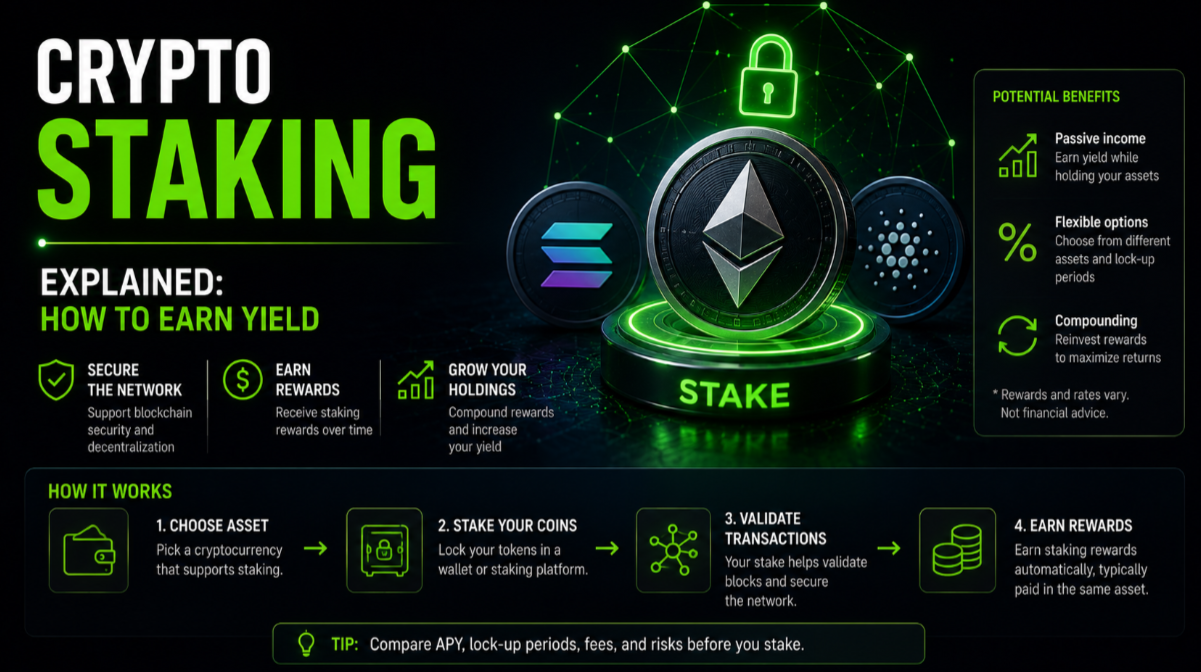 EarningCrypto staking explained: how to earn yieldA beginner-friendly guide to crypto staking: how it works, the rewards and risks, and practical steps to start earning yield safely.8 min read·
 Staking & YieldLiquid Staking, ExplainedLiquid staking lets you stake tokens and receive a tradable receipt (an LST) that stays usable across DeFi. Learn how it works and where the risks hide.7 min read·
 Staking & YieldWhat Is Restaking?Restaking reuses already-staked tokens to help secure additional services, layering extra rewards on base staking. Learn the mechanics and stacked risks.7 min read·
 RegulationBitcoin ETF Outflows Weigh on Market as Interactive Brokers Launches Ethereum StakingSpot Bitcoin ETFs recorded $65.4 million in net outflows as hawkish Federal Reserve comments pressured prices. Meanwhile, Interactive Brokers rolled out Ethereum staking for eligible US clients.4 min read·
 MarketsCFTC Opens Retail Crypto Leverage Rulemaking as Bitcoin Holds Near $84KThe CFTC has begun a rulemaking on leveraged retail crypto trading, while Bitcoin hovers near $84,000 and traders wait for U.S. inflation data and the Fed’s October meeting.4 min read·
 MarketsUS Moves $1B in Seized Bitcoin as Senate Scrutiny of Tether GrowsU.S.-linked wallets shifted 12,267 BTC from a Bitfinex hack seizure address without any exchange deposit, while Senator Richard Blumenthal pressed Cantor Fitzgerald over its Tether partnership.3 min read·