No hack, exploit or slashing event attributed to P2P.org was found in the sources reviewed (company states zero slashing in seven years)
—outcome unclear- Outcome
- —
- Loss
- —
- Recovered or reimbursed
- —
P2P.org is a staking infrastructure company that runs validators on more than 40 proof-of-stake blockchains. Institutions, wallets, exchanges and individuals can delegate or stake to those validators and earn network rewards 1. Its services are non-custodial. P2P.org operates the validator, but you keep the keys to your tokens or withdrawal address 2. In exchange, it takes a share of the rewards, for example 5% for native Ethereum staking and 7% on Solana as of October 2026 45. The website terms are with an entity called P2P Staking and are governed by Cayman Islands law 2.
P2P.org has operated validators publicly since at least 2020. In December 2020, under the name "P2P Validator," it applied to become a node operator for Lido. At the time it described a team of 20–50 people running validators on networks including Tezos, Cosmos, Polkadot and Solana 8.
Startup database RootData lists:
The company's own site states several figures. These are company claims, not audited figures 1:
The website Terms of Use name the counterparty only as "P2P Staking." Disputes go to the Grand Court of the Cayman Islands, or to arbitration seated there at P2P's option 2. The terms do not give a registered company number.
On most delegated proof-of-stake networks, such as Solana, Cosmos or Polkadot, the process looks like this 5:
On Ethereum, native staking works differently 34:
P2P.org quotes a "net reward rate" (NRR), meaning what remains after its fee, alongside the gross rate (GRR) 5. In October 2026 its Ethereum page showed 2.9% NRR for native staking 4. These figures move with network conditions and are not guaranteed. For background, see how crypto staking works.
Businesses can be asked for KYC, KYB or source-of-funds documents. The terms also require users to confirm they are not subject to US, UK, EU or UN sanctions 2.
P2P.org charges a percentage of staking rewards, not of your principal. Published rates as of October 23, 2026 45:
| Product | Fee for services |
|---|---|
| Ethereum native staking | 5% of rewards |
| Ethereum DVT staking (SSV) | 7% of rewards |
| Solana | 7% of rewards |
Illustration (assumptions stated):
P2P.org says holders of more than $500,000 may receive special rates 1. Other networks have their own commission, which is shown on each network page.
Hacks in DefiLlama’s public database are also scored as the security record on the P2P.org rating page.
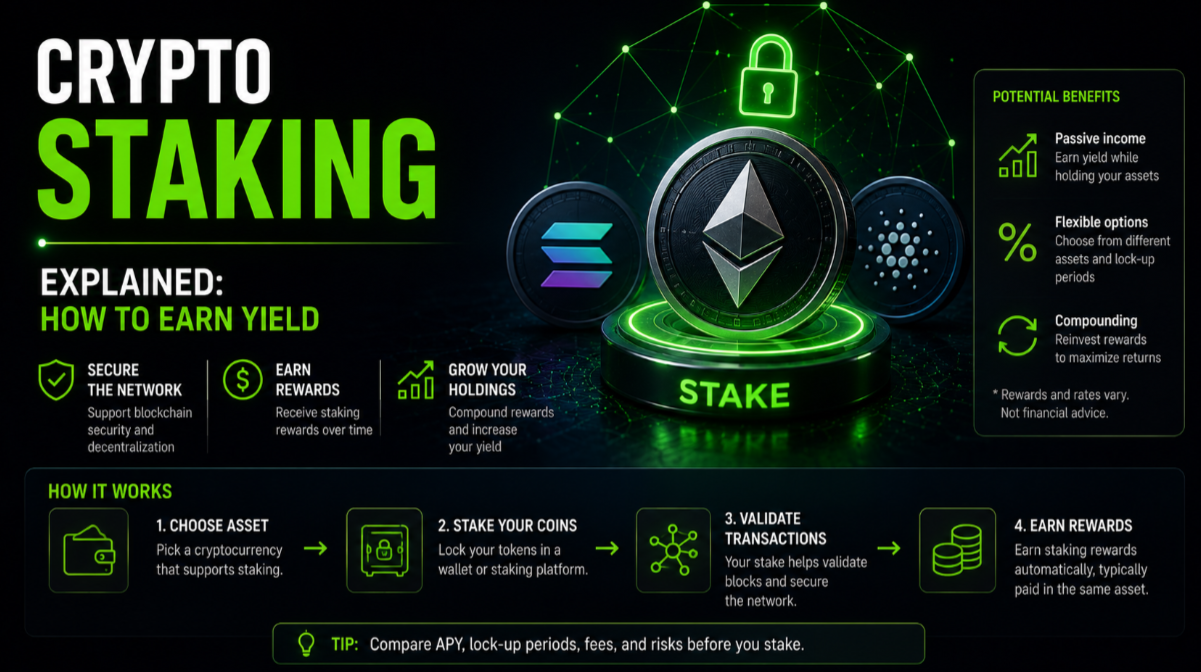 EarningCrypto staking explained: how to earn yieldA beginner-friendly guide to crypto staking: how it works, the rewards and risks, and practical steps to start earning yield safely.8 min read·
 Staking & YieldLiquid Staking, ExplainedLiquid staking lets you stake tokens and receive a tradable receipt (an LST) that stays usable across DeFi. Learn how it works and where the risks hide.7 min read·
 Staking & YieldWhat Is Restaking?Restaking reuses already-staked tokens to help secure additional services, layering extra rewards on base staking. Learn the mechanics and stacked risks.7 min read·
 RegulationBitcoin ETF Outflows Weigh on Market as Interactive Brokers Launches Ethereum StakingSpot Bitcoin ETFs recorded $65.4 million in net outflows as hawkish Federal Reserve comments pressured prices. Meanwhile, Interactive Brokers rolled out Ethereum staking for eligible US clients.4 min read·
 MarketsCFTC Opens Retail Crypto Leverage Rulemaking as Bitcoin Holds Near $84KThe CFTC has begun a rulemaking on leveraged retail crypto trading, while Bitcoin hovers near $84,000 and traders wait for U.S. inflation data and the Fed’s October meeting.4 min read·
 MarketsUS Moves $1B in Seized Bitcoin as Senate Scrutiny of Tether GrowsU.S.-linked wallets shifted 12,267 BTC from a Bitfinex hack seizure address without any exchange deposit, while Senator Richard Blumenthal pressed Cantor Fitzgerald over its Tether partnership.3 min read·