No hack or exploit of Puffer in DefiLlama's database
Jan 2024 – Oct 2026outcome unclear- Outcome
- No exploit on record in sources checked
- Loss
- —
- Recovered or reimbursed
- —

Puffer Finance is an Ethereum protocol that turns staked ETH into a tradable token called pufETH. You deposit ETH, stETH, wstETH or WETH and receive pufETH 3. The protocol stakes the ETH with Ethereum validators and also "restakes" it through EigenLayer, aiming to earn both staking and restaking rewards 15. pufETH rises in value against ETH instead of growing in quantity 5. The Puffer Foundation, a Cayman Islands foundation company, provides the app 11. Puffer went live on mainnet on January 31, 2024 10.
When you deposit, Puffer mints pufETH to your wallet at the current exchange rate. The rate is the same for ETH, WETH and stETH, and different for wstETH 3. Rewards from Ethereum validators and from restaking go into the pool backing pufETH. That raises the ETH value of each pufETH rather than adding tokens to your balance 56. Rewards also go to node operators, restaking operators, Puffer's Guardians and a protocol fee 6. The docs do not publish a fixed percentage for that fee.
Liquid restaking, in brief: staked ETH secures Ethereum, and restaking also commits it to secure other services ("AVSs") through EigenLayer in exchange for extra rewards. The trade-off is extra slashing risk, because misbehavior on those services can also cost ETH 5.
Puffer's documentation describes a permissionless validator set 2:
A small permissioned group called Guardians handles tasks Ethereum does not yet automate 7:
A majority, for example 7 of 8, must agree before major actions 7. Puffer describes Guardians as temporary, to be phased out as Ethereum upgrades land 7.
You exit by converting pufETH back to WETH. There are two modes 4:
| Mode | Cost | Time | Notes |
|---|---|---|---|
| 1-step ("instant") | 1% of the amount | One transaction | Paid from Puffer's liquidity vault; fee goes to the treasury, partly for PUFFER buybacks |
| 2-step ("standard") | No protocol fee | Up to ~14 days | Minimum 0.01 pufETH; may need validator exits and EigenLayer's withdrawal queue |
Illustration: exiting 10 pufETH instantly costs 0.1 pufETH-equivalent in fees plus gas. The standard route avoids that fee but locks your position for up to two weeks 4. You can also sell pufETH on a DEX. That price can differ from the protocol's rate, especially when liquidity is thin.
Puffer's contracts are upgradeable under these controls 8:
In practice, a small group of signers can change the code you deposit into. BlockSec audited the core pufETH contracts and reported no high- or medium-risk issues 13. DefiLlama's hacks database has no entry for Puffer 12. An audit is not a guarantee. pufETH also inherits risks from EigenLayer, from Lido's stETH for stETH deposits, and from validator performance.
DefiLlama's "Puffer Stake" data shows value locked peaked near $1.84 billion on June 6, 2024. It fell to about $97 million by January 1, 2026 and to about $27 million on October 23, 2026 12. Puffer's rollup, vault and preconfirmation products are tracked separately 12. A smaller pool can mean thinner pufETH markets and more reliance on the standard withdrawal queue.
PUFFER is the governance token for the restaking protocol and Puffer's UniFi ecosystem. It has a maximum supply of 1 billion, and 10.23% circulated at launch 9. Allocations:
Locking PUFFER gives vlPUFFER voting power over fees, Guardians, operators and supported AVSs 9. You do not need PUFFER to stake.
Hacks in DefiLlama’s public database are also scored as the security record on the Puffer rating page.
 Staking & YieldWhat Is Restaking?Restaking reuses already-staked tokens to help secure additional services, layering extra rewards on base staking. Learn the mechanics and stacked risks.7 min read·
 Staking & YieldLiquid Staking, ExplainedLiquid staking lets you stake tokens and receive a tradable receipt (an LST) that stays usable across DeFi. Learn how it works and where the risks hide.7 min read·
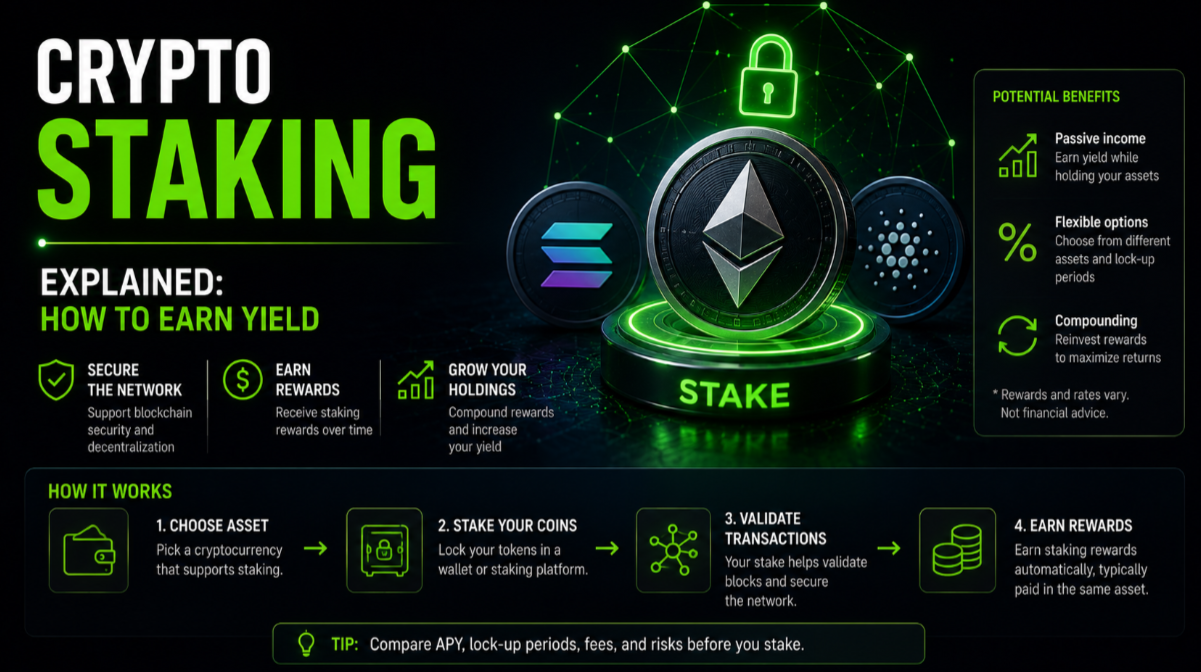 EarningCrypto staking explained: how to earn yieldA beginner-friendly guide to crypto staking: how it works, the rewards and risks, and practical steps to start earning yield safely.8 min read·
 RegulationBitcoin ETF Outflows Weigh on Market as Interactive Brokers Launches Ethereum StakingSpot Bitcoin ETFs recorded $65.4 million in net outflows as hawkish Federal Reserve comments pressured prices. Meanwhile, Interactive Brokers rolled out Ethereum staking for eligible US clients.4 min read·
 MarketsCFTC Opens Retail Crypto Leverage Rulemaking as Bitcoin Holds Near $84KThe CFTC has begun a rulemaking on leveraged retail crypto trading, while Bitcoin hovers near $84,000 and traders wait for U.S. inflation data and the Fed’s October meeting.4 min read·
 MarketsUS Moves $1B in Seized Bitcoin as Senate Scrutiny of Tether GrowsU.S.-linked wallets shifted 12,267 BTC from a Bitfinex hack seizure address without any exchange deposit, while Senator Richard Blumenthal pressed Cantor Fitzgerald over its Tether partnership.3 min read·
In our ratings: See CoinPulse's Puffer rating and evidence Related: Liquid restaking ratings · What is restaking · Liquid staking · Lido · Crypto staking explained