No publicly reported breach of GridPlus devices or systems was found in sources reviewed on October 23, 2026
—outcome unclear- Outcome
- No incident on record
- Loss
- —
- Recovered or reimbursed
- —
GridPlus is a US crypto security company that makes the Lattice1, a desktop hardware wallet with a 5-inch touchscreen, and SafeCards, removable PIN-protected cards that each hold a wallet or a backup 16. Your private keys stay inside the device's secure chips, and you approve each transaction on its own screen, which shows decoded transaction details 14. The Lattice1 differs from pocket-size wallets in one important way: it is an always-online, plugged-in device that receives signing requests over the internet, by default through GridPlus's servers 610. It costs $397 on the GridPlus store 2.
GridPlus describes itself as a blockchain security company working on hardware, software and tools 8. Public business listings date it to 2017 and place it at 100 Congress Avenue in Austin, Texas 9. The company says its products are designed and manufactured in the US, in a facility that meets ITAR (US defense export) rules 8. The website does not name the legal entity behind the brand 8.
The Lattice1 has two separate computers inside one case 4:
The two talk only through a small memory "mailbox," not a direct link 4. When an app such as MetaMask or Rabby asks for a signature, the request reaches the online side, passes through the mailbox, and appears on the screen. You approve it there, and the signature goes back to the app 4. Because the secure side draws the screen, what you see should match what you sign even if your computer is infected 4.
By default, requests from third-party apps travel through GridPlus's infrastructure. Advanced users can route them through their own endpoint instead 6. The device stays plugged in during use 10. That makes it suited to a desk setup rather than carrying around.
Other documented hardware protections 4:
A SafeCard is a PIN-protected smart card that holds its own wallet. Insert a different card and the Lattice1 shows a different wallet. That lets one device manage many wallets 16.
SafeCards also serve as backups. GridPlus suggests at least three card copies kept in separate places if cards are your only backup, a different PIN on each card, and never writing the PIN on the card 7. If the Lattice1 itself breaks, a generic USB card reader and the SafeCard command-line tool can read the card. For cards bought in 2023 or later this recovers the seed phrase; older cards give a "seed hash" 7.
Wallets use a standard BIP39 seed phrase, with an optional passphrase 7. You can also back the phrase up on paper or steel. The docs warn never to keep the 24 words on a computer or in cloud storage 7. See how to set up a hardware wallet.
According to GridPlus's documentation 5:
| Network | How you use it |
|---|---|
| Bitcoin | NuFi or Lattice Manager; legacy, wrapped SegWit (default) and native SegWit addresses |
| Ethereum and EVM chains (e.g. BNB Chain, Polygon, Avalanche, Arbitrum) | MetaMask, Rabby, Frame, MyCrypto; ERC-20 tokens and NFTs |
| Solana | NuFi; SPL tokens and NFTs |
GridPlus's rule of thumb: if an app connects to MetaMask or Rabby, it works with the Lattice1 5. Lattice Manager is GridPlus's own companion app for Bitcoin and EVM settings, and the company says it collects no user data 6. Developers can use the GridPlus SDK 5.
The Lattice1 lists at $397 on gridplus.io. The box includes the device, one SafeCard, a two-pack of extra SafeCards and a US power supply; buyers elsewhere need a plug adapter 2. A SafeCard Pack costs $40 3. The store advertises free worldwide shipping 2. Stock status differed between store pages on October 23, 2026, so check before ordering 23. Buy from gridplus.io or an authorized seller, and use the certificate check on arrival 6.
Hacks in DefiLlama’s public database are also scored as the security record on the GridPlus rating page.
 WalletsHardware Wallets, ExplainedA hardware wallet is a dedicated device that keeps your private keys offline and signs transactions internally, so your crypto stays under your control.7 min read·
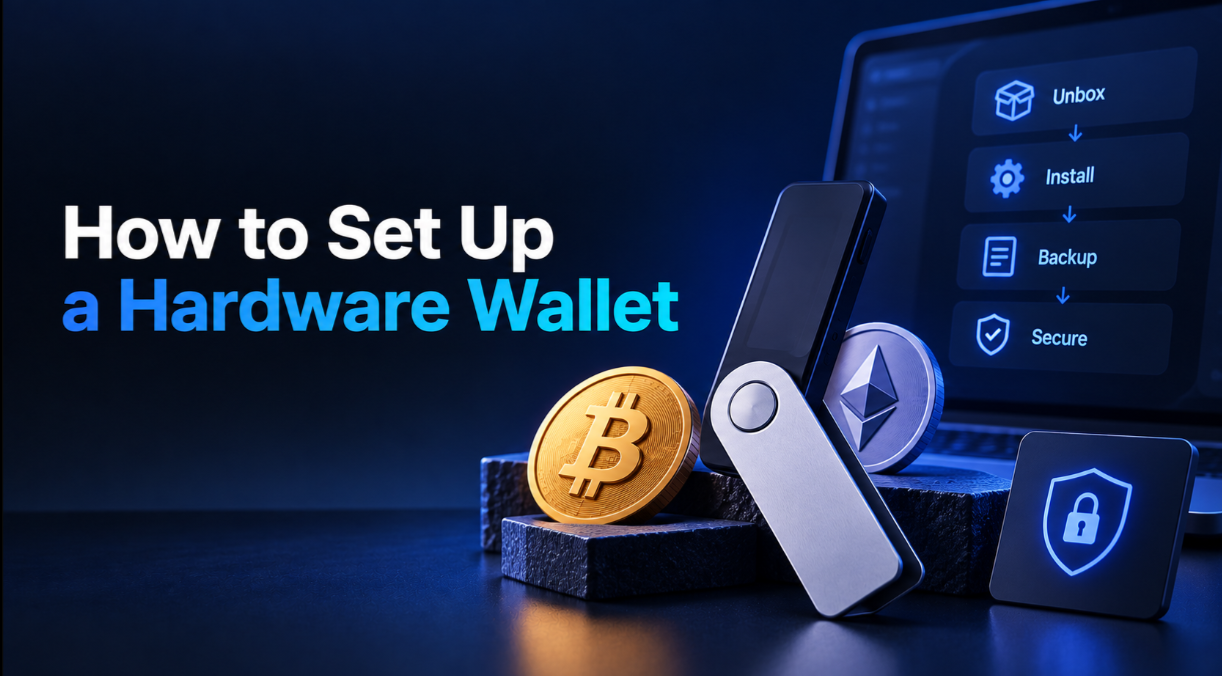 WalletsHow to Set Up a Hardware WalletTo set up a hardware wallet, verify the device is genuine, create a new PIN, write down the recovery phrase offline, and test a small transfer first.7 min read·SecurityHot wallet vs cold wallet: which should you use?A clear, beginner-friendly breakdown of hot wallets vs cold wallets, how each protects your crypto, and how to choose the right mix for your needs.8 min read·
 Crypto BasicsPublic and Private Keys, Explained SimplyPublic and private keys are the pair that proves you own your crypto. Learn what each does, how they relate to addresses, and why the private key is everything.7 min read·
 RegulationBitcoin ETF Outflows Weigh on Market as Interactive Brokers Launches Ethereum StakingSpot Bitcoin ETFs recorded $65.4 million in net outflows as hawkish Federal Reserve comments pressured prices. Meanwhile, Interactive Brokers rolled out Ethereum staking for eligible US clients.4 min read·
 MarketsCFTC Opens Retail Crypto Leverage Rulemaking as Bitcoin Holds Near $84KThe CFTC has begun a rulemaking on leveraged retail crypto trading, while Bitcoin hovers near $84,000 and traders wait for U.S. inflation data and the Fed’s October meeting.4 min read·
 MarketsUS Moves $1B in Seized Bitcoin as Senate Scrutiny of Tether GrowsU.S.-linked wallets shifted 12,267 BTC from a Bitfinex hack seizure address without any exchange deposit, while Senator Richard Blumenthal pressed Cantor Fitzgerald over its Tether partnership.3 min read·