No protocol exploit or slashing event found in the sources checked, as of Oct 23, 2026
—outcome unclearStakeWise has warned about phishing clones of its interface
- Outcome
- No incident on record in sources checked
- Loss
- —
- Recovered or reimbursed
- —

StakeWise is a liquid staking protocol for Ethereum and Gnosis Chain. You deposit any amount of ETH into a staking "Vault" run by a node operator of your choice, and you can mint osETH, a token that represents your staked ETH plus rewards and can be used in DeFi 129. Unlike pooled staking, each Vault is isolated, so a penalty in one Vault does not affect stakers in another 3. The protocol is governed by the StakeWise DAO through the SWISE token and developed by StakeWise Labs 1. It has been live since 2021, and the current Vault-based version, V3, launched in late 2023 1019.
StakeWise has four separate parts 1:
Operators run the validators. Named operators with StakeWise Vaults include Chorus One, Figment, P2P, Consensys Staking, NodeSet and Serenita. MetaMask also uses StakeWise Vaults for its staking product 317.
Vaults. A Vault is a staking pool contract. Your deposit buys Vault shares, which grow in value as rewards come in. Once a Vault has 32 ETH (or 1 GNO on Gnosis Chain), its operator registers a validator. Six of StakeWise's eleven oracles must approve each registration 5. Vaults come in several types 4:
Oracles. An independent committee of 11 oracles per chain reports Beacon Chain rewards and penalties to the contracts. It also approves validators and can force exits. On Ethereum the oracles include Chorus One, stakefish, Telekom, Finoa, Bitfly, P2P and StakeWise Labs. Oracles hold no funds, and any update needs 6 of 11 signatures 12.
Isolation. Because Vaults do not share risk, a slashing or performance problem in one Vault stays in that Vault 310. The trade-off is that your rewards depend on the operator you pick.
StakeWise gives you three options 29:
Use only app.stakewise.io. StakeWise warns that phishing sites have copied its interface 15.
osETH is a repricing token: your balance stays the same, and each osETH becomes worth more ETH as rewards accrue 6. It is minted against your Vault stake like a loan, so you can only mint up to a maximum loan-to-value (LTV) 6:
| Vault type | Max osETH LTV (Ethereum) | Safety mechanism |
|---|---|---|
| Standard Vault | 90% | 10% overcollateralization buffer |
| DAO-approved Vault | 99.99% | Operator posts a 5M SWISE bond and meets performance criteria |
"100% osETH minting" in StakeWise discussions means this near-100% LTV tier. In May 2025, NodeSet asked the DAO, through proposal SWIP-32, to grant it for NodeSet's Private Vault. It cited criteria including a 5% fee, more than 10,000 ETH staked, top-half performance and a 5M SWISE bond 18.
If your osETH debt grows faster than your Vault's rewards, your position's health drops. A "Risky" position can be redeemed, meaning part of your collateral is used to settle osETH that others hand back to the protocol. An "Unhealthy" one can be liquidated 67. These grades do not apply in DAO-approved Vaults 6. You can fix a position by burning osETH or adding stake 9.
When osETH trades below its fair value on the market, anyone can redeem it for ETH at the protocol rate through a queue. That keeps the market price close to the exchange rate 710.
You pay two possible fees, both taken from rewards and never from principal 8:
StakeWise's own example: 10 ETH in a 5%-fee Vault earning 0.4 ETH a year nets 0.38 ETH, or about 0.361 ETH if the full position is also minted as osETH 8. Gas fees come on top.
Boost is a one-click leveraged strategy on Ethereum. It deposits your osETH as collateral on Aave, borrows ETH, stakes it and repeats 11. It earns extra only while staking rewards exceed Aave's ETH borrow rate. If that spread turns negative for long, the position loses value and moves toward Aave's 95% liquidation threshold 1011. Above 94.5% LTV anyone can unwind ("unboost") the position, and StakeWise says it monitors positions. It states that this is a safeguard, not a guarantee 10.
Unstaking is not instant. Your request joins the Vault's exit queue. It is paid first from ETH already sitting in the Vault, and then from validator exits 10. Two things set the timing:
Rewards keep accruing while you wait. If an operator does not free up ETH within 24 hours, the oracles force validator exits, so an unresponsive operator cannot hold your withdrawal indefinitely 10.
StakeWise launched its first pooled product, V2 with the sETH2 and rETH2 tokens, in 2021. SWISE emissions began on April 1, 2021 1417. V3 replaced the single pool with the Vault marketplace and osETH in late 2023, and V2 holders can migrate in the app 1519. SWISE has a fixed supply of 1 billion: 51% to the community, about 25% to investors, about 22% to the team and 2% for future fundraising 14. Protocol changes go through SWIPs, which are discussed on the forum and voted on through Snapshot 13.
Hacks in DefiLlama’s public database are also scored as the security record on the StakeWise rating page.
 Staking & YieldLiquid Staking, ExplainedLiquid staking lets you stake tokens and receive a tradable receipt (an LST) that stays usable across DeFi. Learn how it works and where the risks hide.7 min read·
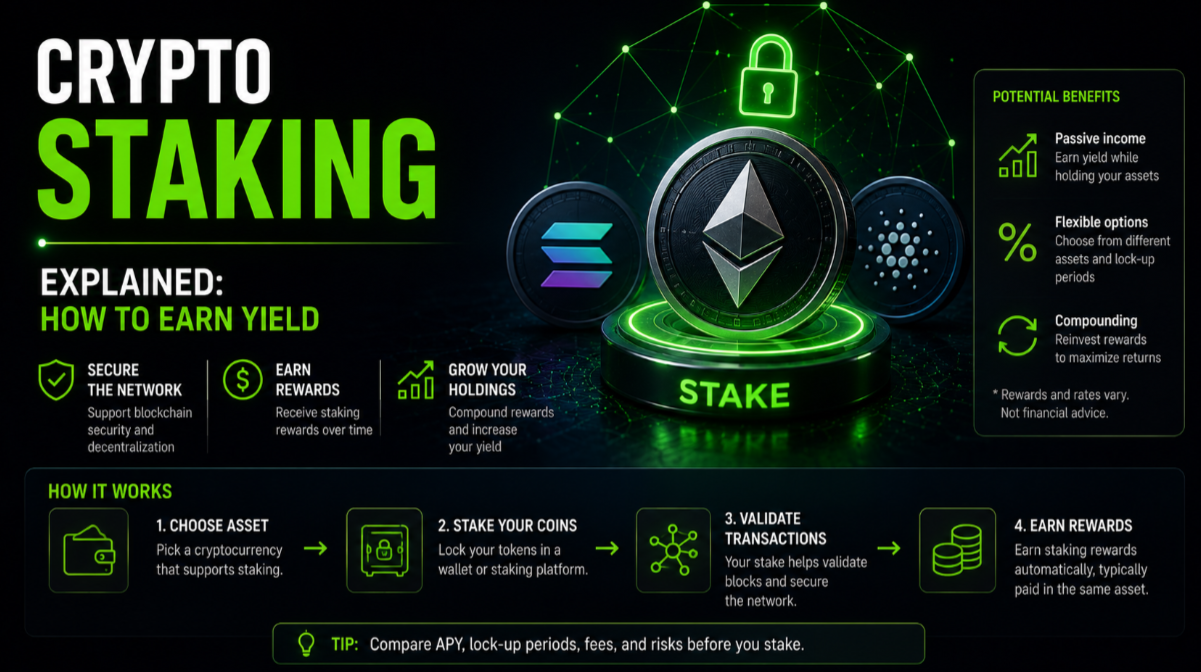 EarningCrypto staking explained: how to earn yieldA beginner-friendly guide to crypto staking: how it works, the rewards and risks, and practical steps to start earning yield safely.8 min read·
 Staking & YieldWhat Is Restaking?Restaking reuses already-staked tokens to help secure additional services, layering extra rewards on base staking. Learn the mechanics and stacked risks.7 min read·
 RegulationBitcoin ETF Outflows Weigh on Market as Interactive Brokers Launches Ethereum StakingSpot Bitcoin ETFs recorded $65.4 million in net outflows as hawkish Federal Reserve comments pressured prices. Meanwhile, Interactive Brokers rolled out Ethereum staking for eligible US clients.4 min read·
 MarketsCFTC Opens Retail Crypto Leverage Rulemaking as Bitcoin Holds Near $84KThe CFTC has begun a rulemaking on leveraged retail crypto trading, while Bitcoin hovers near $84,000 and traders wait for U.S. inflation data and the Fed’s October meeting.4 min read·
 MarketsUS Moves $1B in Seized Bitcoin as Senate Scrutiny of Tether GrowsU.S.-linked wallets shifted 12,267 BTC from a Bitfinex hack seizure address without any exchange deposit, while Senator Richard Blumenthal pressed Cantor Fitzgerald over its Tether partnership.3 min read·
In our ratings: See CoinPulse's StakeWise V3 rating and evidence Related: Liquid staking ratings · Liquid staking · Crypto staking explained · Lido · Aave · MetaMask · What is a DAO