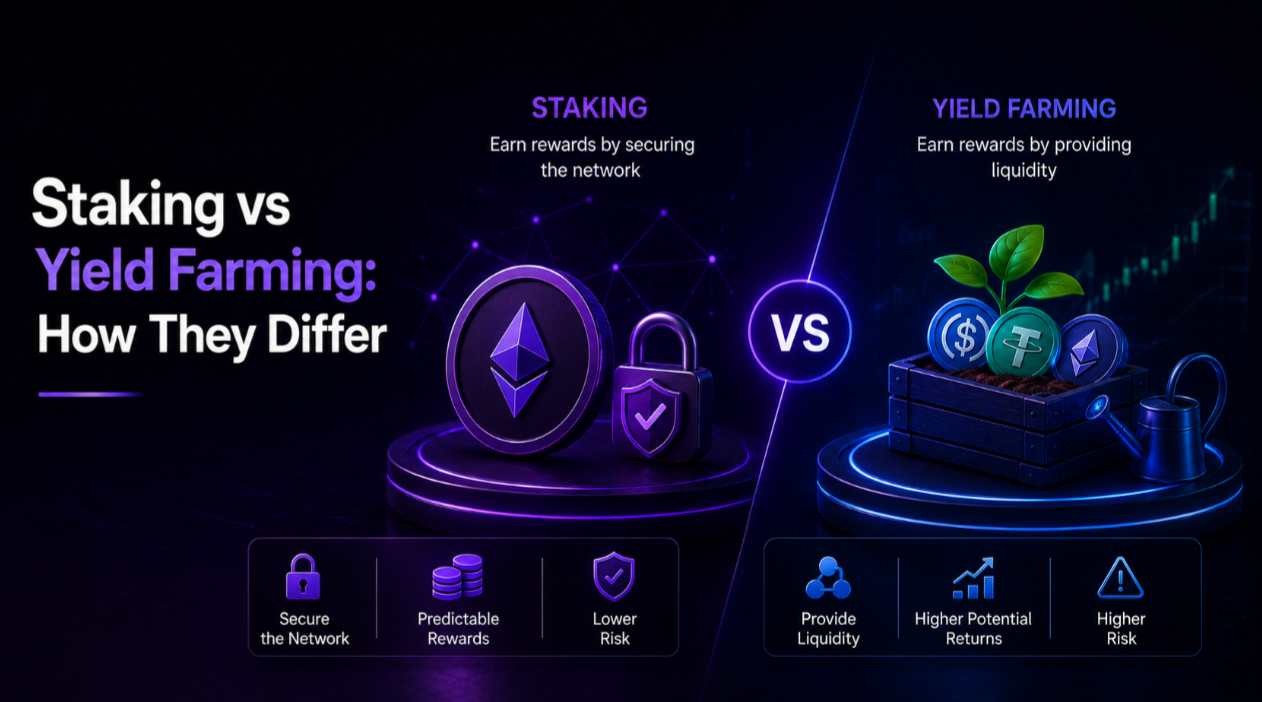
Staking and yield farming are both ways to earn rewards on crypto assets, but they differ fundamentally: staking commits tokens to secure a proof-of-stake blockchain in return for protocol rewards, while yield farming supplies capital to decentralized applications in return for trading fees and incentive tokens. One is a network-security role paid by the chain itself; the other is a capital-provision role paid by the market activity you help enable. Understanding that distinction is the key to knowing which fits your goals.
Key takeaways
- Staking earns from the protocol, through token issuance and transaction fees for helping validate the network.
- Yield farming earns from the market, through trading fees, lending interest, and incentive rewards paid by applications.
- Risk profiles differ: staking centers on slashing and lockups, farming on impermanent loss and smart-contract exposure.
- Complexity and effort differ: staking is relatively passive, while farming often requires active management.
What they have in common
Both activities put idle tokens to work rather than leaving them sitting in a wallet, and both express rewards as an annualized percentage. Both also depend on the value of a volatile underlying asset, so a headline reward rate can be undone by a falling token price. And in both cases, higher advertised returns almost always signal higher risk rather than a free lunch. Beyond these surface similarities, however, the mechanics diverge sharply.
How staking works
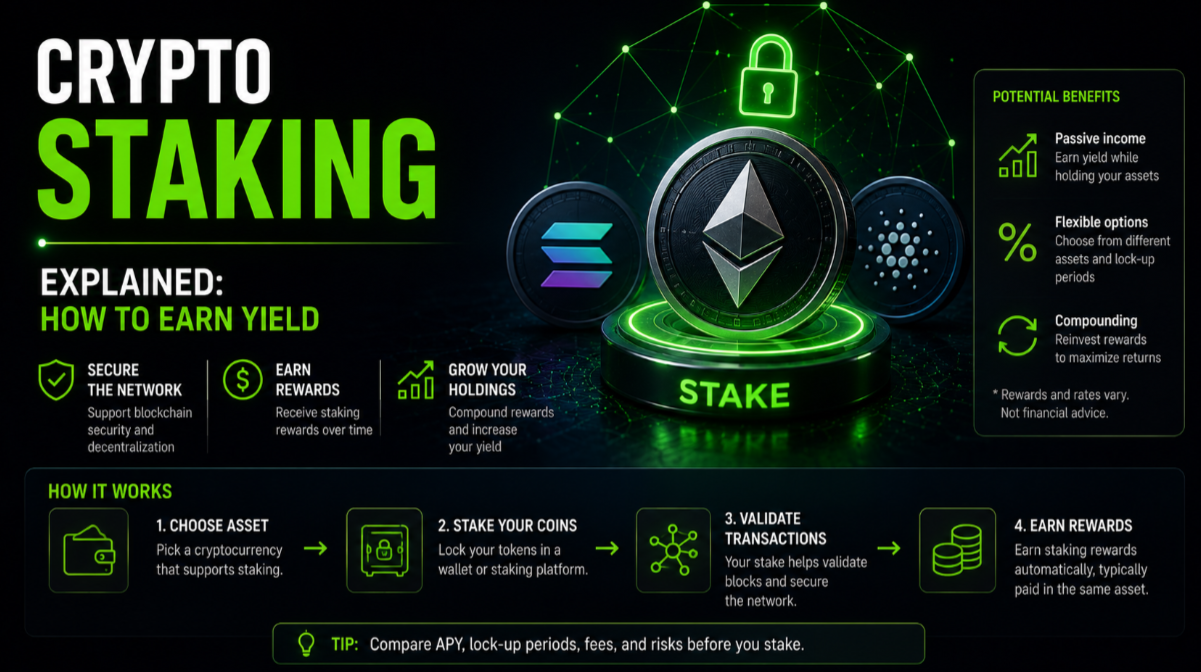
Staking bonds your tokens to a proof-of-stake network so validators can use them to confirm transactions. In exchange, the protocol pays rewards drawn from newly issued tokens and network fees. You can stake by running a validator, delegating to one, or using a liquid staking service that issues a tradable receipt token. Rewards are comparatively predictable, tied to the network's issuance schedule and participation rate. For the full mechanics, see our guide to crypto staking.
The defining feature of staking is that you are being paid to secure infrastructure. Your capital's job is to make the chain trustworthy, and the risks flow from that role: penalties for validator misbehavior and delays when you want to withdraw.
How yield farming works
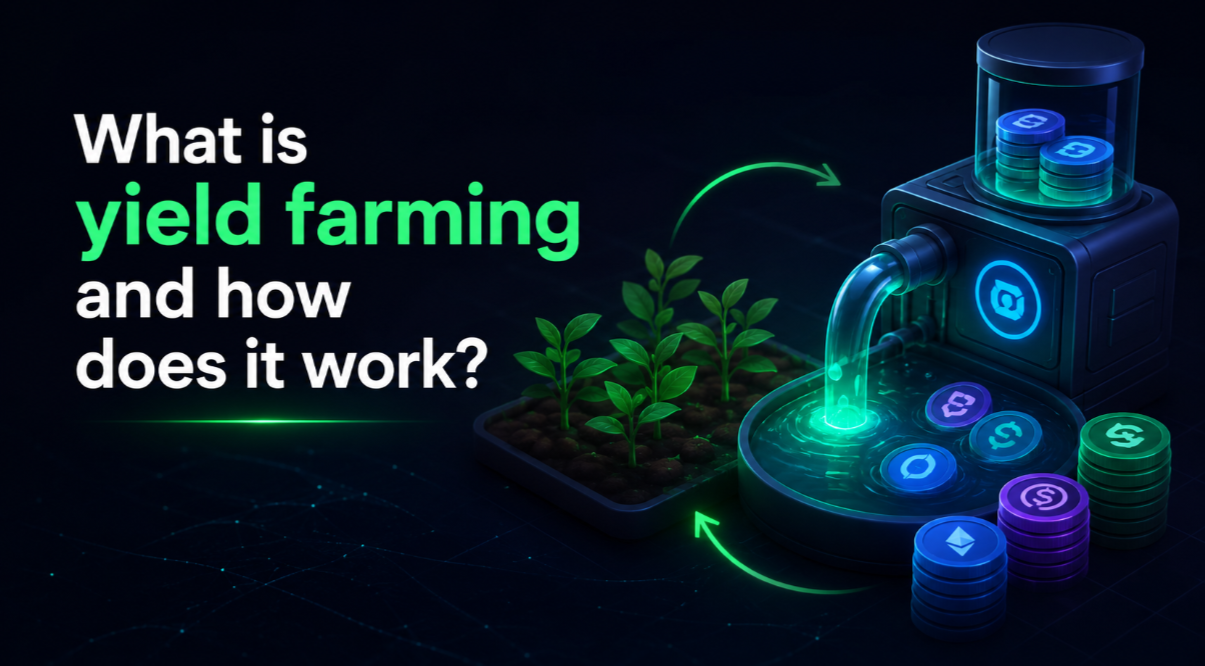
Yield farming means deploying capital into DeFi protocols to earn a return. The most common form is providing liquidity to an automated market maker, where you deposit a pair of tokens into a pool and earn a share of the trading fees. Other forms include lending assets for interest or staking liquidity-provider tokens to earn additional incentive rewards.
The rewards here come from real economic activity, traders paying fees, borrowers paying interest, plus incentive tokens that protocols distribute to attract capital. Those incentive rewards can be generous but are often temporary, and they are paid in tokens whose own value can fall. Farming also tends to require ongoing attention, moving capital between opportunities and monitoring pool health.
It helps to separate the two components of a farm's return. The organic yield comes from genuine usage, the fees and interest that persist as long as people trade or borrow. The incentive yield comes from a protocol printing and distributing its own token to bootstrap activity. Organic yield tends to be durable but modest; incentive yield can be large but fades as programs wind down or as more capital dilutes the rewards. Many of the eye-watering figures that draw newcomers to farming are dominated by the incentive component, which is exactly the part most likely to disappear. A clear-eyed farmer asks how much of a quoted return would survive if every incentive were switched off tomorrow.
The key differences
Placing the two side by side clarifies which is which.
- Reward source: staking is paid by the blockchain's issuance and fees; farming is paid by application-level fees and incentive programs.
- Role played: stakers secure a network; farmers provide liquidity or lending capital to apps.
- Effort: staking is largely set-and-forget; farming often demands active management and rebalancing.
- Predictability: staking rewards follow a known issuance model; farming returns swing with market volume and shifting incentives.
- Capital form: staking uses a single network token; many farming strategies require a pair of assets.
Comparing the risks
Neither activity is risk-free, and the specific dangers are different, which matters when deciding how much to allocate to each.
- Slashing (staking): validator misbehavior or downtime can destroy part of the bonded stake, and delegators can suffer if they choose an unreliable operator.
- Lockups (staking): unbonding periods can prevent you from selling during a sharp market move.
- Impermanent loss (farming): when the prices of pooled assets diverge, a liquidity provider can end up worse off than simply holding the tokens, sometimes outweighing the fees earned.
- Smart-contract risk (both, higher for farming): farming usually involves multiple layered protocols, widening the attack surface for bugs and exploits; liquid staking carries this too.
- Incentive decay (farming): high advertised returns often rely on temporary token incentives that shrink as more capital arrives.
- Depeg risk: receipt tokens used in liquid staking or farming strategies can trade below their underlying value under stress.
Which one fits you?
Staking generally suits long-term holders who want a relatively passive, network-aligned return and can tolerate lockups. Yield farming suits more active participants who understand DeFi mechanics, accept impermanent loss and layered contract risk, and are willing to manage positions. Many people combine the two, for example using a liquid staking token as an input to a farming strategy, though that stacks the risks of both. A closely related advanced path is restaking, which layers extra obligations on staked capital.
A practical way to decide is to start from your own constraints rather than from headline rates. Ask how quickly you might need the capital, how much volatility and complexity you can genuinely monitor, and whether you would understand what went wrong if a position lost value. Staking answers well when the honest reply is that you want something durable and mostly hands-off. Yield farming answers well when you have the time, the appetite, and the technical fluency to manage layered positions actively. Matching the activity to your temperament and schedule matters more than squeezing out the last fraction of a percentage point of return.
Whichever route you consider, evaluate the specific provider or protocol before committing, and read widely first. Our full library of guides covers the surrounding concepts so you can judge any headline rate on its merits.