CoinPulse
Harvest Finance
Yield aggregator· founded 2020

Harvest Finance: How the Yield Aggregator Works, FARM Token, Fees and Risks

Harvest Finance is a decentralized yield aggregator. You deposit a token such as USDC, ETH or WBTC into a vault, and automated strategies farm rewards on other DeFi protocols and reinvest them. In return you hold an interest-bearing "fToken" receipt 14. Harvest runs on Ethereum, Arbitrum, Base, Polygon and zkSync Era 1. Its FARM token launched in September 2020, and FARM emissions ended in September 2024 2. The protocol is non-custodial, and its anonymous team works under a Panama-law operator. That operator's Terms bar US persons 47.

Facts checked 12 cited sources No score on this page, no affiliate links

At a glance

What it is
DeFi yield aggregator: auto-compounding vaults and "Autopilot" allocators 15
Operator (per Terms)
The Farmer Chad Foundation; Panama governing law 7
Team
Anonymous 4
Launched
September 1, 2020 (FARM token launch) 2
Chains
Ethereum, Arbitrum, Base, Polygon, zkSync Era 1
Custody
Non-custodial; funds sit in smart contracts you interact with from your own wallet 7
Costs
Performance fee on yield, included in the displayed APY; no convert/revert fee; gas extra 4
Token
FARM, max supply 690,420; iFARM = staked FARM that shares protocol fees 23
Access
US persons and sanctioned regions are restricted under the Terms 7
Facts checked
October 23, 2026

Who runs Harvest Finance

Harvest's Terms & Conditions name The Farmer Chad Foundation as the Operator of the website and interface. They are governed by the laws of Panama, with disputes going to arbitration seated in London 7. The Terms publish no registration number or address. The development team is anonymous, according to the project's FAQ 4. Harvest has no license as a financial firm, and the Terms describe a non-custodial interface rather than a regulated service 7.

Governance has moved away from token voting. FARM originally carried Snapshot voting power. Most decisions are now made through contributor proposals and discussion, with votes kept for major strategic questions 2.

How Harvest vaults work

  1. Convert. You deposit a token from your own wallet into a vault. The docs suggest about $5 of USDC or ETH covers starting costs, and "One Click" lets you enter from other tokens via Portals 14.
  2. Receive fTokens. The vault mints fTokens, such as fUSDC or fETH. The number you hold stays fixed while each one gains value against the underlying token. In Harvest's example, 1 fETH worth 1 ETH at launch is worth 1.10 ETH a year later at a 10% APY 4.
  3. Strategies farm. Each vault's strategy deploys funds to lending, staking or liquidity pools elsewhere, harvests reward tokens and reinvests them. Strategy changes are protected by a timelock 16.
  4. Revert. Reverting burns your fTokens and returns the underlying token plus accrued growth. You can choose a different output token, but that triggers a swap and adds price risk 46. Rewards are claimed when you revert 4.

Autopilots are vaults that move a deposit among Harvest's own sub-vaults, rebalancing several times a day based on rates, gas costs and liquidity. They have no lockups or cooldowns. The allocation code was developed by IPOR Labs AG. New sub-vaults are announced at least seven days ahead and go live after a 72-hour timelock 5.

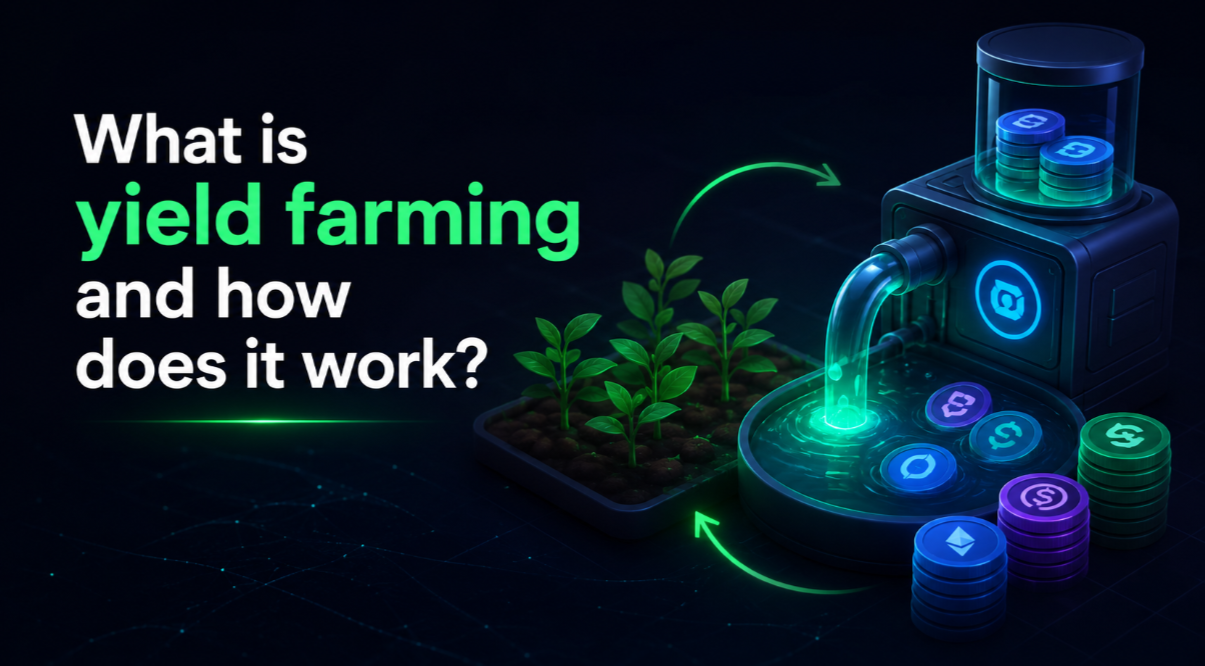
APYs vary and are not guaranteed. They depend on the external protocols' rates and reward-token prices. Background: what yield farming is.

Fees and costs

Harvest doesn't charge to convert or revert. It takes a performance fee from the yield a strategy earns, and the APY shown in the app already deducts it 4. Part of the performance fees buys FARM on the open market for iFARM holders, and part funds the Harvest treasury 3. The fee percentage is not stated in the documentation pages reviewed.

You also pay network gas on every deposit, revert and claim. On Ethereum mainnet this can be significant for small amounts, and Harvest's own FAQ notes that gas estimates can come in at about double the final cost 4. Swapping to a different output token on exit adds slippage 6.

FARM and iFARM

FARM launched on September 1, 2020 with no premine, presale or venture investors. Emissions went 70% to liquidity incentives, 10% to an operations treasury and 20% to the founding developers 2. A community vote set the maximum supply at 690,420 FARM. The last FARM was minted on September 6, 2024, and 14,870.23 FARM has been burned 2.

Staking FARM in the Communal Harvest pool gives you iFARM, an interest-bearing token that collects a share of yield from Harvest strategies. iFARM trades on Uniswap, Quickswap and Camelot 34. FARM itself is available on Ethereum and Base 4. CoinPulse doesn't publish price forecasts for FARM.

Access and eligibility

The Terms list the United States (including its territories) as a Restricted Jurisdiction and treat any US Person as a Restricted Person. Crimea, Donetsk, Luhansk, Cuba, Iran, North Korea, Syria, Sudan, China and sanctioned regions are also restricted. Users must be 18 or older 7. The FAQ also warns that the site may not be accessible in the US 4. Because the contracts are public, the restriction applies to use under the Terms, not to what the blockchain technically permits. Readers should take that legal distinction seriously.

Security model and risks

  • Smart-contract and strategy risk. Funds sit in Harvest contracts and then in third-party protocols. A bug or economic exploit at either layer can cause losses. Harvest's FAQ states that audits reduce risk but don't eliminate it 4.
  • Audits. Harvest lists audits by PeckShield, Haechi Labs, CertiK and Least Authority (2020–2021) and Halborn (Base contracts, January 2025) 8. An audit is a point-in-time review, not insurance.
  • Liability cap. The Operator's total liability is capped at USD 1,000 under the Terms 7.
  • Exit swaps. Choosing a different token on exit exposes you to price moves during the swap 6.

Incident record

1 partly recovered1 outcome unclear

The October attack exploited a pool on Curve, not a bug in Curve itself. It is an example of how a strategy's dependence on an external pool's pricing can be turned against an aggregator.

fWETH reverts failed when the CREAM lending market lacked liquidity

Sep 18, 2020outcome unclear
Some users' fWETH was burned without the full WETH paid out 12
Outcome
Recovered. Funds were restored and reverts re-enabled the same day
Recovered or reimbursed
Recovered. Funds were restored and reverts re-enabled the same day

Source: docs.harvest.finance

Attacker manipulated USDC/USDT prices in Curve's Y pool to buy fUSDC/fUSDT vault shares cheaply and redeem at a higher value

Oct 26, 2020partly recovered
Harvest's incident page cites $24M; The Block cites $33.8M from the post-mortem 910
Outcome
Partially recovered. The attacker returned about $2.5M (1.76M USDC and 0.72M USDT), distributed pro-rata from December 7, 2020. The remainder was issued as GRAIN debt tokens (1 GRAIN = $1 of debt) with a buyback plan. Current GRAIN repayment status is not documented
Recovered or reimbursed
Partially recovered. The attacker returned about $2.5M (1.76M USDC and 0.72M USDT), distributed pro-rata from December 7, 2020. The remainder was issued as GRAIN debt tokens (1 GRAIN = $1 of debt) with a buyback plan. Current GRAIN repayment status is not documented
Source: docs.harvest.finance

Hacks in DefiLlama’s public database are also scored as the security record on the Harvest Finance rating page.

Questions about Harvest Finance

Is Harvest Finance still operating?
Yes. As of October 2026, the documentation describes active vaults on five chains and Autopilot products 15. FARM emissions ended in 2024, but the protocol continues 2.
Is Harvest Finance licensed?
No financial license is described. The Terms present it as a non-custodial interface run by The Farmer Chad Foundation under Panama law 7.
Can US residents use Harvest Finance?
Not under its Terms. US persons are classed as Restricted Persons 7.
How do Harvest "staking rewards" work?
There is no validator staking. "Rewards" are yield earned by vault strategies, reflected in your fToken's rising value, plus iFARM's share of protocol fees for FARM holders 34.
What are alternatives to Harvest Finance?
Other yield aggregators include Beefy and Yearn. See the Beefy rating, the Yearn rating and the yield aggregator ratings.

For CoinPulse's separate evaluation, see CoinPulse's Harvest Finance rating and evidence.

Harvest Finance elsewhere on CoinPulse

Sources

  1. 1[Harvest docs — Overview]()docs.harvest.finance
  2. 2[Harvest docs — FARM token]()docs.harvest.finance
  3. 3[Harvest docs — Communal Harvest and iFARM]()docs.harvest.finance
  4. 4[Harvest docs — FAQ]()docs.harvest.finance
  5. 5[Harvest docs — Autopilots]()docs.harvest.finance
  6. 6[Harvest docs — Vaults]()docs.harvest.finance
  7. 7[Harvest — Terms & Conditions]()docs.harvest.finance
  8. 8[Harvest docs — Audits]()docs.harvest.finance
  9. 9[Harvest docs — fUSDC/fUSDT economic attack, Oct 26, 2020]()docs.harvest.finance
  10. 10[The Block — Harvest Finance exploited (Oct 26, 2020)]()theblock.co
  11. 11[Harvest docs — GRAIN token (archived)]()docs.harvest.finance
  12. 12[Harvest docs — fWETH revert failure, Sep 18, 2020]()docs.harvest.finance

Other yield aggregatorsAll →

What changed on this page

  • 2026-10-232026-10-23 — Profile created.
All companies