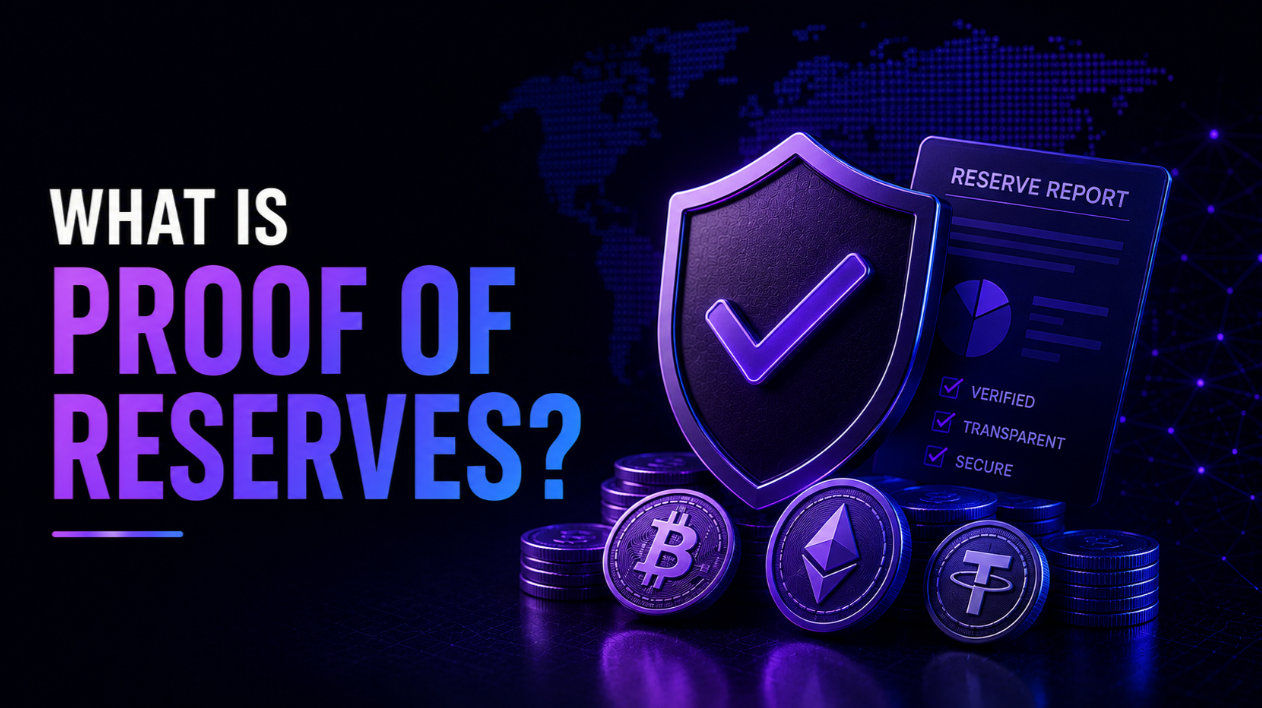
Proof of reserves is a method a crypto exchange or custodian uses to demonstrate, using verifiable on-chain and cryptographic evidence, that it actually holds enough assets to cover the balances it owes to customers. In an industry where you cannot see inside a company's vault, proof of reserves is an attempt to replace "trust us" with "verify it," giving depositors a way to check that their funds are backed rather than quietly lent out or missing. It is a valuable transparency tool, but only if you understand precisely what it shows and, just as importantly, what it leaves out.
Key takeaways
- Proof of reserves shows that a custodian holds assets matching customer balances at a point in time.
- A complete picture needs both a proof of assets (what the platform holds) and a proof of liabilities (what it owes).
- Merkle-tree methods let individual users verify their own balance is included without exposing everyone's data.
- Reserves prove backing, not solvency; hidden liabilities, borrowed assets, and timing gaps are real limitations.
How proof of reserves works
The core idea is to compare two things: the assets a platform controls and the total it owes its users. Demonstrating the assets is relatively straightforward, because public blockchains are transparent. A custodian can point to the wallet addresses it controls and prove ownership, often by signing a message or moving a small amount to show it holds the keys. Anyone can then read the on-chain balances of those addresses.
The harder half is proving liabilities, meaning the sum of what every customer is owed. This is where a cryptographic structure called a Merkle tree is commonly used. Each customer's balance is hashed and combined with others up the tree until a single value, the Merkle root, represents all balances at once. The platform publishes this root, and any individual user can be given the specific hashes needed to confirm their own balance is included in the total, without seeing anyone else's data. If assets meet or exceed liabilities, the platform can claim it is fully backed.
Why it matters
Proof of reserves exists because centralised platforms take custody of your assets, and history has shown that some misuse that trust by lending out deposits, gambling with them, or simply lacking the funds they claim. When a custodian collapses, users often discover too late that their balances were never fully backed. A regularly published, independently reviewed proof of reserves lets you check backing continuously rather than finding out during a crisis.
It also shifts incentives. A platform that commits to transparent, verifiable reserves signals confidence and invites scrutiny, whereas one that refuses is asking you to rely purely on faith. When comparing where to keep funds, this transparency is one signal worth weighing alongside track record and security, which you can research in our crypto exchange ratings.
What proof of reserves cannot prove
Proof of reserves is powerful but frequently overstated. Understanding its limits is what keeps it from becoming false reassurance.
- It is a snapshot. A proof reflects a single moment. A platform could hold enough at the time of the check and move funds immediately after.
- Assets are only half the equation. Showing large wallet balances means little without a verified, complete accounting of liabilities. A proof of assets alone can hide the fact that the platform owes far more than it holds.
- Borrowed assets can inflate reserves. A platform could temporarily borrow funds to appear fully backed during the check, then return them afterwards.
- Off-chain and hidden liabilities are invisible. Debts, loans, or obligations that do not appear in the proof can leave a "fully reserved" platform actually insolvent.
- It does not prove ongoing control or good custody. Reserves say nothing about whether keys are secured properly or whether an operator will behave honestly tomorrow.
In short, proof of reserves can show backing at a moment, but it does not prove genuine solvency, sound risk management, or future safety on its own. It is one input, not a guarantee.
How to read a proof of reserves
When you evaluate a platform's proof of reserves, look past the headline claim and ask sharper questions. Does it cover liabilities as well as assets, or only show wallet balances? Is it verified or attested by an independent third party, rather than self-published? How frequently is it updated, and can you personally verify that your own balance is included in the reported liabilities? A meaningful proof combines a liability commitment, independent review, regular cadence, and user-level verifiability. A vague dashboard showing only big wallet balances is closer to marketing than assurance.
Because reserve claims are sometimes faked or misrepresented, treat them the way you would any other security signal, cross-checked and never taken in isolation. This mindset connects directly to broader defensive habits in our guide on how to avoid crypto scams, and to recognising outright fraud in our piece on what a rug pull is. More explainers are gathered in our guides.
Reserves versus self-custody
It also helps to see where proof of reserves sits in the wider toolkit of exchange transparency. On its own it answers one narrow question, whether backing existed at a moment in time, so it is strongest when combined with other signals: a long operating history without incidents, clear financial disclosures, transparent ownership, appropriate regulatory registration, and a demonstrated ability to process withdrawals smoothly during periods of stress. A platform that scores well across all of these is meaningfully safer than one leaning on a single reserve snapshot. Treat proof of reserves as one column in a scorecard rather than a pass-or-fail grade by itself.
Proof of reserves only matters when someone else holds your assets. The alternative is self-custody, where you hold your own keys and there is no third party whose solvency you need to verify. Self-custody carries its own responsibilities, chiefly protecting your seed phrase and avoiding phishing, but it removes counterparty risk entirely. Many people use both: keeping trading balances on transparent, well-reviewed platforms and moving long-term holdings into their own wallet. Proof of reserves is best understood as a tool that reduces, but never eliminates, the risk of trusting a custodian, which is why the old principle still holds: assets you do not control are only as safe as the entity holding them.