No hack or exploit involving Mellow found in the sources checked
2022 – Oct 2026outcome unclear- Outcome
- No incident on record in sources checked
- Loss
- —
- Recovered or reimbursed
- —

Mellow is a DeFi vault platform on Ethereum. Third-party curators run investment strategies inside it, within limits written into the smart contracts 13. Mellow became known in June 2024 for launching liquid restaking tokens (LRTs). These vaults took stETH, restaked it through the Symbiotic protocol, and were run by curators such as Steakhouse, P2P, Re7 Labs and MEV Capital 11. Its current product, Core Vaults, runs Lido's earnETH and earnUSD vaults and other partners' yield products 16. Users deposit into a specific vault, so the risks depend on that vault's curator and strategy.
Every Mellow product follows the same split of roles:
The point of the design is that a curator cannot move funds anywhere it likes. It can only act within rules set when the vault was configured 3. The rules can still allow risky strategies, though. Read a vault's stated strategy and limits before depositing.
In June 2024, Mellow and Lido introduced vaults that let stETH holders restake through Symbiotic, a then-new restaking protocol 1112. Each vault issued its own LRT and had a named curator. Steakhouse, P2P, Re7 Labs and MEV Capital were among the first 11. Restaking means the staked ETH also backs other networks' security. That earns extra rewards but adds the risk of being slashed (penalized) if an operator misbehaves.
Mellow built several versions of these vaults: Multivault, Interoperable Vaults and Simple LRT. It also built DVstETH, a vault tied to distributed validator technology 2. Mellow now calls them historical architectures. Some remain live and are documented for existing holders, but new products launch on Core Vaults 24. DefiLlama tracks this restaking business as "Mellow Restaking," with about $24 million locked on October 22, 2026, almost all on Ethereum 10.
Core Vaults is Mellow's current system. Banks, exchanges, wallets and other partners use it to run "Earn" products under their own brand 1.
The best-known example is Lido Earn, which has two vaults 67:
Lido sets the fees and runs an interface at stake.lido.fi/earn. Mellow runs its own interface at app.mellow.finance. The Lido DAO put in $5 million as first-loss capital: $3 million in wstETH for earnETH and $2 million in USDC for earnUSD 6. That money absorbs losses before other depositors take any.
Mellow's older strETH vault, which aimed to boost staking rewards through DeFi, is closed to new deposits. Holders can still withdraw 8.
Mellow has no single fee. Each vault sets its own, and fees are taken in shares, so your token count stays the same while its value reflects the charge 68. Two documented examples:
| Vault | Fees | Withdrawal |
|---|---|---|
| strETH (closed to deposits) | 1% a year platform fee + 10% of rewards 8 | Request, then claim wstETH; usually about 3 days 8 |
| earnETH (Lido Earn) | Set by Lido, shown in the Lido interface 6 | Request, then claim wstETH; about 3 days 7 |
Withdrawal requests on these vaults cannot be cancelled once made 68. Deposits also queue: they are processed after the next oracle price report 6. Gas fees on Ethereum come on top.
Mellow lists audits of Core Vaults by Nethermind (several from August 2025 to June 2026), a Sherlock public contest (August 2025) and MixBytes (July 2026). Older vault types were reviewed by StateMind, ChainSecurity, Nethermind, Decurity, MixBytes and Sherlock 5. The security page does not mention a bug bounty 5. DefiLlama lists no hacks for Mellow Restaking 10.
Risks to weigh:
Hacks in DefiLlama’s public database are also scored as the security record on the Mellow rating page.
 Staking & YieldWhat Is Restaking?Restaking reuses already-staked tokens to help secure additional services, layering extra rewards on base staking. Learn the mechanics and stacked risks.7 min read·
 Staking & YieldLiquid Staking, ExplainedLiquid staking lets you stake tokens and receive a tradable receipt (an LST) that stays usable across DeFi. Learn how it works and where the risks hide.7 min read·
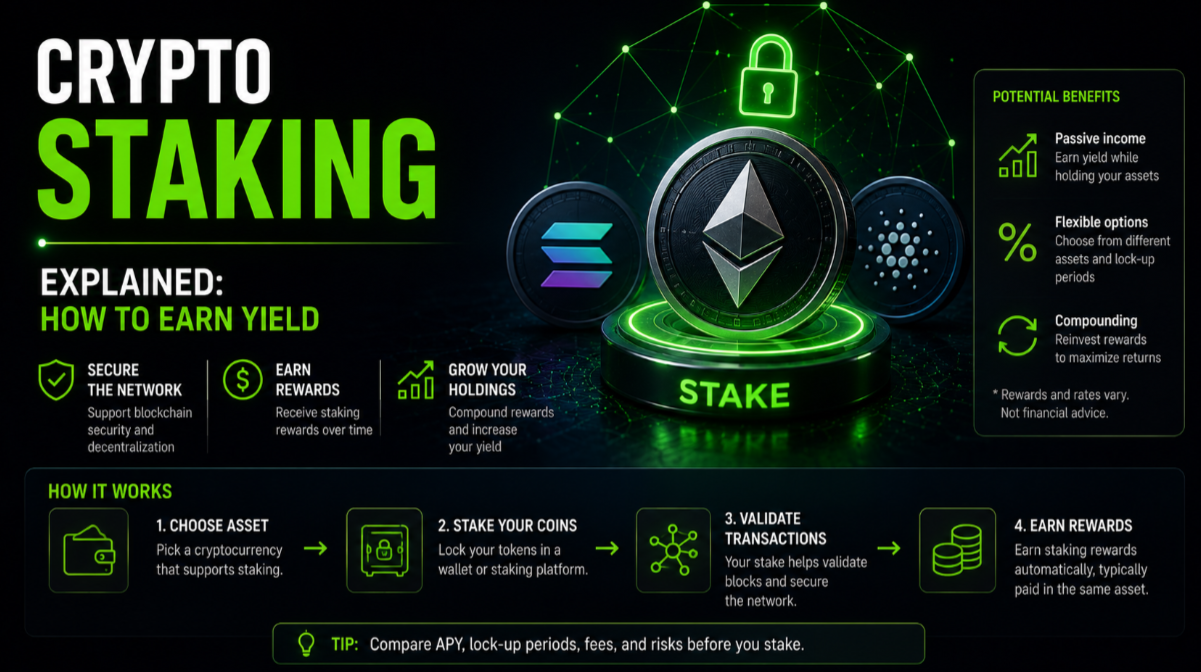 EarningCrypto staking explained: how to earn yieldA beginner-friendly guide to crypto staking: how it works, the rewards and risks, and practical steps to start earning yield safely.8 min read·
 RegulationBitcoin ETF Outflows Weigh on Market as Interactive Brokers Launches Ethereum StakingSpot Bitcoin ETFs recorded $65.4 million in net outflows as hawkish Federal Reserve comments pressured prices. Meanwhile, Interactive Brokers rolled out Ethereum staking for eligible US clients.4 min read·
 MarketsCFTC Opens Retail Crypto Leverage Rulemaking as Bitcoin Holds Near $84KThe CFTC has begun a rulemaking on leveraged retail crypto trading, while Bitcoin hovers near $84,000 and traders wait for U.S. inflation data and the Fed’s October meeting.4 min read·
 MarketsUS Moves $1B in Seized Bitcoin as Senate Scrutiny of Tether GrowsU.S.-linked wallets shifted 12,267 BTC from a Bitfinex hack seizure address without any exchange deposit, while Senator Richard Blumenthal pressed Cantor Fitzgerald over its Tether partnership.3 min read·
In our ratings: See CoinPulse's Mellow Restaking rating and evidence Related: Liquid restaking ratings · What is restaking · Liquid staking explained · Lido